
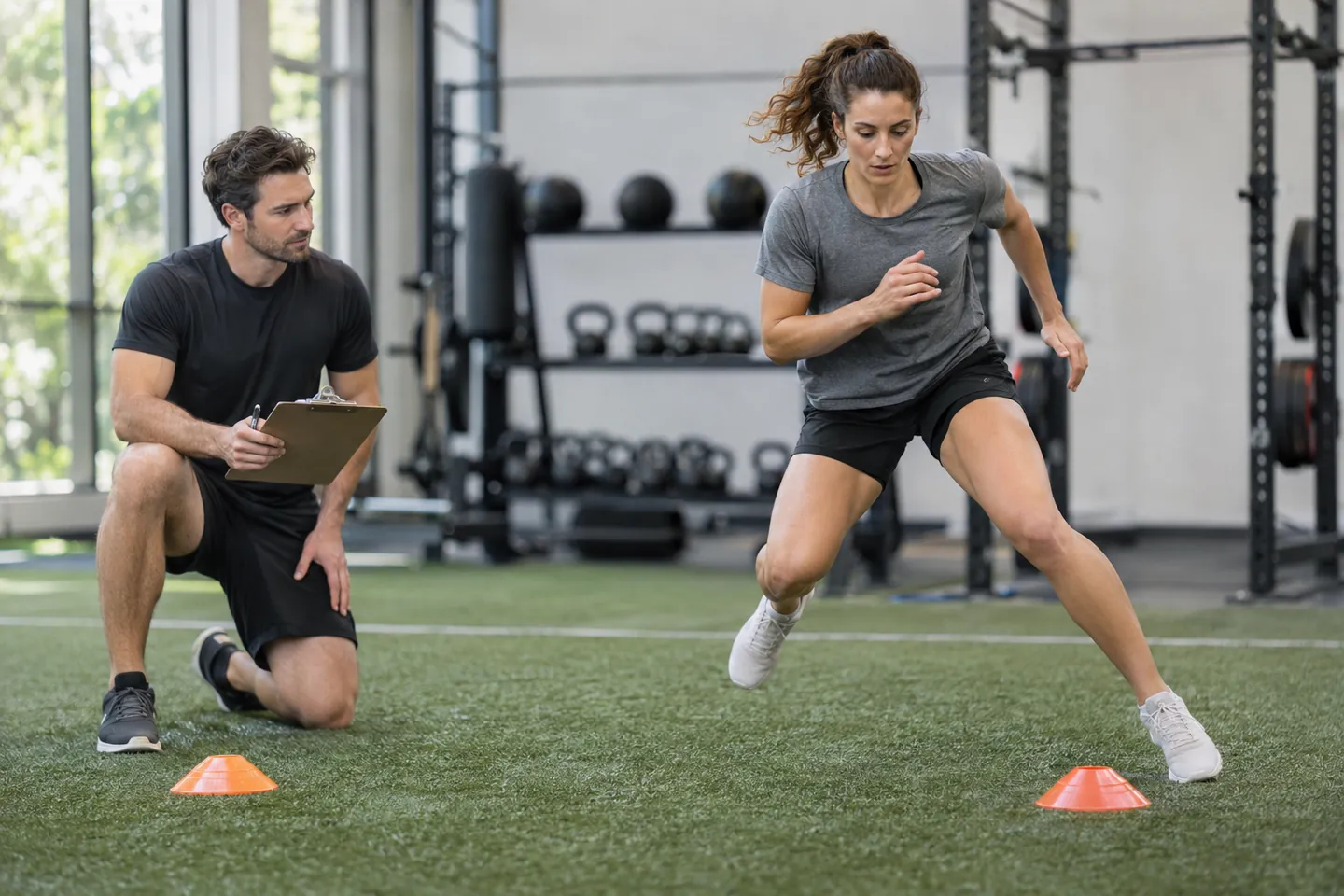
How sport-specific personal training in Mississauga works: assessing your sport's demands, planning around a season, and building strength that actually transfers.
A recreational hockey player who wants a stronger first few strides. A soccer player in her thirties who keeps tweaking a hamstring every spring. A jiu-jitsu student preparing for a first local tournament. A weekend tennis player who wants their shoulder to stop complaining by the third set. On the surface these people have little in common, but they share one need: training that is designed around the specific demands of their sport rather than general fitness.
That is what sport-specific personal training aims to provide. In Mississauga, where people play everything from cricket to basketball to Brazilian jiu-jitsu, one-size-fits-all programs often miss the mark. A good personal trainer can look at what your sport asks of your body, identify where you are falling short, and build a plan that fills those gaps without interfering with your practices and games.
This post explains how that process generally works, what to expect from the first sessions, and how to judge whether a program is actually helping. We focus on adult recreational and amateur athletes, though many of the principles apply to older teens as well, under appropriate supervision.
Start with the sport, not the exercises
The first question a sport-focused trainer should ask is not “What exercises do you like?” but “What does your sport demand?” Every sport has a profile: the movements involved, how long efforts last, how much rest you get, what direction you move in, and where injuries commonly happen.
Hockey involves explosive skating strides, quick changes of direction, and repeated short shifts. Soccer combines long periods of jogging with sprints, cuts and kicks. Brazilian jiu-jitsu requires grip endurance, hip mobility and strength in awkward positions. Tennis involves rotation, lateral movement and a lot of repetitive shoulder work.
Once those demands are clear, the trainer can choose exercises that build the relevant qualities. This is the difference between training that looks impressive and training that transfers to performance.
The initial assessment
Most sport-specific programs begin with an assessment. This usually includes a conversation about your sport, your position or style, your schedule, your injury history and your goals. It may also include simple movement tests, such as squats, lunges, single-leg balance, hip and shoulder mobility checks, and basic strength measures.
The goal is not to judge you but to find a starting point. You might discover that one hip moves much less freely than the other, that your single-leg stability is poor on your non-dominant side, or that your upper back is weak relative to your chest. These findings shape the plan.
Be honest during this stage. If you have had recurring injuries, mention them, even if they feel minor. If something hurts during a test, say so. A trainer can only plan around what they know. Where pain or injury is involved, they may recommend you see a physiotherapist or other qualified professional before proceeding.
Building the foundation first
Even sport-specific programs usually begin with general strength and movement quality. Athletes who skip the basics and jump straight to complex, sport-like drills often hit a ceiling or pick up injuries. A solid foundation of squatting, hinging, pushing, pulling, carrying and single-leg work supports everything else.
For many recreational athletes, this foundation phase brings significant improvements on its own. Simply getting stronger and more stable tends to make people feel faster and more resilient in their sport. It can also reduce the aches that come from repetitive play.
The foundation phase is also when you learn good technique on key lifts. Taking time to groove proper movement patterns pays off later, when loads get heavier and drills get faster.
Making strength transfer
Once the foundation is in place, training becomes more targeted. This might involve choosing exercise variations that resemble sport movements, adjusting the speed of lifts, or adding power and agility work.
A hockey player might focus on single-leg strength, lateral bounds and hip stability to support skating. A soccer player might add Nordic hamstring curls under careful progression, deceleration drills and change-of-direction practice. A grappler might emphasise grip work, isometric holds, neck strengthening done cautiously, and hip mobility. A tennis player might work on rotational power with medicine ball throws and shoulder stability with bands.
The key is that each exercise has a reason. If you ask your trainer why you are doing something, they should be able to explain how it connects to your sport.
Planning around your season
Sport-specific training should respect your competitive calendar. In the off-season, you generally have more time and energy for building strength and fitness. During the season, the focus usually shifts to maintaining what you have built while staying fresh for games or competitions.
Many recreational leagues in Mississauga run on seasonal schedules: indoor soccer and hockey through the colder months, outdoor sports from spring into fall. Your trainer can help you map these phases and adjust volume and intensity accordingly.
If you play multiple sports or train martial arts year-round, planning becomes even more important. Two or three hard sessions in a row across different activities can leave you exhausted. A good plan balances the whole week, not just the gym sessions.
Conditioning that matches the work
Conditioning should reflect the energy demands of your sport. Long, slow runs may help a distance runner but are less relevant to a hockey player who works in short, intense shifts. Interval training with appropriate work-to-rest ratios is often more useful for stop-and-start sports.
Combat sports are a good example. A Muay Thai or boxing round involves sustained effort with bursts of high intensity. Conditioning might include rounds on the bag or bike, interval sprints and an easy aerobic base. Jiu-jitsu tends to favour longer efforts with grip and isometric strength demands.
Your trainer will usually blend conditioning with your actual sport practice. If you already play two games a week, you may need less extra conditioning than you think.
Reducing the risk of common injuries
No program can guarantee you will avoid injury, and you should be sceptical of anyone who claims otherwise. What training can do is address some common risk factors, such as poor strength in key muscles, limited mobility, or imbalances between sides.
For field and court sports, this often means hamstring strength, ankle stability and good landing mechanics. For overhead sports, shoulder and upper back strength matter. For grappling, neck, hip and lower back resilience are frequent priorities.
If you have an existing injury or a history of recurring problems, a trainer working alongside a physiotherapist can be very effective. Konga Fitness offers on-site physiotherapy, which can make that kind of collaboration easier.
How many sessions you need
The right frequency depends on your goals, budget and schedule. Some athletes work with a trainer once or twice a week for full sessions. Others meet less often for program updates and technique checks, then train independently between visits.
What matters most is consistency. A well-designed program followed for three months usually produces better results than an elaborate one followed for three weeks. Discuss realistic expectations with your trainer before committing.
If you are on a budget, ask whether a hybrid approach is possible. You might combine occasional personal training with strength and conditioning group classes for the bulk of your work.
Tracking progress that matters
It is easy to track gym numbers like how much you lift, but the real question is whether you are performing better in your sport. Good trainers use a mix of measures: strength tests, movement quality checks, conditioning markers and, most importantly, your feedback about how you feel during play.
You might notice you are less tired late in games, faster to loose balls, more stable in scrambles, or recovering better between sessions. These subjective improvements count. Share them with your trainer, along with anything that is not improving.
Revisit your goals periodically. As your sport changes, as you age, or as you shift priorities, your program should evolve too.
What to look for in a trainer
Look for a trainer who listens carefully, asks about your sport, and explains their reasoning. Experience working with athletes in your sport or similar ones is helpful, but curiosity and willingness to learn matter too. Relevant certifications are a good sign.
Pay attention to how they handle pain or injury. A responsible trainer will modify exercises, refer you to a qualified health professional when needed, and avoid pushing through warning signs.
Finally, consider chemistry. You will spend a lot of time with this person. Choose someone you trust and enjoy working with.
Combining training with martial arts
Many of our members use personal training to support their martial arts. A boxer might work on footwork, rotational power and shoulder endurance. A jiu-jitsu student might focus on grip, hips and posture. An MMA student might need a little of everything.
If martial arts is your main sport, your trainer can coordinate with your class schedule so you are not lifting hard the day before sparring. This kind of integration is one of the advantages of training under one roof.
Communication is what makes it work. Tell your trainer when a class was unusually hard, when you are heading into a tournament or grading, or when you picked up a knock in drilling. A plan written on paper is only a starting point; the trainer adjusts it based on what actually happened in your week.
What the first month can look like
To make this less abstract, imagine a recreational soccer player from Erin Mills who plays one indoor game a week through the winter and wants to arrive at the outdoor season without the usual hamstring trouble. After an assessment, the trainer notices limited hip mobility on one side and relatively weak single-leg strength.
The first couple of weeks might focus on learning a hip hinge, split squats, a row and a carry, with short mobility work at the start of each session. By the third and fourth weeks, the trainer may introduce a careful hamstring progression, some low-level hopping and landing practice, and a simple change-of-direction drill. Loads stay moderate, and the day after the indoor game stays light.
Nothing in that month is flashy. The point is to build a base that the next phase can stand on, and to check how the player responds before adding more. Progress at this stage often shows up as feeling steadier, moving more freely and recovering faster after games.
Book a consultation
If you play a sport in Mississauga and want training that actually supports your performance, sport-specific personal training can be a worthwhile investment. It brings structure, accountability and expertise to your preparation.
Learn more about our personal training options, or book a free trial to meet the team and talk about your sport, your schedule and your goals.
Filed under
Keep exploring
More training insights await.