
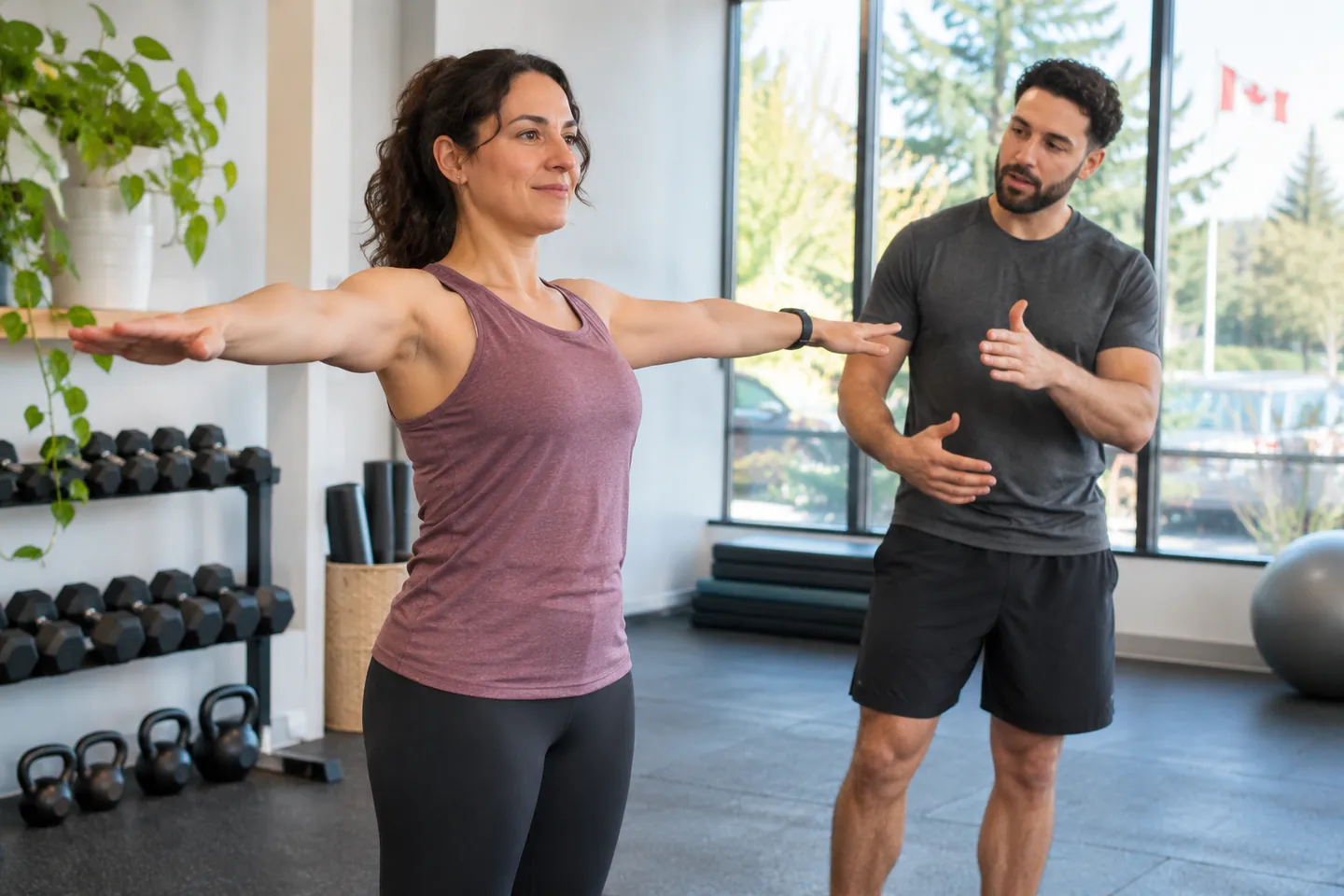
Plan a clearer gym warmup in Mississauga by understanding its place in your session, asking useful coaching questions, and leaving enough time to begin.
A warmup often becomes the part of a workout people improvise. They arrive with a clear idea of the main exercise but only a vague instruction to do something first. Planning your gym warmup in Mississauga is a chance to make the beginning of the session as understandable as the rest of it.
You do not need an elaborate ritual copied from several different sources. You need to know what your coach has assigned, how it relates to the session, and how much time the whole appointment requires. This article focuses on those practical questions. The actual movements and amount of preparation should be selected for the person and the planned activity, rather than assumed from a generic list.
Give the opening of the session a defined place
When you put a workout in your calendar, include the preparation within the appointment. If your schedule only leaves enough time for the main exercises, the beginning will repeatedly become rushed. Ask your coach how the full session is structured so that you understand where each part belongs.
Also distinguish arrival time from exercise time. Walking through the door, changing shoes, storing belongings, and finding the training area take time of their own. A warmup should not become the place where you try to recover minutes lost because you planned to arrive at the exact moment the appointment began.
For a routine built around work or family commitments in Mississauga, this may require a small adjustment to the departure time. Review the complete journey. A few practical decisions before leaving home can make it easier to start the session with attention rather than urgency.
Ask what the warmup is preparing you to do
A useful first question is, “How does this opening relate to today’s session?” The coach’s answer should connect the preparation to the activity ahead. You do not need a technical lecture, but you should understand why you are doing the assigned tasks.
The explanation can also clarify why the opening differs between sessions. A class focused on one activity may begin differently from an individual strength appointment. Copying one warmup into every context without discussion can miss the purpose of the specific plan.
If the routine is familiar, ask which parts should remain consistent and which may change. This helps you avoid treating every small variation as a new mystery. You begin to understand the structure while leaving the exercise selection to the plan designed for your session.
Learn the instructions before trying to move quickly
An unfamiliar warmup movement is still an unfamiliar movement. Ask for a demonstration if you do not understand the setup or sequence. The fact that it happens at the beginning does not mean you are expected to know it automatically.
Clarify what the coach wants you to notice. Is the task an opportunity to practise a movement, become familiar with a position, or prepare for the next exercise? A clear focus can make a short sequence more useful than simply copying motions without understanding them.
If several instructions arrive at once, ask for the priority. You can learn the sequence in manageable pieces. Rushing to keep up while remaining confused may make the start feel chaotic, especially if you are also learning the environment and the coach’s vocabulary.
Make the order easy to follow
A warmup can become difficult to remember when it involves many stations or transitions. Ask for a short written outline if you will need to complete it independently. Include the order and any practical setup details that are not obvious from the exercise names.
Know where the required items are kept and how to return them. If you need a mat, band, or another piece of equipment, learn the facility’s arrangement instead of searching for it each visit. Familiarity with these details can reduce unnecessary interruptions.
If the intended space or equipment is unavailable, ask what alternative is appropriate. Do not automatically replace the opening with whatever activity happens to be convenient. A brief conversation can establish options that preserve the purpose without requiring improvisation under time pressure.
Tell the coach how you are arriving
Your coach benefits from knowing if the day has been unusual. You might have rushed from a meeting, spent extra time travelling, or feel distracted by an unresolved practical issue. You do not need to narrate the whole day, but relevant context can help the session begin clearly.
Describe your experience rather than assuming the coach can infer it. If something feels wrong or painful, stop and say so. If the main issue is that you cannot concentrate on a long sequence, explain that too. Different concerns require different conversations.
The warmup is not a requirement to conceal how you feel until the main work begins. Use the opening as an opportunity for accurate communication. A coach can respond more usefully to a specific observation than to a problem you try to hide in order to appear ready.
Avoid turning preparation into an unplanned workout
Some people add more and more activities before the planned session because beginning the main work feels intimidating. Others collect routines from different videos until the warmup becomes longer than the appointment can comfortably hold. If that sounds familiar, ask the coach to help define what is actually needed.
A clear plan gives you permission to stop adding tasks. Know when the opening is complete and what comes next. You should not have to keep searching for another exercise because you are uncertain whether you have done enough.
If you enjoy a particular activity, mention that preference. It may fit elsewhere in the program, or the coach may explain why it is not part of the current opening. The useful discussion connects enjoyment, time, and purpose rather than treating extra activity as automatically helpful.
Plan for a shortened appointment before it happens
Late arrivals and changed schedules occur. Ask how to handle a session when you have less time than expected. The response may involve changing the main work or choosing an agreed shorter structure. It should be a deliberate adjustment, not an automatic decision to remove the beginning.
Let the coach know the time constraint as soon as you arrive. Saying that you must leave early at the final minute gives little room to plan. A clear limit at the start helps the appointment remain understandable.
If shortened sessions become common, review the schedule itself. You may need a different booking window, a simpler travel plan, or a program designed for the time you truly have. Repeatedly compressing an unsuitable appointment is less useful than acknowledging the pattern and redesigning it.
Learn how preparation relates to the first exercise
The transition from the warmup into the main work deserves explanation too. Ask what should happen before the first working set or main activity. If the coach has assigned introductory practice with the same movement, understand how it differs from the later work.
Keep those instructions attached to the relevant exercise in your notes. A general opening sequence and exercise-specific preparation may have different roles. If you cannot tell which instruction belongs where, ask the coach to walk through the session order with you.
This is particularly useful when you begin training independently. Knowing the first main exercise is not the same as knowing the complete lead-in. A clear sequence prevents you from guessing how to move from arrival to preparation to the planned task.
Use familiarity without going on autopilot
A repeated opening can make the gym feel easier to navigate. You know where to start and can settle into the session without choosing from dozens of possibilities. Familiarity is useful when it supports attention rather than replacing it.
Continue to check the setup and listen for changes. If a coach adjusts the routine, ask what is different and why. Avoid completing last week’s instructions automatically while assuming the new session must be identical.
You can also notice which instructions have become easier to remember. That is information worth sharing. The coach may be able to simplify reminders or focus attention elsewhere once a sequence is familiar. The routine can become more fluent without becoming careless or endlessly complicated.
Review the opening as part of the whole appointment
If you move between individual coaching and classes, keep their instructions distinct. Ask the relevant coach how the opening should work in that setting rather than assuming the routines are interchangeable. A class may have its own sequence and shared timing, while an individual appointment may respond more directly to the day’s plan. Knowing which instructions apply lets you participate without trying to combine two different beginnings into one crowded routine.
After several visits, ask whether the warmup feels clear and practical. Can you remember the order? Do you have enough time? Are you unsure about any movement or transition? These questions belong in a program review alongside the main exercises.
If the opening repeatedly feels rushed, solve the cause. It might be late arrival, too many tasks, unclear equipment setup, or a misunderstanding about the session length. Naming the issue makes it possible to change something specific.
Konga’s personal training service offers a starting point for people who want a more structured session. Contact the team to discuss your experience and current options. A useful warmup is one you understand within the context of your own plan, with clear instructions and enough room in the appointment to follow them thoughtfully.
Filed under
Keep exploring
More training insights await.