
Learn how to remember Muay Thai combinations in Mississauga using clear demonstrations, smaller practice sections, helpful cues, and a simple class journal.
You watch the coach demonstrate a combination and understand every movement. A moment later, with gloves on and a partner waiting, the middle disappears. Was there a step before the kick? Did the sequence finish with the same hand that began it? This experience is familiar to many beginners, and it does not mean you are unsuited to martial arts.
Remembering Muay Thai combinations in Mississauga is a practical learning problem. The sequence contains information, movement, timing, and partner communication. When all of those arrive together, a new student needs a way to organize them. The answer is usually less dramatic than trying harder: clarify the assignment, reduce the amount being held in mind, and practice the transitions deliberately.
Hear the complete instruction before rehearsing
It is tempting to begin silently copying the first action while the coach is still explaining the rest. That can leave you with a clear beginning and an incomplete ending. During the demonstration, give attention to the whole sequence. Notice where it starts, how the parts connect, and what signals the finish.
If the coach gives numbers or names, find out what they mean in that class. Numbering systems and shorthand are not guaranteed to match everything you have seen elsewhere. Repeating a number confidently is not helpful if it represents the wrong movement in your mind. Ask for a demonstration tied to the terminology being used.
Wait until the instruction is complete before asking the question that remains. Sometimes the coach is already about to explain the detail you missed. At other times, your question will help several students. Keep it specific: “Does the step happen before the second action?” directs attention to an identifiable transition.
Find the point where the sequence breaks
When a combination feels difficult, avoid labelling the entire thing confusing. Try to identify the first place where you hesitate. You may know the opening and the ending but lose the change between them. That observation gives the coach a smaller problem to address and makes your own practice more focused.
Ask whether you can rehearse that section at a slower pace or in a simpler form. The coach may choose a different breakdown, but your description helps them see what you need. Working on two connected actions can be more informative than repeating a long sequence with the same uncertain middle every time.
After the troublesome section makes sense, reconnect it to the beginning and finish. A movement that feels clear in isolation can still become uncertain in context. This is why the transition deserves attention. You are learning how one action leaves you ready for another, not merely memorizing a list of unrelated movements.
Use a short cue instead of a running commentary
Some students try to narrate every body part during every repetition. The internal explanation becomes longer than the exercise. Ask your coach for a concise cue connected to the main correction. A few useful words are easier to recall while moving than a paragraph of technical instructions.
The cue should refer to something you understand from the demonstration. A memorable phrase is not useful if it encourages the wrong action. Repeat it back to the coach if necessary and check that your interpretation matches the lesson. This small conversation can prevent you from carefully rehearsing a misunderstanding.
Different students may remember different kinds of cues. One person finds a rhythm helpful; another remembers the starting and finishing positions. Use what supports the coach’s instruction without turning it into a private replacement. If your chosen cue creates confusion, change it rather than defending it because it sounded clever.
Confirm the plan with your partner
Before padwork begins, tell your partner which sequence you understand. If either person is uncertain, ask the coach together. A striker who expects three actions and a holder who expects two will struggle even if both know the individual techniques. Shared understanding is part of remembering the combination correctly.
Agree on how to pause and restart. If you lose the sequence, stop rather than inventing an ending. A simple “Reset, please” gives the holder a clear next action. The holder can then return to the agreed setup, and both people can begin again without trying to repair a moving mistake.
Avoid making your partner responsible for an endless stream of verbal reminders unless that is the assigned drill. They may also be learning their role. If you require repeated prompting, ask the coach whether the sequence should be shortened or demonstrated again. The goal is a manageable task for both people.
Separate memory from speed
A combination can feel easier when performed quickly because there is less time to hesitate. That does not necessarily mean you understand it better. Speed may carry you through an uncertain transition without showing how it works. Use the pace assigned by the coach, especially while learning the order.
If you can only complete the sequence by rushing, say so. The coach may ask for a controlled version with distinct resets. That can feel less fluent at first, but it makes the missing connection easier to observe. Once the order and movement are clear, the coach can decide when to change the pace.
Do not let a neighbouring pair set your speed. They may be working on a different objective or have much more experience. Your useful comparison is with the task you were given. Can you follow it more consistently than at the start of the round? That question is more relevant than who looks busiest.
Learn the ending deliberately
Beginners often remember the final strike but forget the final position. A combination has not become clear if the last movement leaves you wandering or waiting in confusion. Ask what the finish should look like and whether the next repetition begins immediately or after a reset.
Give the ending its own mental landmark. It might be the moment you return to the assigned stance and hear the next cue. The exact technical details should come from the coach. What matters for learning is recognizing that the sequence includes a controlled conclusion, not merely a last impact.
This attention also helps when roles change. Finish the drill completely before exchanging equipment or starting a conversation. A partner should not be left guessing whether another action is coming. Clear endings support both memory and cooperation because everyone knows when the current task is over.
Keep a journal that you will actually use
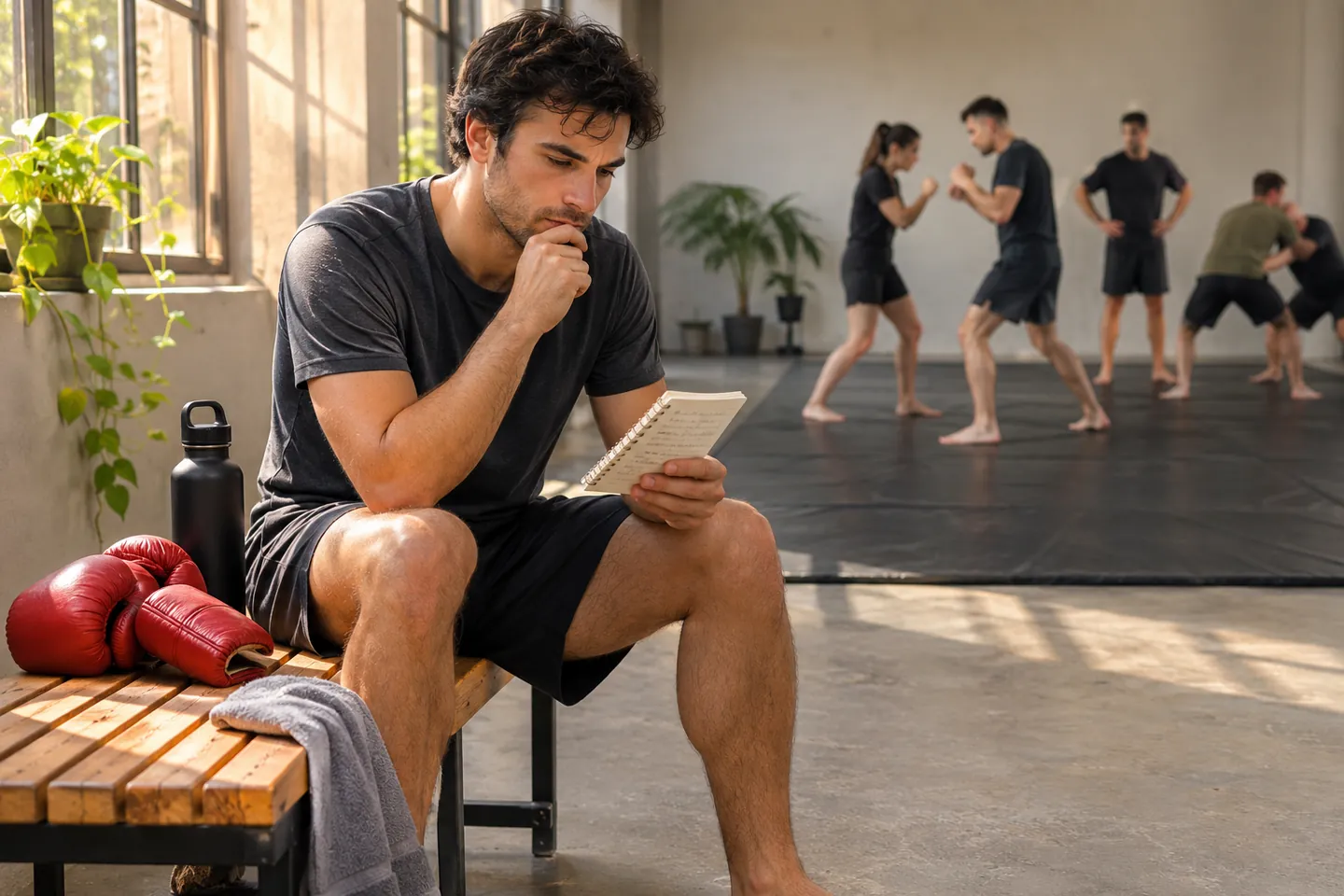
After class, write a brief note while the lesson is still fresh. Record the class topic, the main correction, and one question for next time. You may also record the combination in the terminology the coach used, provided you understand it. Avoid filling pages with uncertain technical details reconstructed from memory.
A useful entry could describe the issue rather than the entire sequence: “I remembered the actions but rushed the change after the step.” That sentence preserves the learning problem and makes it easier to explain at the next session. It also gives you a way to notice whether the same difficulty is becoming more manageable.
Read the note shortly before the following class, then remain open to the new instruction. The journal is a memory aid, not a contract requiring the coach to repeat the previous lesson. If the class covers something different, carry forward the general habit of asking clear questions and recognizing where a sequence becomes uncertain.
Avoid building a second curriculum online
Watching training content can be interesting, but collecting many combinations may make a beginner’s practice more scattered. You can end up recognizing dozens of names without understanding the sequence being taught in class. Give the current lesson enough room before adding another set of movements to memorize.
If a video raises a useful question, bring that question to the coach. Explain what you noticed without assuming the clip provides the missing answer. The exercise may involve a different context, experience level, or purpose. A live instructor can help you connect the idea to your present learning or explain why it should wait.
Do not practice unfamiliar impact sequences with friends at home. Memorizing a list does not establish the equipment skills, distance, or control needed for partner work. If you want extra practice, ask for a suitable noncontact rehearsal using movements already taught. Keep the task small and the space clear.
Notice progress beyond perfect recall
Remembering a whole combination on the first attempt is satisfying, but it is not the only sign of learning. You may begin to identify your point of confusion sooner, ask a more precise question, or reset without frustration. These habits make future lessons easier even when the next sequence is unfamiliar.
Some days will feel less organized than others. Work, travel, and ordinary distraction can affect how much attention you bring into class. Rather than interpreting one difficult session as a permanent limit, simplify the immediate task with your coach. Return to the part you can understand and build from there.
If you are starting Muay Thai at Konga, mention that remembering sequences is one of your concerns during your introductory visit. There is no need to arrive with combinations already memorized. Come ready to watch the complete demonstration, find the uncertain transition, and practice a clear version with a cooperative partner. Those habits give memory something useful to hold onto.
Filed under
Keep exploring
More training insights await.