
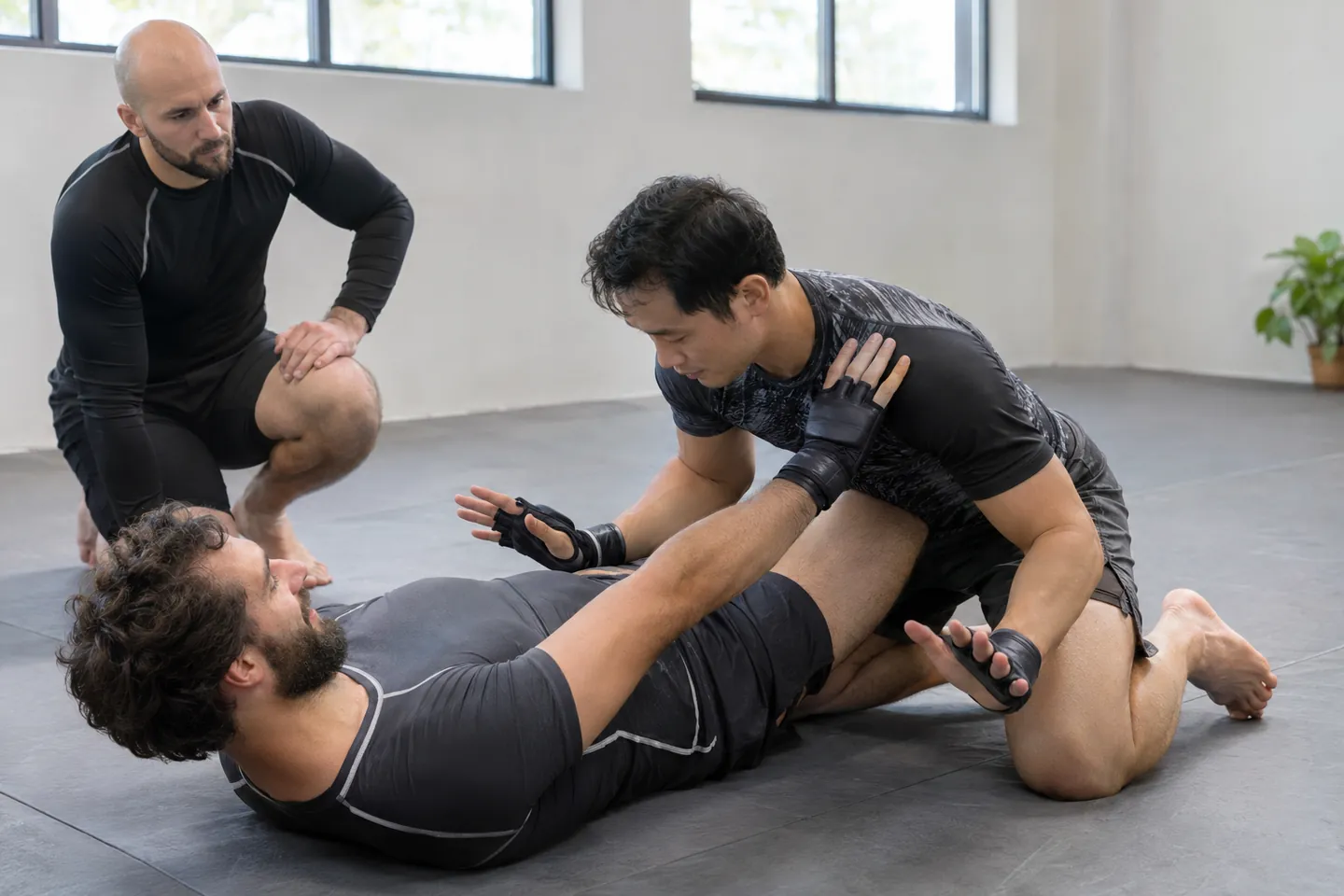
Practical MMA safety habits for Mississauga beginners: tapping early, partner communication, protective gear, hygiene, intensity control and smart recovery.
Mixed martial arts brings together striking, wrestling and ground fighting, which makes it one of the most varied training experiences you can have in a gym. It also means there are more ways for things to go wrong if people are careless. The good news is that most of the risk in a recreational MMA class is managed not by luck but by habits: small, repeated choices that every member makes in every session.
For beginners joining MMA training in Mississauga, those habits can feel like a second curriculum running alongside the techniques. You are learning how to throw a cross and how to escape side control, but you are also learning when to tap, how to tell a partner you are hurt, what to do with your nails and how to pace yourself on a night when you are exhausted. The second curriculum is just as important as the first.
This article collects those habits in one place. Some of them will seem obvious. Others are the sort of thing people only learn after an awkward moment on the mats. Your coach and gym will have their own rules and expectations, which always take priority, but the ideas below are widely shared across well-run training rooms.
Tap early, tap often
In grappling, a tap is a clear signal that you want your partner to release a hold. You can tap with your hand on your partner or the mat, or say “tap” out loud if your hands are trapped. The most important safety habit in any submission-based training is tapping before a hold becomes dangerous, not after.
Beginners often wait too long. Pride, unfamiliarity or simply not recognising what is happening can delay the tap until a joint is under real strain or a choke is nearly complete. There is no reward for holding on. Tapping in training is a normal part of learning, and experienced members tap many times in a single class. Each tap is an opportunity to reset and try again.
The other half of this habit is respecting the tap. When your partner taps, release immediately and smoothly. Do not crank the hold one last time or wait to see if they really mean it. If you are unsure whether they tapped, release anyway and ask. Trust between partners depends on both people honouring this rule without exception.
Know the difference between drilling and live work
Most MMA classes include a mix of drilling, where partners practise a technique cooperatively, and live work, where partners resist and compete within certain rules. These are very different activities, and treating them the same way causes many of the injuries that happen in training.
During drilling, your job is to give your partner a realistic but cooperative body to work with. You should not suddenly resist, explode out of a position or add strikes the coach did not ask for. The goal is repetition and understanding. During live work, resistance increases, but it should still match the intensity your coach has set and the experience levels involved.
If you are unsure which mode a drill is in, ask before starting. A simple “how hard are we going?” between partners prevents misunderstandings. Many problems come from one person drilling while the other thinks it is a live round.
Agree on intensity with every partner
Even within live work, intensity varies. Two experienced members might go relatively hard, while a pairing between a newer member and a veteran should be much lighter. The responsibility for keeping things safe usually sits with the more experienced person, but everyone should contribute.
Before each round, take a second to check in. “Light today? I’m still a bit sore from Tuesday” or “Can we keep strikes to the body?” are perfectly reasonable things to say. During the round, if your partner’s intensity rises beyond what you agreed, you can slow down, step back or ask them to ease up. If it continues, stop and involve a coach.
Size differences deserve attention as well. A heavier partner has a natural advantage in grappling and can cause injury more easily, even without meaning to. Heavier members should adjust accordingly, and lighter members should feel free to ask for a different partner if a pairing feels unsafe.
Protective gear that does its job
MMA training involves a range of equipment, and wearing the right gear for each drill reduces risk considerably. A mouthguard is standard for any striking or live work. Groin protection is common for striking drills. Shin guards help during kicking work, and padded sparring gloves are typically used when strikes are part of a live round. Headgear is used in many recreational settings.
Gear only helps if it fits and is in good condition. A mouthguard that does not stay in place or a pair of gloves with collapsed padding offers less protection than it seems. Check your equipment regularly and replace items when they wear out.
Ask your coach which gear is required for each type of session. Requirements differ between gyms and between classes within the same gym. Arriving with what you need saves time and shows respect for your partners.
Hygiene is a safety issue
Skin infections can spread in any environment where people have close contact on shared mats. Ringworm, staph and other infections are a concern in grappling sports, and preventing them depends on everyone taking hygiene seriously.
Shower before training if you can and as soon as possible afterward. Wear clean training clothes every session, including rash guards and shorts. Keep fingernails and toenails short to avoid scratching partners. Cover any cuts or scrapes properly before training. If you notice an unusual rash, a spreading red area or anything that looks like an infection, stay off the mats and have it looked at by a doctor or pharmacist before returning.
Wear sandals or shoes when you step off the mat, especially in washrooms or change rooms, and never walk on the mats in outdoor footwear. These small habits protect the whole community, and in a busy Mississauga gym with many classes running each day, they matter more than people often realise.
Control in striking drills
When MMA training includes striking, control becomes just as important as it is in boxing or kickboxing. During partner drills, strikes should be thrown at the speed and power the coach specifies. When a technique involves striking toward the head, many drills use very light contact or none at all, especially for newer members.
Be especially careful with techniques that mix levels, such as strikes on the ground. Ground-and-pound drills are often done with pads or at very low intensity, because a partner on their back has limited ability to avoid strikes. Follow your coach’s instructions exactly in these drills.
Pay attention to elbows and knees as well. These are hard, bony surfaces that can cause injury even when thrown lightly. Many recreational classes restrict or remove them from live work. If you are unsure whether a particular strike is allowed, assume it is not until a coach confirms.
Takedowns and the mat edge
Takedowns introduce a different kind of risk: falling. Learning to fall safely, often called breakfalling, is a fundamental skill. Many coaches teach it early, and it is worth practising until it feels natural. A good breakfall spreads the impact and protects your head and neck.
Awareness of space matters too. When several pairs are working takedowns in the same area, collisions can happen. Keep an eye on your surroundings and avoid driving partners into walls, cage fencing or other pairs. If space is tight, reduce the intensity or wait your turn.
Certain takedowns carry more risk than others, particularly those that involve lifting or slamming. Recreational classes often limit these. Respect the limits your coach sets, and remember that your partner’s safety is more important than finishing a technique the way you saw it in a video.
Honesty about injuries and health
Telling your coach about an injury before class is one of the most useful things you can do. It allows them to adjust drills, pair you with a suitable partner and keep an eye on you. Telling your partner is just as important, so they know to avoid a sore shoulder or a tender knee.
Be honest with yourself too. Training through a significant injury often makes it worse and lengthens the time you spend away from the mats. If something hurts in a way that feels different from normal soreness, stop and have it assessed. Our physiotherapy team works with many people who train, and a qualified professional can help you understand what is going on and how to return safely.
Head injuries deserve special caution. If you take a hard hit or fall and experience symptoms such as headache, dizziness, confusion, nausea or blurred vision, stop training and seek medical assessment. Do not return until a qualified professional has cleared you.
Fatigue changes everything
Tired people make mistakes. Their defence drops, their technique gets sloppy and their judgement suffers. Many training injuries happen late in a session or during a final round when people push beyond what their body can handle.
Learn to recognise your own fatigue. If you are struggling to protect yourself, it is fine to sit out a round, take a sip of water and catch your breath. Coaches generally prefer this to someone continuing while exhausted. It is also wise to be cautious after poor sleep, a long day of physical work or a stressful week. Training is still possible on those days, but the intensity may need to come down.
Hydration and fuelling matter too. Arriving at an evening class having eaten nothing since lunch, after a long drive home through Mississauga traffic, sets you up for a rough session. A small snack and some water beforehand often makes a noticeable difference.
Building a culture of care
The safest gyms are not the ones with the most rules but the ones where people genuinely look out for each other. Partners check in, experienced members guide newer ones and everyone feels comfortable speaking up when something is wrong.
You contribute to that culture every time you tap early, respect your partner’s tap, match intensity and keep your gear clean. You also contribute when you speak up about unsafe behaviour, either directly with a partner or quietly with a coach. These conversations can feel awkward, but they protect everyone.
Starting well
The habits you build in your first months tend to stay with you. If you start your MMA training with a focus on safety, communication and control, you set yourself up for years of enjoyable, productive practice.
Our MMA classes in Mississauga combine technical instruction with clear expectations around safety and partner care. If you want to build a foundation in one area first, Brazilian jiu-jitsu is a great way to develop grappling habits, including tapping and positional awareness. When you are ready, book a free trial and see what a well-run class feels like from the inside.
Filed under
Keep exploring
More training insights await.