
Fit kids martial arts into a school week in Mississauga with realistic travel plans, shared family responsibilities, simple preparation, and useful schedule reviews.
A class can look easy to fit into a calendar when it occupies only one line. The family experience is larger: leaving school or childcare, traveling across the city, changing clothes, attending, returning home, and finishing the evening. If those surrounding steps are missing from the plan, an enjoyable activity can become a weekly rush.
Fitting kids martial arts into a school week in Mississauga starts with the whole trip and the whole household. The right routine should be practical enough to repeat during an ordinary week, including the occasional delay. You do not need a complicated family management system. A realistic view of time, clear responsibilities, and a short review after the first few visits can reveal what needs adjusting.
Begin with the current class options
Confirm the current sessions suitable for your child’s age and experience directly with the gym. Do not build a family routine around a timetable found in an old post. Ask which options are appropriate and whether the team recommends a particular starting arrangement for a new student.
Write down the actual start and finish times, along with arrival expectations. If equipment preparation takes time, include it. Ask about any practical details that affect the visit, such as where to check in and how pickup works. These questions are part of planning, not an unnecessary complication.
Avoid choosing only by the class that appears first in the week. Compare the options against the family’s real commitments. A slightly different time may make the journey calmer or reduce conflict with another child’s routine. The best option is the one that can function repeatedly, not simply the one that looks available today.
Map the route from the real starting point
A weekday trip may begin at school, childcare, work, or a relative’s home rather than your front door. Plan from that location. Include the handover and any stop that genuinely needs to happen before class. A route measured from the wrong starting point can make the schedule seem easier than it is.
Use the first few journeys as information. Notice how long it takes to gather belongings, reach the car or transit stop, and find the entrance. Adjust your departure plan based on experience. You do not need to treat every delay as a failure of organization; the initial estimate may simply have been incomplete.
Have a clear communication plan when someone else handles transport. Share the confirmed address, arrival instructions, and pickup arrangement. Avoid assuming that another adult knows the routine because they have heard about the class. A concise, accurate handover prevents unnecessary calls and confusion at the busiest moment.
Protect the transition after school
Children may arrive at the end of a school day ready for activity, needing a quiet moment, or somewhere between the two. Pay attention to the actual transition rather than deciding in advance how they should feel. Build a little room to change, gather belongings, and understand what happens next where possible.
Keep instructions during the transition short. A child managing several steps may struggle with a long list delivered while you are also driving or searching for equipment. Use a familiar sequence and repeat it consistently. The goal is a predictable routine, not a race that becomes faster only when someone gets frustrated.
If the class time repeatedly requires an impossible rush, discuss alternatives with the gym. A program can be a good fit while a particular slot is not. Changing the timetable may preserve enjoyment more effectively than asking the child to tolerate the same crowded transition every week.
Include meals and the rest of the evening
Look at what the family normally does around dinner, homework, and bedtime. The class should be planned within those routines rather than treated as if it occurs in empty space. You may need to shift an ordinary household task or prepare something earlier. The appropriate arrangement depends on your family’s needs.
Avoid using the activity as a reason to make every other part of the evening hurried. If the child consistently returns to a backlog of responsibilities, the class may begin to feel costly even when they enjoy it. Review the sequence and identify what can be simplified or moved without creating a new problem elsewhere.
Do not turn this planning into strict performance expectations for the child. They can help with age-appropriate tasks, but adults are responsible for the overall schedule. A child forgetting a bottle should not become the explanation for every timing issue in a plan that was already too tight.
Divide responsibilities clearly
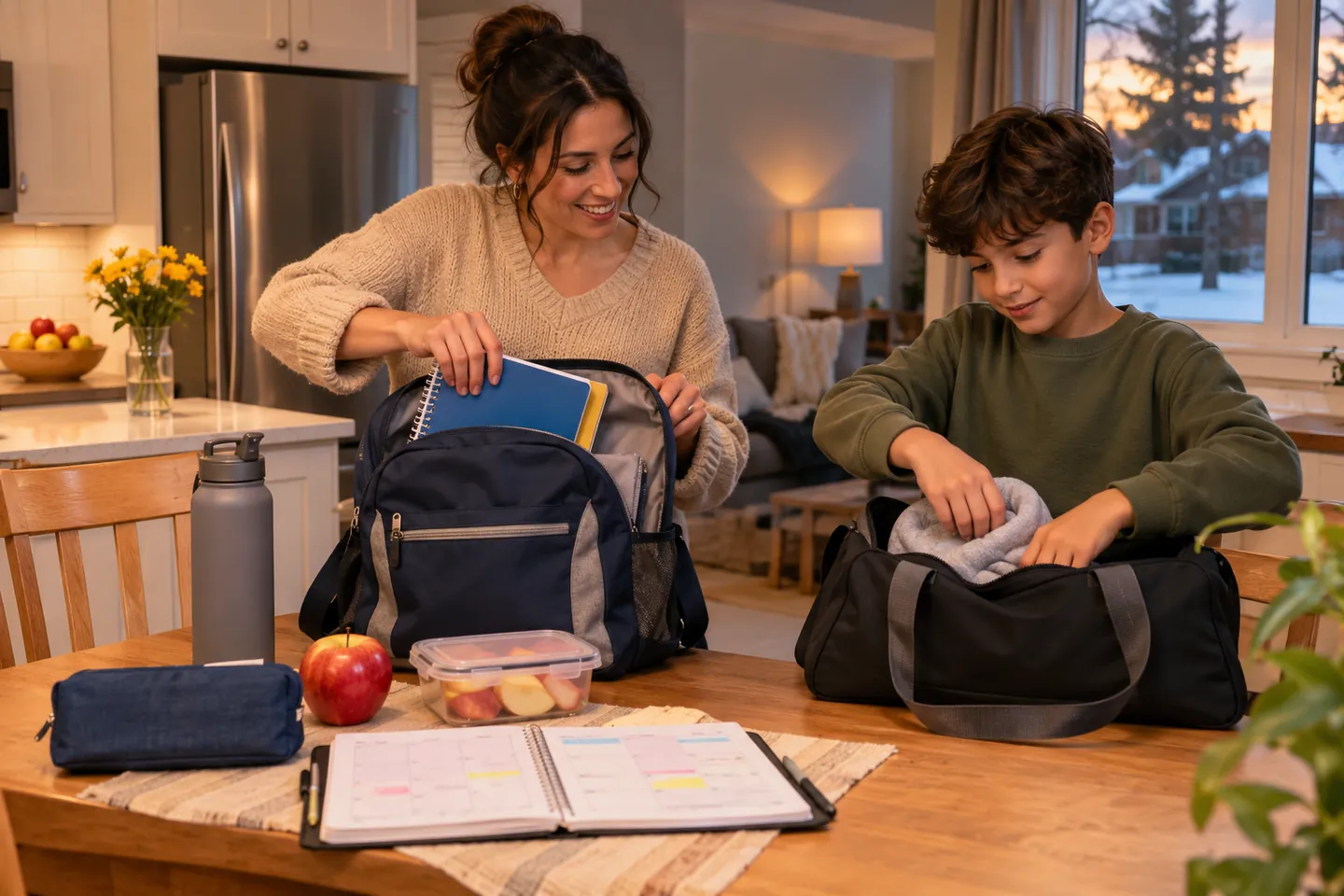
Decide who prepares the bag, who handles transport, and who checks any communication from the gym. When responsibilities remain vague, small tasks are easily missed or duplicated. Clear roles can still be flexible, but someone should know when they are responsible for the next step.
Give the child a manageable contribution. Depending on age, they might place suitable clothing in the bag or return the water bottle to its usual location. Teach the task and check it together initially. Independence develops more usefully through clear practice than through sudden blame when an unspoken expectation is not met.
If several adults share transport, establish how changes will be communicated. A simple message with the actual plan is better than an assumption that someone will notice a calendar edit. Include the child in the explanation at an appropriate level so they know who is collecting them and what to expect.
Build a packing routine that reduces decisions
Keep required items in a consistent place. After class, follow the appropriate care instructions and return clean, ready equipment to storage. Before the next visit, check the kit early enough to resolve a missing item. This is easier than discovering the problem at the door when everyone is already wearing shoes.
Use a short checklist if it helps, especially while the routine is new. The list should contain the actual items required for the current class, not every piece of martial arts equipment that exists. Update it if the coach changes the requirements. A useful checklist reduces thinking rather than creating a new administrative task.
Let the child participate without making the bag a measure of character. Forgetting something is an opportunity to improve the routine. Ask whether the item needs a better storage place or whether the check should happen earlier. Practical solutions usually work better than repeated speeches about being responsible.
Leave room for an imperfect week
School events, work demands, illness, and family commitments can interrupt a plan. When a class is missed, identify the next appropriate session and follow the gym’s attendance arrangements. Avoid treating the whole month as lost because one evening did not work. A routine should be able to resume.
Do not assume that every missed class requires extra home training or an overloaded following week. Ask the coach what is appropriate. Children should not practice strikes on siblings or friends as a way of catching up. The class provides instruction and boundaries that an improvised household drill does not replace.
If the same conflict happens repeatedly, revise the plan. That pattern is useful evidence. Perhaps the class time is unsuitable, the travel estimate is too short, or another obligation needs adjustment. Repeating an unworkable schedule with more determination does not necessarily make it more practical.
Watch the child’s experience of the routine
Ask what feels easy and what feels rushed about class days. A child may identify a small problem adults overlook, such as not knowing where the bag is or feeling uncertain about pickup. Their observations can help you improve the routine without changing the activity itself.
Distinguish enjoyment of the class from frustration with the surrounding evening. A child who complains about going may be reacting to a rushed transition rather than the lesson. Listen and clarify before assuming the program is the issue. Equally, do not dismiss a genuine concern about the class as merely tiredness or inconvenience.
Share relevant patterns with the coach. If your child regularly arrives unsettled after a difficult transition, the instructor may have useful observations or suggest a more suitable session. Keep the conversation practical and avoid expecting the coach to solve the entire family calendar. The aim is coordinated information.
Review the plan after real experience
Keep a backup contact arrangement available for the adults involved in pickup. Everyone should know whom to notify if the plan changes and what the gym expects when a delay occurs. Confirm those details with staff rather than inventing a family-only process. Clear communication makes an unusual evening easier to manage without asking the child to resolve adult logistics.
After several visits, compare the planned routine with what actually happened. Did you arrive with enough time? Were responsibilities clear? Did the evening remain workable afterward? Keep the review focused on adjustments that can be made. You do not need to score the family or assign fault.
A good schedule supports continued participation without demanding that every day be perfect. For current options, explore kids martial arts at Konga and use the free trial page to discuss an introduction. Build the plan around confirmed class information, realistic travel, and your child’s ordinary week. That foundation gives the activity a fair chance to become an enjoyable part of family life.
Filed under
Keep exploring
More training insights await.