
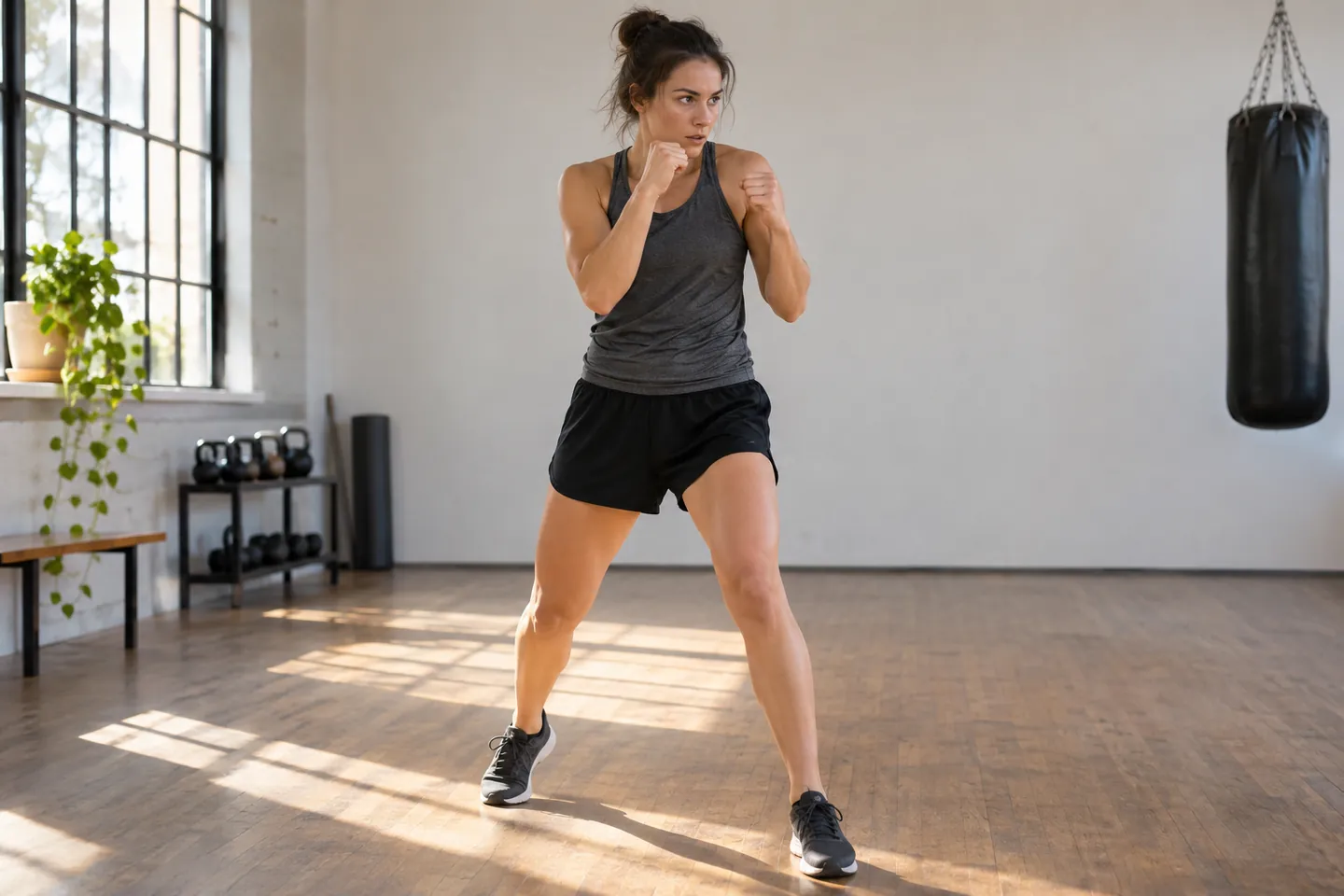
Make beginner shadowboxing in Mississauga more purposeful with clear practice themes, sensible space checks, coached movements, and useful ways to review a round.
Shadowboxing can feel surprisingly difficult when someone says, “Just move around and practise.” There is no bag to tell you where to stand and no pad holder presenting the next target. You are responsible for choosing the movement, remembering its shape, and deciding when to reset. For a beginner, that freedom can be more confusing than a carefully directed equipment drill.
The answer is to give shadowboxing a small, clear purpose. You can use it to rehearse familiar movements without contact, pay attention to a coaching cue, or connect a simple step with a punch. Shadowboxing for beginners in Mississauga works best as part of learning with an instructor, especially when you are still deciding whether what you feel matches what you are doing.
Understand what the practice is asking of you
Shadowboxing means rehearsing boxing movements without striking a target. That description is broad, and different rounds can have different purposes. A coach may ask you to work slowly on a return to stance, follow a short sequence, or respond to verbal directions. Ask what the current round is intended to teach.
Without a stated purpose, beginners often fill the time with whatever movement comes to mind. That can become a collection of half-remembered actions. A focused round is easier to review because you know what you were trying to accomplish. You can tell whether you remembered the cue and where it became difficult.
Do not assume that shadowboxing must look like a dramatic performance. A few careful movements, separated by deliberate resets, can be appropriate for an early lesson. The practice should match your understanding and the coach’s instruction. Its value does not depend on appearing busy throughout every second.
Choose one theme before the round begins
A useful theme is specific enough to notice. You might focus on returning both hands after a simple combination, keeping the steps short, or finishing each movement in the stance you have learned. Ask the coach which theme would help you most rather than selecting several at once.
The theme does not mean that every other detail stops mattering. It gives your attention a priority while the coach observes the whole movement. If another issue needs immediate correction, the instructor can adjust the task. Otherwise, you have a clear question to carry through the round.
For example, a round about the return after a jab might involve one jab, a reset, and a small movement before repeating. There is enough variety to remain attentive without burying the main cue in a long sequence. The simpler the task, the easier it is to understand what the repetitions reveal.
Set up the space before you start
Look around the actual area you will use. You need room for the movements the coach has assigned, including your arms and any steps. Keep away from people passing through, equipment edges, loose bags, and surfaces that make footing uncertain. A clear area should remain clear throughout the practice, not only at the start.
At home, move obstacles rather than assuming you will remember to avoid them. A low table, pet, or open cupboard can change the space quickly. If you cannot create suitable room, choose a different activity, such as reviewing your training notes, until you have an appropriate place to practise.
Use the footwear and surface guidance your coach recommends. Do not add rapid turns or travelling movements on an unfamiliar surface just because there is no equipment involved. Shadowboxing removes the target, but it does not remove the need to consider the setting.
Begin with movements you have been taught
Independent practice is most useful when the material is familiar enough to rehearse meaningfully. Use the stance, punches, and steps your coach has already introduced. If a movement is still unclear, ask for guidance before making it the centre of a home session.
Online clips can be interesting, but they often show a short moment without the instruction that led to it. A beginner may copy the visible shape while missing the purpose or circumstances. Bring unfamiliar movements to your coach as questions instead of blending them into a routine that is supposed to reinforce your current lesson.
Keeping the material familiar does not make practice uninteresting. You can observe a known movement in more detail: where it begins, how you return, whether your feet stay organised, and what happens when you add a small pause. Familiarity creates room for attention.
Use a pace that leaves room to notice
A round can become rushed because there is no target to provide a natural pause. You throw one punch, immediately add another, and soon cannot remember the original theme. Start at a controlled pace that allows you to recognise each action and its ending.
Your coach can explain the intended range and manner of the punches without a target. Do not force movements at the ends of their range or add weights simply to make the practice harder. Those changes create a different task and should not be improvised as a substitute for understanding the basic action.
If you lose track of the cue, pause and reset. A brief pause is part of thoughtful practice. It gives you a chance to restore the stance, remember the theme, and begin again with a clear intention. Filling every moment with movement is not the only way to use the round well.
Decide how much imagination helps
Experienced boxers may imagine an opponent while shadowboxing. For a newcomer, that instruction can add more complexity than it resolves. You may not yet know what situation to imagine or how to respond. Ask the coach whether the current round needs that element at all.
A simpler reference can be enough. You might imagine the location of a familiar pad or the distance used in a recent bag drill, while keeping the movement itself basic. The reference should support the skill you are practising rather than encourage a stream of invented exchanges.
If your attention drifts into elaborate scenarios and the original cue disappears, return to the concrete task. One step, one familiar punch, and a clear reset can restore the structure. Imagination is useful only when it helps you perform the assigned practice with greater understanding.
Use a mirror for a specific question
A mirror can show aspects of your movement, but staring at your reflection continuously can become its own habit. Ask the coach when a mirror is useful and what to look for. A targeted question, such as whether your hands return to the taught position, is more productive than watching yourself generally.
Be careful about turning your head to inspect a movement from an awkward angle. If you cannot see the relevant detail while maintaining the assigned position, ask the coach to observe or use a permitted recording setup. The tool should not alter the movement so much that it creates a different problem.
Practise without the mirror as well when instructed. You want to recognise the starting position and sequence without depending entirely on visual confirmation. The coach can help you connect what the movement looks like with how it feels when performed as intended.
Record briefly and respect the room
A short video may help answer a specific coaching question, provided recording is allowed and other participants’ privacy is respected. Ask permission where appropriate, choose a clear angle, and avoid capturing people who have not agreed to be included. The training session remains the priority.
Keep the recording short enough to review with purpose. A few repetitions can show where a hand finishes or how your feet change after a step. A long clip may be harder to interpret and can encourage you to judge your overall appearance instead of the chosen detail.
Let a coach help interpret what you see. Your impression of an awkward-looking frame may not identify the actual issue, and a polished-looking moment does not prove that the whole sequence is clear. Video is evidence to discuss, not an automatic technical verdict.
End the round with an observation
When the round finishes, ask what you noticed about the theme. Did the cue remain present? Did you lose it when you added movement? Was one transition consistently confusing? An observation gives the next round a direction and helps the coach decide whether to keep, simplify, or change the task.
Avoid turning the review into a judgement about whether you are naturally coordinated. That conclusion is too broad to guide the next repetition. “My feet became narrower after I stepped back” is specific. It describes something that can be demonstrated, discussed, and adjusted.
If you cannot identify anything, ask the coach for one observation. You may still be learning what to look for. That is a legitimate part of beginner practice. Over time, the ability to notice your own patterns can become more useful, but it should develop alongside external feedback.
Keep home practice connected to class
Before leaving a boxing session, ask whether a short shadowboxing exercise would be appropriate between visits. Get a clear description of the movement, the purpose, and any limits. Then keep your independent practice close to that instruction.
Bring back questions rather than pretending the homework made everything automatic. Perhaps the movement felt clear at home but changed when you returned to a bag. Perhaps you forgot the cue after several repetitions. Both observations can help the next lesson become more specific.
Shadowboxing becomes useful when empty space has a clear job. It gives you room to rehearse, notice, and reset without the target dominating your attention. A modest round with a purpose can teach you more about your current movement than several minutes of hurried improvisation.
Filed under
Keep exploring
More training insights await.