
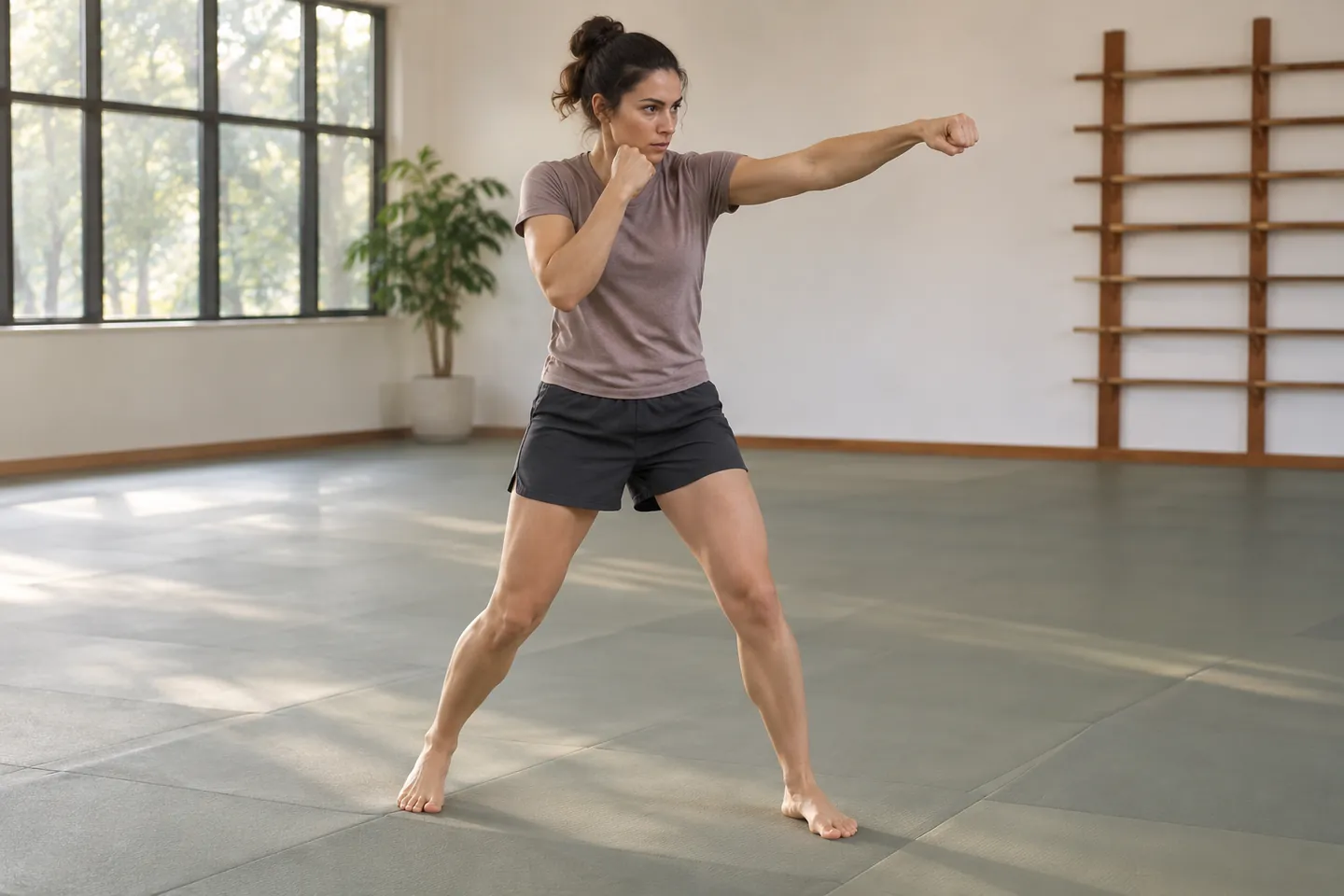
Give Muay Thai shadowboxing in Mississauga a clear purpose with focused rounds, sensible space checks, coach-approved movements, and simple reflection habits.
Shadowboxing can be one of the most puzzling parts of a beginner class. There is no pad to reach, no partner to follow, and sometimes no long sequence to memorize. Experienced students seem to know exactly what to do, while a newcomer may repeat two movements and then wonder whether the round has lasted ten minutes. The missing piece is often a clear purpose.
For someone learning Muay Thai in Mississauga, shadowboxing becomes more useful when it is connected to the current lesson. It can provide a setting for rehearsing familiar movements without contact, noticing transitions, and practicing a coach’s cue. It should not become an invitation to invent techniques or copy every dramatic action seen online. A simple assignment is enough.
Ask what the round is for
Before beginning, listen for the coach’s focus. The round may emphasize a particular movement, a short sequence, or a reset after each action. If the instruction sounds broad, ask what a beginner should concentrate on. “Which two things should I work on this round?” can produce a manageable answer without requiring a lengthy explanation.
Having a focus changes the experience. Instead of trying to look as active as everyone else, you can ask whether you are practicing the assigned detail. A quiet round with deliberate resets may serve the lesson better than constant motion. The coach’s objective gives you a standard that is more useful than appearance.
Do not assume that every shadowboxing round has the same purpose. A later round may connect movements that were separated earlier, or it may use a different pace. Listen again when the instruction changes. Familiarity with the activity should not become a reason to stop hearing the particular task.
Use movements that have already been taught
A beginner’s vocabulary of techniques is still developing. Stay with the movements the coach has introduced and the version practiced in class. Shadowboxing is not an opportunity to teach yourself an unfamiliar kick or imitate a spinning action from a highlight clip. Without a clear reference, repetition can make confusion feel familiar.
If you forget a movement, pause and ask. There is no advantage in filling the remaining time with a guess. The coach may demonstrate it again or suggest a simpler alternative for the round. A small set of understood actions gives you more useful material than a large set of uncertain ones.
You can also ask whether the current round includes footwork or should remain mostly in place. This matters in a shared room and for the learning objective. A movement that is appropriate during one drill may be unnecessary during another. Follow the boundaries of the assignment before adding your own variations.
Choose a space you can actually use
Look around before starting. Know where nearby students are working, where equipment sits, and whether anyone needs to pass through the area. Give yourself the space required by the assigned movements without drifting into someone else’s station. Noncontact practice still depends on shared-space awareness.
If the room is crowded, ask the coach where to stand and how much travel is appropriate. Do not quietly enlarge your area as the round continues. Other students may be concentrating on their own instructions and assume you will stay within the established space. Predictable movement helps everyone keep attention on learning.
At home, be even more conservative. Furniture, low lights, rugs, pets, and family members can make a small room unsuitable for active striking motions. Ask for a coach-approved task that fits the space you actually have. Sometimes reviewing a starting stance is the better choice than attempting a full moving round.
Give the beginning and ending equal attention
A shadowboxing movement has no pad contact to mark completion, so beginners may rush through the end. Ask the coach what the return should look like. The action should leave you able to continue the assigned exercise or pause deliberately, rather than wandering into an unplanned step.
Try noticing one finish for a short block of practice. For example, focus on whether you return to the position demonstrated after each familiar movement. The exact cue should come from the instructor. This gives the round structure without requiring a complicated combination or a constant stream of new actions.
If the finish keeps disappearing, simplify the sequence with the coach’s guidance. A single movement followed by a clear reset can reveal more than a long string of actions. Once the connection is understood, the instructor can decide when it makes sense to remove pauses or add another element.
Avoid performing for the mirror
A mirror can provide feedback, but it can also turn the round into a visual performance. You may begin choosing movements because they look dramatic rather than because they match the lesson. Ask the coach how, or whether, the mirror should be used during the exercise. A specific check is more useful than continuous self-inspection.
If you notice something that looks different from the demonstration, bring it to the coach. Camera angles and reflections can be misleading, and beginners may misinterpret what they see. The instructor can watch the movement directly and decide whether a correction is needed. You do not have to solve every visual difference yourself.
Avoid comparing your reflection with the person beside you. Their assigned focus, experience, and movement options may differ. The mirror should not become a scoreboard. Your task is to practice the instruction you received and recognize whether it is becoming easier to reproduce.
Let pace support attention
Moving quickly can feel more convincing, especially when you are self-conscious. However, speed can also make it harder to notice the detail the coach wants you to learn. Use the assigned pace. If no pace was specified, ask what is appropriate for a beginner working on the current movement.
When you lose the sequence or stop recognizing the finish, pause and reset. Do not fill the gap with random strikes to avoid looking uncertain. A brief reset can restore the purpose of the round. It also makes it easier for the coach to identify what you were trying to do and offer relevant feedback.
Take the breaks provided. Shadowboxing can feel less demanding than padwork at first, but attention can still fade. If you are no longer practicing a recognizable version of the exercise, tell the coach. The useful amount of practice is the amount that continues to serve the lesson, not simply the amount that fills a timer.
Use a theme instead of endless variety
If the coach permits a flexible round, choose a theme from the current lesson. You might focus on a starting position, a particular transition, or the reset after a familiar action. Keep the theme small enough that you can remember it while moving. It should make the round clearer rather than add another layer of complexity.
Variety has a place, but beginners do not need to prove that they know many techniques. Repeating a small set with attention can be a legitimate assignment. Ask the instructor when a variation would be useful and what it should add. The change should have a reason beyond avoiding boredom.
A theme also makes feedback easier. You can tell the coach, “I was trying to keep the finish consistent,” and ask whether that happened. Without a focus, you may only remember that the round felt awkward or energetic. Specific intentions produce observations that can guide the next attempt.
Keep home rehearsal different from a workout challenge
If you want to practice between classes, ask for a short noncontact assignment rather than designing an ambitious routine on your own. Explain your available space and experience. The coach may suggest a few deliberate repetitions instead of a timed round. Follow the advice given for your situation.
Do not add hand weights, household objects, or other resistance because an online clip makes it look effective. Equipment changes the task, and a beginner may not understand the implications. Keep the rehearsal within the conditions the coach approved. Extra difficulty is not automatically extra learning.
Stop when pain, dizziness, or feeling unwell occurs, and seek appropriate guidance. Also stop when the instruction becomes uncertain. Those are different reasons to pause, but neither is solved by stubborn repetition. A note for the next class is better than an extended practice session built around a guess.
Review one observation after the round
When the round ends, ask yourself what became clearer and what remained confusing. Keep the answer concrete. You might have remembered the starting position but lost the return after one movement. That is a useful observation to share. “I was bad at shadowboxing” is too broad to guide the next lesson.
A short note after class can preserve the cue and the question. You do not need a detailed diary of every action. The purpose is to reconnect with the learning task when you return, especially if work and travel make the week feel crowded. A simple record supports consistency without creating another obligation.
The Muay Thai program at Konga can provide the coaching context that makes solo practice meaningful. If you are considering a first class, ask about an appropriate session through the free trial page. You do not need to arrive with an impressive shadowboxing routine. Begin with familiar movements, a clear purpose, and enough attention to notice how each action finishes.
Filed under
Keep exploring
More training insights await.