
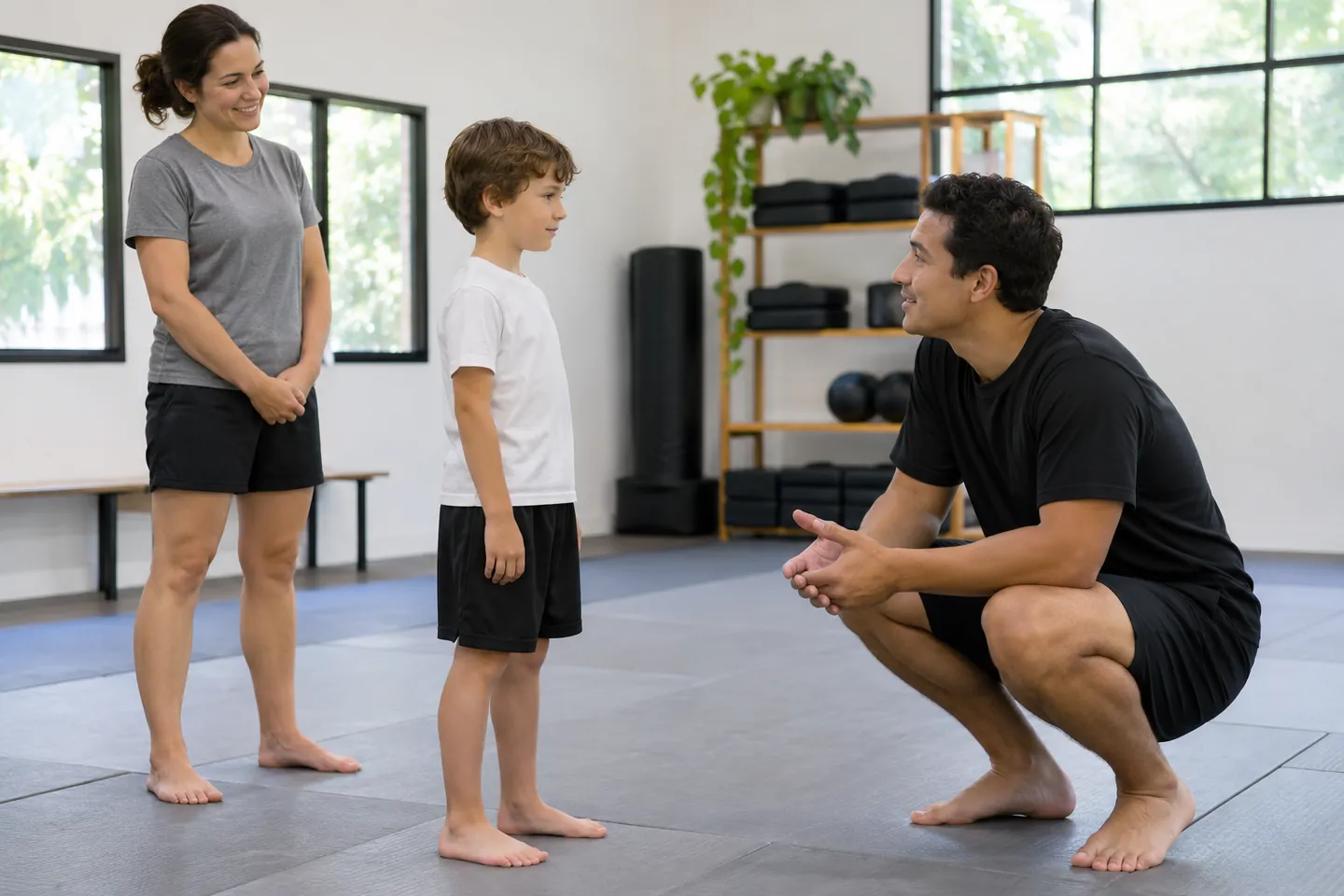
Support a quiet beginner in kids martial arts in Mississauga with predictable visits, respectful coach communication, manageable choices, and patient reflection.
A quiet child may be interested in martial arts and still find the first doorway difficult. They can talk enthusiastically about the idea at home, then become silent when the class is within sight. For a parent, that change can be confusing. It may also create an urge to encourage more loudly, explain more quickly, or promise that everyone will become a friend immediately.
Supporting shy beginners in kids martial arts in Mississauga works better when the goal is participation with appropriate support, not changing the child’s personality. Quietness is not a failure to correct. A useful introduction gives the child understandable steps, a coach who knows the relevant context, and room to become familiar with the setting. The pace and approach should be discussed with the program rather than improvised under pressure.
Describe the situation without fixing a label
When contacting the gym, explain what tends to happen in new groups. Perhaps your child watches before joining, speaks softly to unfamiliar adults, or prefers knowing the routine in advance. Those observations help the coach plan. Saying only “My child is very shy” gives less information about what might make the visit manageable.
Have the conversation privately where possible. Children can hear adults describe them as anxious, difficult, or impossible to persuade, and those labels may shape the experience before it begins. Keep the language practical and respectful. You are sharing information about support, not presenting a defect for the instructor to repair.
Ask what the program can accommodate. Some classes may have a clear process for observing or meeting the coach before joining; others may have different arrangements. Confirm the actual options. Do not promise your child a private introduction, a special partner, or unlimited observation time unless the team has agreed to it.
Make the visit predictable in useful ways
Tell your child what you know about the sequence: arriving, checking in, meeting the coach, and following the introduction arranged by the gym. Keep the explanation accurate and brief. Predictability comes from reliable information, not from describing every possible moment of a class you have not attended.
Let the child ask practical questions. They may want to know where you will sit, where the washroom is, or what happens if they forget an instruction. These details can matter more to them than a broad reassurance that the activity is fun. If you do not know the answer, find out or explain that you will ask together.
Avoid rehearsing disaster scenarios. A long discussion of everything that could feel uncomfortable may make the visit seem more threatening. Focus on the next manageable step and the available way to ask for help. The coach’s actual process should guide how the introduction unfolds.
Offer choices that are real and limited
A small choice can help a child participate in preparation. They might choose between two suitable shirts or decide which approved bottle to bring. Keep the options within the practical requirements of the class. Asking them to choose among many uncertain arrangements can add work rather than provide comfort.
Do not offer choices you cannot honour. If attendance is still being explored, explain that clearly. If the gym requires a particular routine, do not suggest the child can ignore it when nervous. Honest boundaries make the plan easier to trust. The goal is not to remove every expectation, but to make expectations understandable.
Where the program allows it, discuss a simple first step with the child and coach. That might be greeting the instructor or standing in the designated place for the demonstration. The step should fit the actual class process. Avoid turning it into a public challenge with a reward announced to the whole family.
Let the coach build a relationship
Introduce the child and then give the instructor room to speak with them at an appropriate pace. Parents often answer quickly when a child pauses, especially if silence feels uncomfortable. Allow a little time when the situation permits. The child may respond once they understand that the question is genuinely for them.
If your child needs help answering, support them without taking over the whole interaction. You might clarify a practical detail and then return the conversation to the coach. The aim is a gradual connection between student and instructor, not a requirement that the child suddenly speak confidently on demand.
Observe whether the coach’s approach helps the child understand the next action. A warm manner is useful, but clear guidance matters too. The child may benefit from a direct demonstration or a simple instruction more than from repeated requests to smile or appear excited. Notice what makes participation easier in practice.
Avoid comparisons disguised as encouragement
Statements such as “Your younger sibling did it” or “Look, everyone else is joining” may be intended to reassure. They can also make the child feel that their response is being ranked against other people. Focus on the agreed next step rather than using the room as evidence that they should feel differently.
Similarly, avoid calling a child brave only when they become visibly outgoing. A quiet greeting, a question, or an attempt at the assigned movement can all be meaningful forms of participation. Describe the action you noticed. “You asked the coach to show you again” is concrete and does not require the child to adopt a new personality.
Do not compare one visit with a sibling’s history or an idealized version of your own childhood. Your child is meeting this group at this moment. The useful information is what helps them understand and engage with the current setting. Other people’s timelines do not provide a fair deadline.
Keep sideline support simple
Follow the gym’s parent observation rules and the plan discussed with the coach. If you are watching, avoid repeatedly signalling, correcting, or mouthing instructions from across the room. A quiet child may already be dividing attention between the unfamiliar teacher and the familiar parent. Extra directions can make that split harder.
A calm expression and predictable presence may be more useful than visible urgency. If your child looks toward you, respond within the agreed arrangement rather than inventing a new instruction. Let the coach lead the class. Any change to the introduction plan should be coordinated, not communicated through competing gestures.
If you have a concern, raise it at an appropriate time unless something requires immediate attention. Public commentary can make the child feel watched and evaluated. A private conversation gives the parent and coach room to compare observations without turning the child’s participation into a group discussion.
Distinguish quiet participation from distress
A child can be quiet while listening, interested while cautious, or engaged without smiling continuously. Avoid using visible enthusiasm as the only measure of a good session. Ask what they understood and what they remember afterward. Their experience may be more positive than their expression suggested from the sideline.
At the same time, do not dismiss a child’s report that something felt upsetting or uncomfortable. Listen and clarify the situation with the coach. If the concern extends beyond the class or involves significant distress, appropriate professional support may be needed. A martial arts program should not be presented as a guaranteed solution to every emotional difficulty.
The practical question is whether the setting and support are helping the child participate appropriately. Sometimes an adjustment is useful; sometimes a different time or activity may fit better. Exploring that possibility is a thoughtful response, not a failure of parenting or a verdict about the child.
Review with curiosity rather than persuasion
After class, ask one question and allow the answer to guide the conversation. “What did the coach show you?” may feel easier than “Did you love it?” The first asks for an observation; the second can suggest that a particular emotional response is expected. Give the child room to describe mixed feelings.
Listen for small practical barriers. Perhaps they could not hear an instruction or did not know which line to join. These concerns may have clear solutions. Share them with the coach in descriptive language and ask how the next visit could be introduced. Do not assume every hesitation is a deep objection to the activity.
Avoid negotiating a long-term commitment immediately after a difficult moment. Review the information, talk with the instructor, and choose a clear next step. The decision should consider the child’s response, the program’s approach, and the family’s routine. Patience includes making informed choices, not simply repeating the same plan indefinitely.
Build familiarity without demanding a transformation
If the family continues, keep the arrival routine and communication consistent where possible. Familiar equipment, a known check-in process, and a clear class time can make the next visit easier to understand. Progress might appear as fewer questions about the doorway, more direct communication with the coach, or a willingness to try one additional activity.
Explore kids martial arts at Konga and use the free trial page to discuss an appropriate introduction. Explain the child’s actual needs and ask what support the program offers. The aim is to help a child learn within a respectful setting, with their quietness treated as part of their starting point rather than something that must disappear before they belong.
Filed under
Keep exploring
More training insights await.