
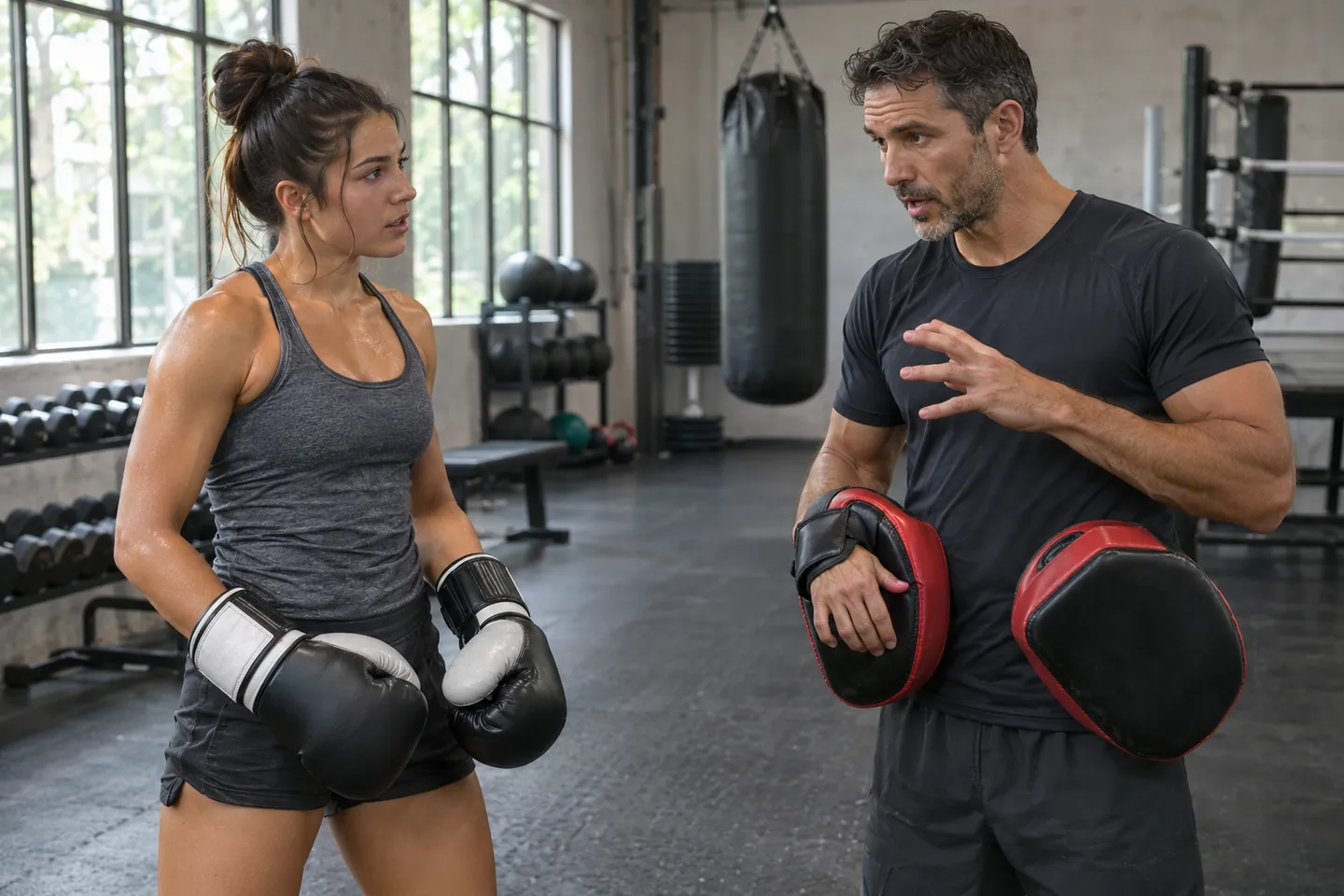
Make boxing combinations easier to follow in Mississauga with a practical approach to learning sequences, connecting punches, pacing practice, and asking questions.
You remember the first punch. You remember the second punch when someone asks for it separately. But when the coach calls them together, your hands pause as if they need to negotiate whose turn it is. This is a familiar beginner experience. Learning a combination is a different task from learning its individual movements, because now you must remember an order, manage transitions, and finish ready to continue.
Simple boxing combinations in Mississauga can be practised without turning the class into a memory contest. A short sequence gives you room to understand how one action changes the starting point for the next. The aim is not to collect the longest possible combination. It is to make a manageable sequence clear enough that you can repeat it with attention.
Find out what the sequence is teaching
Before memorising a combination, ask why the coach has chosen it. The immediate purpose might be connecting two straight punches, returning the hands, coordinating a step, or responding to a pad cue. That purpose helps you decide what to notice while practising.
For example, if the lesson is about returning to stance after a short sequence, adding more punches does not necessarily make the exercise better. It may simply postpone the part you are meant to learn. A clear goal keeps the practice from becoming an attempt to impress yourself with complexity.
The same sequence can serve different purposes at different times. A coach might first use it to teach order and later use it to examine rhythm. Ask what matters today rather than assuming that the name or number pattern tells you everything. You are learning a task in context, not memorising a universal performance standard.
Translate the coach’s language
Some classes use numbers for punches; others use names or a mixture. Numbering conventions can vary, so ask what each cue means in the room you are attending. Do not assume that a sequence learned elsewhere translates automatically. A brief clarification prevents repeated mistakes caused by vocabulary rather than movement.
Say the sequence back in words if that helps. “Lead straight, rear straight, then reset” may be easier to understand initially than a string of numbers. Once the actions are familiar, the shorter cues can become convenient. There is no prize for using shorthand before it makes sense to you.
If the coach demonstrates while facing the group, check which side they intend you to use. Mirrored demonstrations can be confusing, especially when a sequence includes movement. Ask to watch from beside the instructor or have the first action identified clearly. Small communication adjustments can resolve what feels like a coordination problem.
Learn the pieces before joining them
A combination becomes difficult when one of its individual movements is still unclear. If you do not understand the second punch, repeating the entire sequence quickly will not necessarily clarify it. Ask to rehearse that movement separately for a moment, then return to the combination.
This does not mean every punch must be mastered before you can combine anything. It means you need enough familiarity to recognise what you are trying to do. The coach can decide how much detail is appropriate at your stage and which elements can remain simple while you learn the order.
Be honest about where you lose track. “I can start the sequence, but I forget which hand returns after the second punch” gives useful information. “I am bad at combinations” does not identify a teachable point. Describe the moment of confusion rather than making a judgement about your ability.
Use a short pause as a teaching tool
A brief pause between actions can help you understand the sequence. It lets you check where the first movement ends and where the next begins. Follow the coach’s guidance about how long to pause and what to observe during that moment.
Once the order is clearer, the pause can gradually become smaller. You are not trying to preserve a stop-start rhythm forever. You are using a slower version to make the connections visible. The important transition is from deliberate steps toward a connected sequence, not from confusion directly to maximum speed.
If you rush and lose the order, return to the earlier pace. That is a practical adjustment, not a failure. The practice should remain understandable enough that you can notice whether the correction is working. Speed that removes all useful feedback is not helping the particular lesson.
Pay attention to the hand that is not punching
In a combination, attention tends to follow whichever hand is moving toward the target. The other hand can drift without you noticing. Ask your coach where it should be during the sequence and which return needs your attention first.
A simple two-punch combination can reveal this clearly. The first hand may remain extended while the second begins, or it may return to an unfamiliar position. Rather than trying to monitor every detail, choose the specific cue the instructor gives you. Let the coach observe the whole pattern while you focus on that cue.
This is one reason slow repetitions are useful. They create enough time to see the relationship between the hands. As the connection becomes more familiar, you can discuss how the rhythm changes without abandoning the intended arrangement.
Include the ending in what you memorise
A combination is often remembered as a list of punches, with the final reset treated as an afterthought. For a beginner, it can help to include the ending explicitly: perform the sequence, return to the instructed stance, and pause ready for the next cue.
Ask what a suitable finish looks like in the current drill. Are you staying in place, taking a small step, or waiting for the coach? The answer may vary, but you should know it before improvising. A clear ending also helps a partner or pad holder understand when the repetition is complete.
Practise the finish even when the punches feel awkward. If you stop thinking as soon as the last hand reaches the target, you may miss a useful opportunity to regain your position. The ending prepares the beginning of the next repetition, so it belongs inside the learned sequence.
Keep target work predictable at first
A pad holder can make a combination easier to follow by providing clear, consistent targets, but padwork also introduces another person’s timing. Listen to the coach’s instructions for both roles. Do not assume that holding equipment is self-explanatory or that a partner should improvise cues for you.
Start with the agreed sequence and contact level. If a target appears in an unexpected place, stop and clarify rather than chasing it. Both participants should understand what is about to happen. Predictability gives you room to learn the movement before adding more responsive tasks.
On a bag, establish where to stand and how to reset if it moves. A swinging bag can tempt you to alter the sequence, reach, or hurry. Ask the coach how to handle that situation. You are practising the assigned combination, not required to make contact at every moment regardless of position.
Add footwork as a separate challenge
A sequence that feels manageable while stationary can become confusing when a step is added. That does not erase what you learned; it creates a new coordination task. Ask the coach to show how the movement and punches relate, then rehearse at a pace where the relationship is visible.
You may need to practise the step alone, review the punches, and then combine them. Keep the travel distance modest while learning. Large movements can make it harder to understand where the sequence begins and ends relative to the target.
Avoid adding extra steps simply because you feel you should always be moving. Every step changes the situation. Stay with the movement the coach requested until its purpose is clear. Once you can arrive in a useful position, the instructor can decide what additional movement is appropriate.
Handle mistakes without starting a race
When you forget a punch, the instinct may be to hurry through the remaining actions to catch up. That often makes the sequence less clear. Instead, stop at an appropriate moment, reset, and ask for the cue again if necessary. A clean restart provides more useful practice than an improvised scramble.
In a group class, other participants may continue while you reset. That is fine when you follow the coach’s instructions and remain aware of the space. You are not required to match someone else’s learning speed. Your job is to participate thoughtfully in the assigned drill.
Notice whether confusion appears at the same place each time. Perhaps the transition after the second punch is the recurring issue, or perhaps you lose the sequence when the pace increases. That pattern gives the coach a specific problem to address. Repeated mistakes become informative when you identify their location.
Make your training notes small and useful
After class, write the sequence in the terminology used by your coach and add one sentence about its purpose. Include the ending and any footwork. This creates a reminder that is more useful than a bare string of numbers you may interpret differently later.
Do not turn your notes into a catalogue of every combination you have seen online. Keep the focus on what you have been taught and what you need to clarify. If you encounter an unfamiliar sequence elsewhere, bring it as a question rather than silently inserting it into a class drill.
During boxing practice, a short combination can offer plenty to learn: order, transitions, hand returns, target distance, and a clear finish. Give the sequence enough time to become understandable. Remembering two actions and their connection well is a stronger foundation for the next lesson than rushing through a long pattern you cannot explain.
Filed under
Keep exploring
More training insights await.