
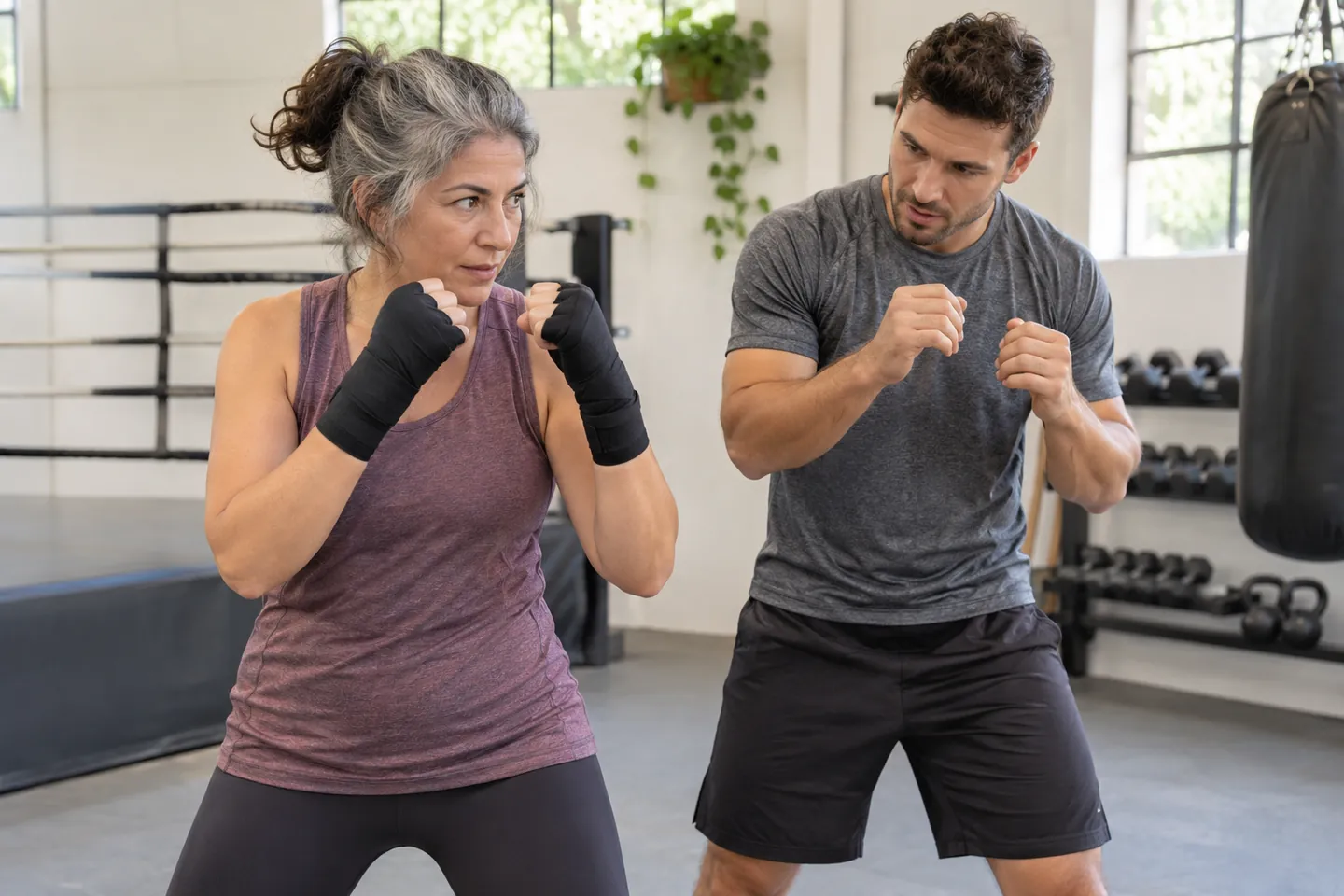
Explore starting boxing over 40 in Mississauga with practical questions about class fit, coaching, noncontact options, pacing, equipment, and a workable routine.
Starting a new activity after 40 can come with questions that have little to do with the activity itself. Will the class assume you already know what to do? Will everyone be much younger? Will you be expected to prove something by keeping up immediately? These are reasonable questions about the learning environment, and they deserve practical answers rather than a slogan about age.
Starting boxing over 40 in Mississauga begins with choosing instruction that fits your goals and present circumstances. People in the same age group can have very different experience, schedules, preferences, and individual needs. Your age provides context, but the coach still needs to understand you as a person who is learning a particular activity.
Decide what you want from boxing now
You may want an engaging class, a new skill, a noncontact activity, or a structured reason to leave the desk at the end of the day. Write the goal in plain language. It does not need to sound competitive or ambitious to be useful.
A clear goal helps you ask better questions. “I want to learn basic boxing technique without sparring” tells a gym more than “Am I too old?” The first statement points toward class format and instruction. The second invites a broad reassurance that may not answer your actual concerns.
Your goal can change later. You are choosing a starting point, not signing a permanent definition of what boxing must mean in your life. Give yourself permission to begin with curiosity and a manageable commitment while you learn whether the routine suits you.
Ask how beginners are taught
Find out whether the class welcomes adults with no boxing experience and how the instructor introduces the basics. Ask whether a new participant receives help with stance, wraps, equipment, and the language used in the session. These practical details matter more than a general claim that everyone is welcome.
Ask how the coach handles different levels within a group. You want to understand whether a drill can be simplified, how questions are answered, and what happens when someone needs another demonstration. The answer can help you judge whether the format supports learning at your starting point.
Avoid assuming that a class with younger participants is automatically unsuitable or that an age-specific label guarantees a good fit. Observe the actual instruction and communication. The important question is whether the session’s demands and teaching approach match your needs.
Describe your current experience honestly
Tell the coach what activity you currently do and what is unfamiliar. Someone who walks regularly but has never punched a bag needs a different introduction from someone returning after years of technical training. Neither description requires apology or exaggeration.
Mention relevant limitations and obtain appropriate individual advice if you have health questions about participation. A coach can explain movements and possible class adjustments, but a general fitness conversation should not be treated as a medical assessment.
Be specific about what you need from the first visit. You might want help judging pace, learning the equipment routine, or understanding whether noncontact participation is available throughout the class. Concrete requests give the instructor a better starting point than a broad concern about being older.
Clarify contact before joining a drill
Boxing-related classes can include very different activities. Ask whether the session involves only solo and equipment work, partner drills, or sparring. If you want noncontact training, state what that means for you and ask which activities fit.
Do not assume that beginner status answers every contact question. A drill can be introductory and still involve something you do not want to do. Clear information lets you choose knowingly rather than discovering the expectations while everyone is pairing up.
Respect your own current preference. You do not need to agree to contact to demonstrate that you are taking the activity seriously. If the format does not match your goals, ask about another suitable option instead of treating the mismatch as a personal shortcoming.
Make the first session a learning visit
Choose a small objective for the first class. You might aim to understand the starting stance, learn the room’s routine, or identify one useful coaching cue. A manageable objective gives the visit direction without requiring a polished performance.
Expect some mental effort. New terms, unfamiliar equipment, and movement sequences can demand attention even when the physical action looks simple. Give yourself time to listen and ask for clarification. There is no need to compare your first hour with someone else’s established practice.
Observe how the coach responds when you need help. A useful correction should give you something you can try. The first visit is also your opportunity to evaluate whether the explanation style and class structure make learning understandable.
Use a pace that lets you stay engaged
Follow the instructor’s guidance and begin with room to adjust. Notice whether you can keep track of the sequence, return to the taught position, and hear feedback. If the task becomes unclear as the pace increases, communicate and ask for a suitable change.
Do not make age the explanation for every difficult moment. A new combination may be confusing because it is new. A rushed arrival may affect your attention. Describe what happened so the coach can identify the actual issue rather than relying on a broad assumption.
At the same time, do not ignore your experience to prove that age is irrelevant. If you need a pause, an equipment adjustment, or a different version of a drill, ask. Thoughtful participation includes responding to the present task and your circumstances honestly.
Let fundamentals be interesting
Stance, short steps, hand returns, and simple straight punches provide plenty to learn. A fundamentals class does not need to feel like a waiting room for more exciting material. It can be a place to notice how small changes affect the whole movement.
Ask the coach for one priority at a time. For example, you might focus on finishing a short sequence in a recognisable stance. That creates a clear question for practice and makes feedback easier to use.
Resist the pressure to progress through a large list of techniques quickly. Familiarity grows through repeated, understandable practice. The number of movements you have been shown is less useful than your ability to explain and rehearse the current lesson with appropriate guidance.
Choose equipment around the actual class
Before buying gloves or accessories, ask what the gym requires and whether introductory equipment is available. The appropriate choice depends on the activities and the fit, not simply your age or a marketing category.
Try the required setup with help if needed. Ask about wraps, glove fit, closure, and footwear. If something pinches, shifts, or feels awkward, raise the issue before continuing. Equipment should support the task rather than become another uncertainty you quietly tolerate.
Keep the bag simple and ready. Bring what the session requires, unpack damp items afterward, and follow the manufacturer’s care instructions. A dependable preparation routine gives you more time to focus on the lesson when you arrive.
Fit the routine into an ordinary week
Adults often balance training with work, caregiving, commuting, and other responsibilities. Look at the actual time required for a class, including travel, changing, wrapping, and getting home. A schedule that works only when nothing else goes wrong may be difficult to sustain.
For a Mississauga routine, compare the practical journey at the time you would attend. Do not judge a location only by how close it looks on a map. The usable class is the one you can reach with enough margin to arrive ready.
Begin with a schedule you can review after several visits. You do not need to match another participant’s frequency. Once you understand how training fits your week, discuss whether a change would support your goals.
Measure progress by clearer participation
Early progress may appear as knowing where to stand, understanding a cue, or finding your stance without looking down. These are meaningful changes because they reduce the mental effort of participating and create room for the next lesson.
Keep a brief note after class if it helps. Record one thing that became clearer and one question for the next visit. This can provide a more balanced view than judging the session solely by effort or comparing yourself with experienced classmates.
Ask the coach for a review after you have attended several times. Which skill should take priority? Does the current class remain appropriate? What would a useful next step look like? Those questions keep progression tied to your actual learning.
Choose a beginning you can own
You can read the boxing information and use the free trial enquiry to ask about current beginner options. Explain your goals, your experience, and the practical questions that matter to you. A specific conversation is more valuable than trying to decide from a distance whether someone over 40 belongs in a boxing gym.
The first step is not to perform a younger version of yourself or to prove an age-related point. It is to learn a new activity in a setting that fits. Clear instruction, manageable expectations, and a workable next appointment give that beginning a practical shape.
Filed under
Keep exploring
More training insights await.