
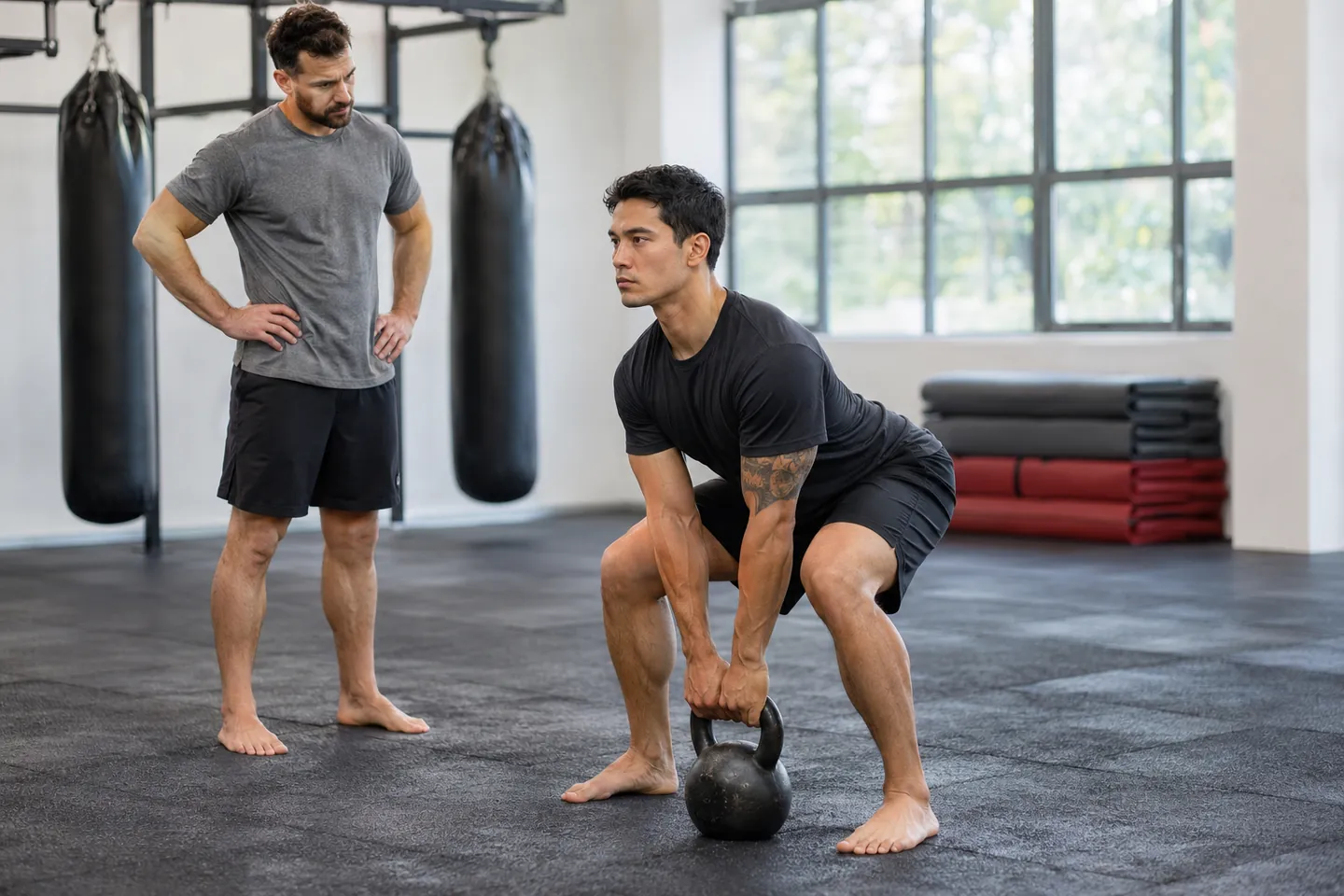
How strength training can support boxing, Muay Thai, BJJ and MMA in Mississauga: key movement patterns, weekly scheduling, recovery and avoiding common mistakes.
There is an old argument in combat sports gyms about whether lifting weights makes fighters slow, stiff and bulky. You may still hear echoes of it today. Most modern coaches have moved past that debate, though. The more useful question is not whether martial artists should do strength work, but what kind, how much and where it fits in an already demanding week.
Strength training for martial artists in Mississauga often looks different from a typical bodybuilding or powerlifting program. The goal is not to build the biggest muscles or lift the heaviest weights possible. It is to become more robust, more resilient and better able to express the skills you learn in boxing, Muay Thai, jiu-jitsu or MMA. Strength should serve your martial art, not compete with it.
This article outlines the principles behind that kind of training. It is general guidance. A qualified coach who knows your sport, history and schedule is the best person to build a program for you.
What strength actually does for a martial artist
Martial arts are skill-based activities. No amount of lifting will replace hours of practice on the mats or the bag. Strength training works in the background, supporting that practice in several ways.
First, it can help your body tolerate the demands of training. Grappling places heavy loads on the neck, back, hips and grip. Striking involves repeated rotation and impact through the shoulders, wrists and knees. Building strength in the muscles and connective tissues around these areas may help them handle the work. Second, strength contributes to qualities like stability and balance, which matter when someone is pushing, pulling or trying to take you down.
Third, being stronger can make some techniques feel easier to execute, especially in grappling, where controlling a resisting partner involves real force. Strength does not replace technique, but a technically sound martial artist with a solid strength base often has more options available than one without.
The movement patterns that matter
Rather than thinking in terms of individual muscles, many coaches organise strength programs around movement patterns. These typically include a squat or knee-dominant pattern, a hinge or hip-dominant pattern, pushing, pulling, carrying and rotating or resisting rotation.
Each of these maps onto martial arts movements. The hinge is central to level changes, sprawls and lifting a partner. Squatting builds the leg strength that supports stance and explosive movement. Pulling strengthens the back and grip, which matter enormously in clinch work and grappling. Pushing supports framing, posting and striking. Carries build grip, trunk stability and general toughness. Anti-rotation work helps you stay stable while absorbing or generating force.
A well-rounded program touches each of these regularly. It does not need to be complicated. A handful of exercises, done well and progressed sensibly, can cover the essentials.
Exercises commonly used
The exact exercises depend on your experience, equipment and any limitations. Some common choices include goblet squats, split squats and step-ups for the knee-dominant pattern; kettlebell deadlifts, Romanian deadlifts and hip thrusts for the hinge; push-ups, landmine presses and dumbbell presses for pushing; rows, pull-ups and band pull-aparts for pulling; and farmer’s carries or suitcase carries for loaded carrying.
For trunk work, exercises like dead bugs, side planks, Pallof presses and various carries train the body to resist unwanted movement, which is arguably more useful for martial artists than endless crunches. Neck strengthening exercises are sometimes included for grapplers and strikers, but these should be introduced carefully and under supervision.
Unilateral exercises, which work one side at a time, deserve a place in most martial artists’ programs. Combat sports are rarely symmetrical, and working each side independently can help address imbalances and improve stability.
Fitting strength around skill training
The biggest challenge for many martial artists is scheduling. If you already attend several classes a week, adding heavy lifting can quickly lead to fatigue. The key is to treat strength training as a supporting element and plan it so it does not interfere with your skill development.
A common approach for recreational martial artists is two strength sessions per week, often on days with lighter skill training or on separate days entirely. Sessions can be relatively short, perhaps forty-five minutes to an hour, focused on a few key exercises rather than an exhaustive routine.
Pay attention to sequencing. Heavy leg work right before a jiu-jitsu class may leave you sluggish on the mats. A demanding upper-body session the night before sparring could affect your guard. Many people find it works best to lift after skill training on the same day, or on separate days with enough recovery in between. Experiment and notice how your body responds.
Strength through the training year
Your training demands are not the same all year. There may be periods when you train skills intensely, perhaps preparing for a grading or competition, and periods when you have more room for strength work. Adjusting the balance across the year is sensible.
During heavier skill phases, strength training might focus on maintenance: fewer sessions, moderate loads and an emphasis on staying healthy. During lighter phases, you might increase volume or intensity to build strength. This approach, sometimes called periodisation, does not need to be complicated for recreational athletes. Simply being aware of your overall load and adjusting accordingly goes a long way.
Life outside the gym matters too. Busy periods at work, family commitments and seasonal changes, like the shift to darker evenings in Mississauga as fall arrives, all affect how much you can handle. A flexible plan adapts to these realities rather than ignoring them.
Technique first, load second
In strength training, as in martial arts, technique comes first. Learning to squat, hinge and press with good form before adding significant weight reduces the risk of injury and builds a better foundation for progress.
Work with a coach to learn the main lifts. Have someone watch your form and give feedback. Start with weights that allow you to complete every repetition with control, and increase gradually. Rushing to lift heavy is one of the most common reasons people get hurt in the weight room.
This mindset should feel familiar to martial artists. You would not try a complex submission before learning the basic positions, or spar at full intensity before mastering your guard. Strength training follows the same logic.
Power and speed
Martial arts demand more than raw strength. Explosive movements like takedowns, sprawls and strikes require power, which combines strength with speed. Many programs for combat athletes include exercises designed to develop this quality.
Examples include medicine ball throws, jumps, kettlebell swings and some Olympic lifting variations. These exercises train your body to produce force quickly. They should be done when you are fresh, usually early in a session, with an emphasis on quality rather than fatigue.
Power training carries its own risks, particularly with jumping and throwing movements. Learn them under supervision, start with low volume and make sure you have a solid strength base before adding significant explosive work.
Recovery is not optional
Combining martial arts and strength training creates a substantial workload. Recovery is where your body adapts to that work. Without enough recovery, progress stalls and the risk of injury rises.
Sleep is the foundation. Most adults benefit from consistent, adequate sleep, and people who train hard often feel the effects of poor sleep quickly. Nutrition also matters, including enough overall energy, protein and carbohydrates to support training. Managing stress, staying hydrated and taking rest days all contribute.
Pay attention to warning signs. Persistent fatigue, declining performance, frequent minor injuries, poor sleep or loss of motivation can indicate that your overall load is too high. When you notice these signs, reduce intensity or volume for a while. If they persist, consider speaking with a healthcare provider. Our physiotherapy and massage services can also support recovery when you need professional input.
Common mistakes
A few mistakes come up often. One is copying programs designed for bodybuilders or powerlifters without adjusting them for martial arts. These programs can be excellent for their intended purpose but may create too much fatigue or focus on the wrong qualities for combat sports.
Another mistake is doing too much too soon. Enthusiasm leads some martial artists to add several intense strength sessions on top of an already full class schedule. The result is often exhaustion, soreness and declining skill performance. Start small and build gradually.
A third mistake is neglecting certain areas. Some people focus heavily on upper body pressing because it feels productive, while ignoring pulling, hinging and single-leg work. A balanced program covers all the main movement patterns.
Finally, some martial artists skip strength training entirely, believing their classes provide enough. Classes do build fitness and some strength, but dedicated resistance training can address gaps that skill practice alone may not.
Women, older athletes and beginners
Strength training benefits martial artists of all ages, sizes and backgrounds. Women sometimes worry about becoming bulky, but for most people, a well-designed strength program builds strength and resilience without dramatic changes in size. Older athletes may find strength training particularly valuable as part of a long-term approach to staying active, provided it is introduced gradually and adjusted for any health considerations.
Beginners to both martial arts and strength training should start slowly. Focus on learning technique in both areas before increasing intensity. There is no need to rush; consistency over months and years produces far better results than intense short-term efforts.
If you have any medical conditions, injuries or concerns, speak with a healthcare professional before starting a new strength program.
Building your foundation
Strength training is not a replacement for time on the mats, but it can be a powerful complement to it. A thoughtful program, built around key movement patterns, scheduled sensibly and supported by good recovery, can help you train more consistently and enjoy your martial art for years to come.
If you want help building strength that supports your training, our strength and conditioning sessions in Mississauga are designed with martial artists in mind, and personal training offers individual programming if you want something tailored to your sport and schedule. When you are ready, book a free trial and talk with a coach about where to start.
Filed under
Keep exploring
More training insights await.