
A practical look at suspension trainer workouts in Mississauga: how body angle changes difficulty, key exercises, setup safety, and two sample beginner circuits.
Two nylon straps, a pair of handles, and a solid anchor point overhead. At first glance, a suspension trainer looks almost too simple to be useful. Then you try an inverted row at a steep angle, or a single-leg squat while holding the handles for balance, and you begin to understand why these tools have found a permanent place in gyms, studios and home setups.
Suspension training uses your bodyweight as resistance and lets you adjust difficulty by changing your body angle or foot position. Lean further back and a row gets harder; step forward and it gets easier. That makes the same piece of equipment suitable for a complete beginner and a seasoned athlete, often in the same class.
For people training in Mississauga, suspension trainers are a practical addition to a strength routine. They are compact, versatile and gentle on the joints, and they challenge stability and core control in ways that machines often do not. This guide explains how they work, how to set them up safely, and how to build effective workouts around them.
How body angle controls difficulty
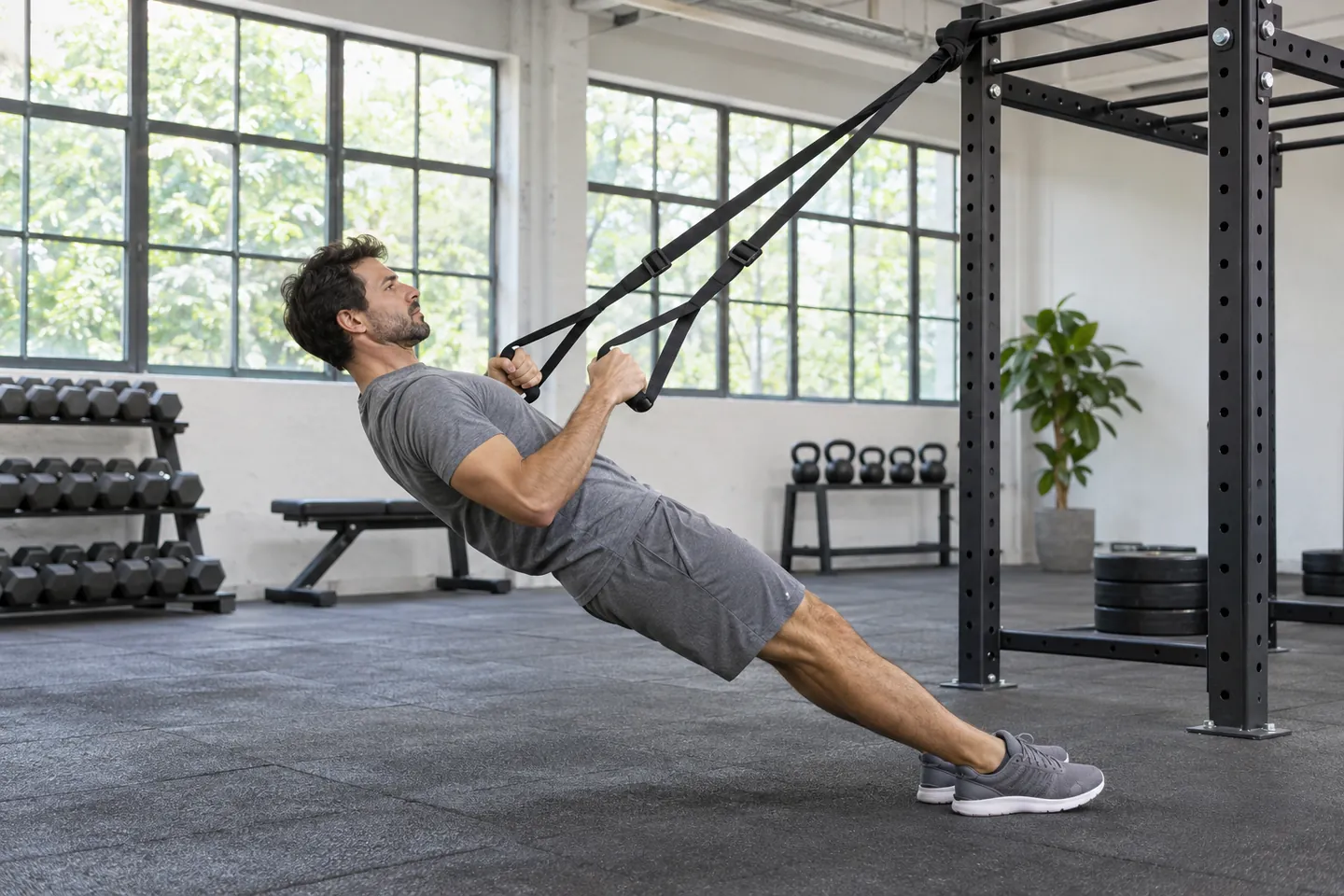
The core principle of suspension training is simple: the more horizontal your body, the more of your weight you are lifting. Standing nearly upright and leaning back slightly during a row means you are moving a small fraction of your bodyweight. Walking your feet forward until your body is closer to parallel with the floor means you are moving much more.
Pushing exercises work the opposite way. In a suspended push-up or chest press, facing away from the anchor, standing more upright makes the exercise easier, while leaning further forward makes it harder. Small changes in foot position can make a noticeable difference.
This adjustability is one of the main reasons suspension trainers are popular. You can tailor each exercise to your current strength, then progress gradually by moving your feet a few centimetres at a time. There is no need to change weights or machines, which keeps workouts moving efficiently.
Stability and the core
Because the straps move freely, your body must work to stay stable. Your shoulders, hips and trunk have to control the movement rather than relying on a fixed path. This can make familiar exercises feel very different and often more challenging.
That instability is a feature, not a flaw. It trains the muscles that support your joints and encourages good alignment. Many people notice that their core is working hard even during exercises that seem to target the arms or legs.
At the same time, instability means technique matters. If your body sags or your shoulders shrug toward your ears, the exercise becomes less effective and potentially uncomfortable. Moving slowly, with control, and maintaining a straight line from head to heels during rows and presses keeps you safe and makes the work count.
Setting up safely
Safety starts with the anchor. Suspension trainers should be attached to a sturdy point designed to hold bodyweight, such as a rig, a strong beam or a purpose-built mount. At a gym, the setup will usually be handled for you. At home, follow the manufacturer’s instructions carefully and avoid improvised anchors such as light fixtures or flimsy door frames.
Check the straps before each session. Look for fraying, damaged buckles or worn handles. Adjust the length so that both straps are even, and make sure the handles are secure. If you are unsure how to adjust the straps, ask a coach to show you.
Give yourself space. Suspension exercises often involve stepping, leaning or moving the body in an arc. Clear the floor of bags, water bottles and other equipment. If you are training in a group, keep a respectful distance from others so straps do not tangle and nobody is accidentally bumped.
Key upper-body exercises
The inverted row is one of the most valuable suspension exercises. Holding the handles and leaning back with straight arms, you pull your chest toward your hands while keeping your body straight. It trains the upper back, shoulders and biceps, and it is an excellent counterbalance to pushing exercises.
The chest press is the mirror image. Facing away from the anchor, you hold the handles in front of you, lean forward, lower your chest between your hands and press back up. It feels similar to a push-up but with more demand on shoulder stability.
Other useful upper-body options include the Y-raise and T-raise, which target the muscles around the shoulder blades, and the face pull, which helps posture and shoulder health. These exercises can be done at an easy angle to start and progressed gradually.
Key lower-body exercises
Suspension trainers are often associated with upper-body work, but they are just as useful for the legs. The assisted squat is a great entry point. Holding the handles lightly in front of you, you sit back into a squat and stand up, using the straps for balance. This helps many beginners learn squat depth and posture.
Lunges, split squats and single-leg squats can all be assisted in the same way. The straps provide support so you can focus on control and range of motion. As you get stronger, rely less on your hands and more on your legs.
Suspended hamstring curls and hip bridges, where your heels rest in the foot cradles while you lie on your back, are more advanced options. They challenge the hamstrings and glutes and require good core control. Start with small ranges and progress carefully.
Core-focused movements
Several suspension exercises focus directly on the core. Planks with feet in the cradles are significantly harder than regular planks because the straps move. Even holding still requires constant small adjustments.
The suspended knee tuck builds on that plank. From the plank position, you bring your knees toward your chest, then extend back out. The pike is a more advanced version, where you keep your legs straight and lift your hips toward the ceiling.
Fallouts are another option. Standing and facing the anchor, you hold the handles and lean forward while extending your arms overhead, then pull back to the start. This works the core in a way similar to an ab wheel, and the difficulty can be adjusted by changing your foot position.
Sample beginner circuit
Here is a simple circuit to try once you are comfortable with the basic exercises. Perform each exercise for about thirty to forty seconds, rest for twenty seconds, and move to the next. Complete two or three rounds.
- Inverted row at a moderate angle.
- Assisted squat.
- Chest press at a comfortable angle.
- Assisted reverse lunge, alternating legs.
- Face pull.
- Plank with feet on the floor and forearms on the ground beside the straps, or a gentle fallout.
Focus on smooth, controlled movement. If you cannot maintain good form for the full interval, adjust your angle or slow the tempo. The aim is consistent quality across the whole circuit.
Sample intermediate circuit
Once the beginner circuit feels manageable, you can progress to more challenging exercises and angles. Try this version with the same timing:
- Inverted row with your feet further forward.
- Single-leg assisted squat, alternating legs each round.
- Chest press at a steeper angle.
- Suspended split squat with the rear foot in the cradle.
- Y-raise.
- Knee tuck with feet in the cradles.
Allow enough recovery between rounds to maintain good technique. If the circuit is too demanding, swap the hardest exercises for easier versions until you build more strength and control.
Combining suspension work with other training
Suspension trainers work well as part of a broader program. They can serve as a warm-up, an accessory block after heavier lifting, or a main session on days when you want lower-impact work. Many people use them to complement free weights and machines.
For combat sports athletes, suspension exercises can build shoulder stability, grip endurance and core strength that support striking and grappling. A few rounds of rows, presses and core work after a technical boxing or Muay Thai class can be a time-efficient way to add strength training.
If you prefer guided sessions, a strength and conditioning class may include suspension work alongside other tools. Coaches can show you how to set up and progress each exercise safely.
Progressing without adding weight
Since you cannot simply load another plate onto a suspension trainer, progress comes from other variables. Changing body angle is the most obvious, but it is not the only one. Slowing the lowering phase of a row or press to three or four seconds makes the same angle noticeably harder. Pausing for a second at the top of a row, with the shoulder blades squeezed together, adds another layer of challenge.
Reducing your base of support is another option. A row performed with your feet together is harder than one with your feet hip-width apart, because your body must resist more rotation. Moving from two legs to one in a squat or lunge variation shifts the demand dramatically. Single-arm rows and presses take that idea further and ask a great deal of the core.
Make one change at a time and keep notes on what you did. Writing down the foot position, the tempo and the number of repetitions gives you a clear record to beat in later sessions. Without that record, it is easy to drift between easy and hard versions at random and lose track of real progress.
Common mistakes to avoid
Letting the hips sag during rows and presses is one of the most common errors. Keep your glutes and core engaged so your body stays straight. If you cannot hold the line, step to an easier angle.
Another mistake is letting the straps rub against your arms during exercises. Most suspension exercises work best with the straps hanging freely. If you feel rubbing, adjust your hand position or strap length.
Finally, avoid using momentum. Swinging your body to finish a row or bouncing out of a squat reduces the effectiveness of the exercise and increases the risk of strain. Slow, controlled movement is safer and builds better strength. If you have a past shoulder, wrist or back injury, check with a qualified health professional before trying more demanding variations.
Trying suspension training in Mississauga
Suspension trainers are an accessible way to build strength, stability and confidence. They work for beginners and experienced trainees alike, and they fit easily into busy schedules because setup is quick and exercises flow smoothly from one to the next.
At Konga Fitness in Mississauga, personal training sessions can introduce suspension exercises tailored to your level and goals. If you would like to see how they fit into your routine, book a free trial and ask a coach to walk you through the basics.
Filed under
Keep exploring
More training insights await.