
How Mississauga parents can teach kids self-defence awareness calmly, from noticing surroundings and using a strong voice to setting boundaries and asking for help.
“What would you do if someone you didn’t know asked you to help find their dog?”
A question like that, asked calmly over dinner or on the drive home from school, can open one of the most useful conversations a parent has with a child. It is not meant to frighten. It is meant to start your child thinking, in a relaxed setting, about what they might notice, say, and do in situations that feel uncertain.
Self-defence for children is often imagined as a set of physical moves. Those have their place, and a good martial arts class teaches them with care. But for most kids, most of the time, the more valuable skills are awareness, boundaries, a confident voice, and knowing when and how to get help. This article looks at how families in Mississauga can build those skills at home, and how structured classes can reinforce them.
Awareness before techniques
Self-defence awareness starts with noticing. Can your child describe where they are, who is around them, and where they would go if they needed help? These are not complicated questions, but many children have never been asked to think about them deliberately.
You can practise this in ordinary settings. At a park, ask your child to point out where the washrooms are, which adults look like they work there, and how you would find each other if you got separated. At a shopping centre near Square One or any busy plaza, talk about what store staff look like and where the information desk is. Keep it light and conversational rather than turning it into a test.
Over time, this kind of noticing becomes a habit. A child who naturally scans their surroundings is better prepared to recognise when something feels off, and better positioned to move toward help.
Teaching the idea of trusted adults
Children need to know who they can turn to. Many families talk about “trusted adults,” a small group of people a child can go to with problems or concerns. That might include parents, grandparents, teachers, coaches, or close family friends.
It is also useful to discuss which strangers are generally safer to approach if a child is lost or needs help. Many safety educators suggest looking for a worker in uniform, a staff member behind a counter, or a parent with children. Discuss this with your child in your own words and in the context of places they actually visit.
Avoid teaching that all strangers are dangerous. Most people children encounter are kind, and a child who is afraid of every unfamiliar adult may hesitate to seek help when they need it. The goal is thoughtful judgment, not fear.
Practising a strong voice
A confident voice is one of the most practical tools a child can have. Saying “No,” “Stop,” or “Leave me alone” clearly and loudly can draw attention, signal confidence, and create space. Many children, especially those who are naturally quiet, have never practised using their voice this way.
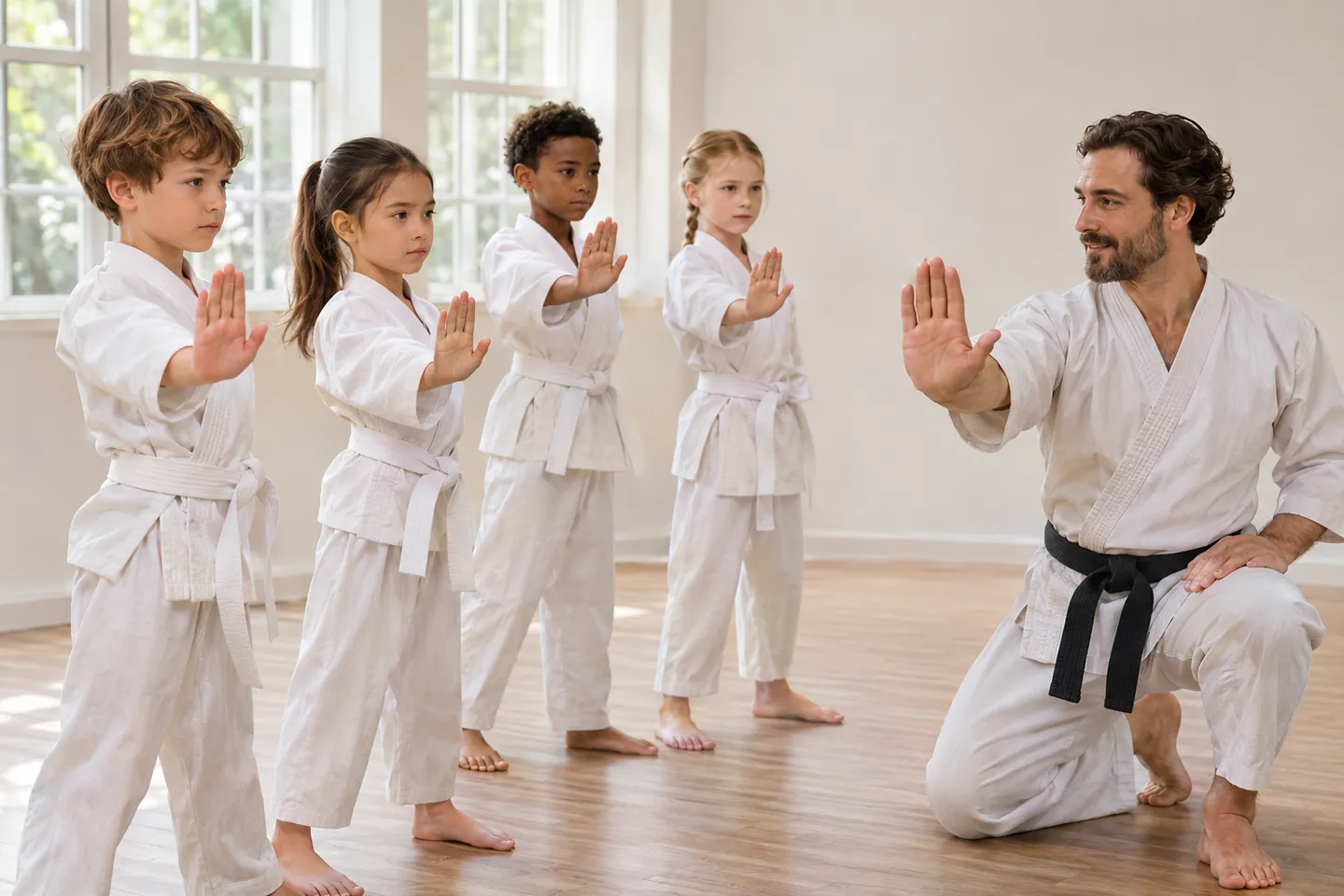
Make it a game at home. Stand a few steps apart and have your child practise saying a firm “Stop!” with their hands raised and palms open. Encourage them to stand tall and look up. Then switch roles. Children often find this fun, and the repetition builds familiarity with a voice they may not use in everyday life.
In martial arts classes, instructors frequently include this kind of voice work. Kids practise strong verbal boundaries alongside movement, which helps connect confidence in the body with confidence in speech.
Body boundaries and consent
Teaching children that their body belongs to them is an important part of self-defence awareness. Kids should know they can say no to unwanted touch, even from people they know, and that they should tell a trusted adult if someone makes them uncomfortable.
Model this at home in simple ways. Ask before hugging, respect a child’s “no” during tickling games, and avoid forcing affection with relatives. These small actions teach children that their boundaries matter and that adults will listen to them.
Talk about the difference between safe secrets, such as a surprise birthday gift, and unsafe secrets that make them feel worried or confused. Make it clear that they will never be in trouble for telling you about something that made them uncomfortable. If you have concerns about your child’s safety or wellbeing, contact appropriate professionals or authorities for guidance.
Role-play without drama
Role-playing gives children a chance to practise responses before they need them. Keep scenarios age-appropriate and calm. For younger children, you might practise what to do if they get separated from you at a store. For older children, you might discuss what to do if someone they do not know offers them a ride or asks them to keep a secret.
After each scenario, talk about their choices. What did they notice? What did they say? Who would they go to for help? Praise good thinking rather than looking for perfect answers. The aim is to build a calm, practical response, not to rehearse fear.
Repeat scenarios occasionally, perhaps every few months. Children grow and their world expands, so the situations worth discussing change too. A conversation that suited a six-year-old may need updating for a ten-year-old who is starting to walk to school with friends.
Online awareness counts too
For many children, the online world is as much a part of their lives as the playground. Self-defence awareness extends there as well. Kids should know not to share personal information, such as their full name, school, or address, with people they meet online.
Discuss what to do if someone online makes them uncomfortable, asks for photos, or pressures them to keep conversations secret. The answer, again, is to tell a trusted adult. Make sure your child knows they will not lose device privileges simply for reporting something worrying.
Keep devices in shared spaces where possible, especially for younger children, and stay curious about the apps and games they use. Approach it as a partnership rather than a surveillance exercise.
Physical skills in their proper place
Physical self-defence skills can be valuable for children, but they should be taught by qualified instructors in a structured setting. Typical skills for kids might include maintaining balance, breaking free from a grab, creating distance, and moving toward safety. The emphasis is usually on escaping and getting help, not on fighting.
In a good kids class, these skills are taught with control and care. Partners practise at a safe pace, and instructors closely supervise contact. Children learn that physical techniques are a last resort, used only when they cannot get away or get help in other ways.
Avoid teaching physical techniques you have seen online without proper instruction. Children may misremember details or apply them at the wrong time, such as during play with friends. Leave technical teaching to experienced instructors who can provide feedback and context.
How martial arts classes support awareness
Structured martial arts training offers more than techniques. Classes typically build focus, discipline, body awareness, and confidence. Children learn to follow instructions, work respectfully with partners, and manage emotions when things get challenging. These qualities support self-defence awareness in quiet but meaningful ways.
Many children who participate in martial arts become more comfortable standing tall, making eye contact, and speaking clearly. Those changes do not happen overnight, but over months of regular classes they can be noticeable. Instructors often reinforce safety messages that parents discuss at home, which helps them stick.
Our kids martial arts classes include age-appropriate lessons on awareness, confidence, and respect alongside physical skills. Children train in a supervised environment where safety and control are always the priority.
Matching lessons to age
What you teach should reflect your child’s age and maturity. A four-year-old might learn their full name, a parent’s phone number, and to stay close in busy places. A seven-year-old might practise using a strong voice and identifying trusted adults. A twelve-year-old might discuss online safety, peer pressure, and what to do if a situation with friends begins to feel unsafe.
Pay attention to how your child responds. Some children absorb these conversations easily; others become anxious. If your child seems worried, slow down and emphasise that these are just good habits, similar to looking both ways before crossing the street. Reassurance is just as important as information.
Revisit topics as your child grows. Safety awareness is not a single conversation but a series of small ones over many years.
Getting to and from school
The school commute is one of the most natural places to practise awareness. Whether your child walks, takes the bus, or gets dropped off, talk through the route together. Which streets do they use? Where would they go if something felt wrong along the way? Are there houses of family friends, a school crossing guard, or a busy store they could head toward?
As children get older and start walking with friends or on their own, these conversations become more important. Agree on a clear plan for what happens if a ride does not arrive, if a friend wants to change the route, or if the weather turns bad on a January afternoon. Some families use a simple code word that a child can ask for if anyone unexpected offers to pick them up.
Keep the plan practical and review it at the start of each school year. A new school, a new bus route, or a new after-school activity are all good reasons to walk through it again.
Keeping the tone positive
The most effective safety conversations tend to be calm, brief, and woven into everyday life. Long, serious lectures can overwhelm children and make the topic feel frightening. Short, practical exchanges are easier to absorb and remember.
Focus on what your child can do rather than what might happen to them. “If you get lost, go to someone at a counter” is more empowering than a list of dangers. Children who feel capable are more likely to respond thoughtfully when something unexpected occurs.
Celebrate the skills they show in everyday life. If your child notices something, speaks up confidently, or asks for help appropriately, acknowledge it. Those moments reinforce that the skills matter and that they are capable of using them.
Building confidence together
If you would like your child to develop confidence, awareness, and physical skills in a supportive environment, explore our kids martial arts program and see what fits on the kids schedule. Families are welcome to book a free trial so your child can experience a class first. Conversations at home and practice on the mat work best together, each reinforcing the other as your child grows.
Filed under
Keep exploring
More training insights await.