
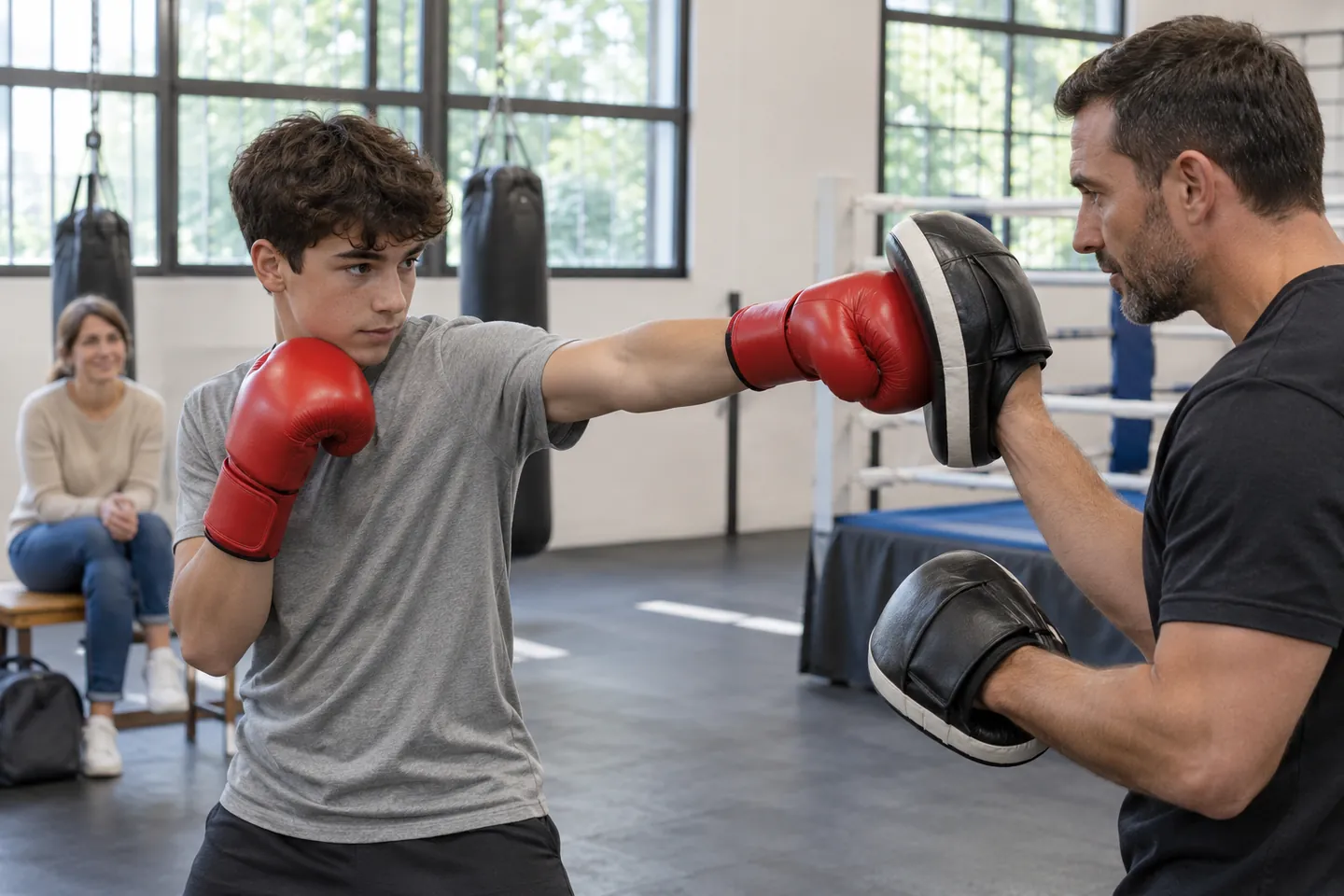
A practical parent's guide to teen boxing classes in Mississauga: safety, contact levels, equipment, coaching quality, school balance and what to ask first.
Your teenager comes home and announces they want to box. Maybe a friend started, maybe they watched a few fights online, or maybe they just want something more physical than another season of the sport they’ve played since grade three. Whatever the reason, the request probably raised a few questions for you: Is it safe? Will they get hit? Is this a phase? And where do you even start looking?
Those are all fair questions. Boxing has a reputation that doesn’t always match what happens inside a well-run youth program. For many teens, boxing classes in Mississauga are mostly about fitness, footwork, discipline and learning technique on pads and bags, with contact introduced slowly and only under close supervision.
This guide is written for parents. It covers what teen classes typically involve, how to judge a gym and coaching team, the gear your teen will need, and how to support them without becoming the sideline parent they’re embarrassed by.
Why teenagers are drawn to boxing
Teenagers often want challenges that feel grown-up. Boxing offers a clear, demanding skill set and a training culture built on effort and respect. It’s individual enough that your teen’s progress depends on them, but social enough that they’re part of a group.
For some teens, the appeal is fitness. Boxing training is famously demanding, combining skipping, footwork, bag work and conditioning. For others, it’s confidence or a sense of belonging. A teen who has never felt at home in team sports may find that a boxing gym offers a different kind of community.
Some teens also want a healthy outlet for stress. Hitting pads with focus and intention can feel satisfying in a way that’s hard to describe. That said, a good gym will emphasize control and discipline, not aggression.
What a teen class usually involves
A typical class starts with a warm-up: skipping, jogging, dynamic stretches and footwork drills. Then comes technique work, where coaches teach and refine punches, defensive movements and stance. Teens might practise in the air (shadowboxing), on heavy bags, or on pads held by a coach or partner.
Conditioning often finishes the class, with exercises like push-ups, core work and short intervals. The pace is challenging but should be appropriate for the group. Teens of different ages and fitness levels may be in the same class, so good coaches give options to scale up or down.
Many teen programs separate beginners from more experienced students, or at least group them differently within class. Ask how the gym handles that, especially if your teen is brand new.
Contact, sparring and how it’s introduced
This is usually the biggest question for parents. In most recreational youth boxing programs, contact is not something that happens on day one. Beginners spend weeks or months learning the basics without any sparring. When contact is introduced, it typically starts with very light, technical drills where partners take turns attacking and defending at a slow pace.
Sparring, if offered, should always be supervised, optional, matched carefully by size and experience, and done with proper protective equipment. Many teens train for a long time without ever sparring, and that’s perfectly fine. Fitness-focused boxing classes may not include any contact at all.
Ask the gym directly: When does contact happen? Is it optional? How are partners matched? What equipment is required? Who supervises? If the answers are vague or you get the sense that beginners are thrown into hard sparring, that’s a red flag.
Safety and head injury awareness
Any contact sport carries some injury risk, and parents are right to think about head injuries in particular. A responsible youth program takes this seriously through supervision, controlled intensity, appropriate equipment and clear rules. Coaches should know how to recognize warning signs and should stop activity if a concern arises.
Talk to your teen’s doctor if you have specific concerns, especially if your teen has a history of concussion or other health conditions. Your doctor can offer guidance based on your teen’s individual situation. Share any relevant medical information with the coaching staff.
It’s also worth teaching your teen to speak up. If they feel unwell, dizzy, or just uncomfortable with a drill, they should tell a coach immediately. A good gym culture encourages that kind of communication and never treats it as weakness.
Judging the coaching
Coaches make or break a youth program. Look for coaches who explain clearly, watch closely, correct technique patiently and keep the room organized. They should know students’ names and adjust drills for different ability levels.
When you visit, notice how coaches speak to teens. Are they encouraging but firm? Do they enforce rules about control and respect? Do they stop drills when things get sloppy? These are signs of a coach who prioritizes learning and safety.
You can also ask about the gym’s policies on supervision, how many coaches are present during teen classes, and how they handle conflicts between students. Clear answers suggest a well-organized program.
Gear your teen will need
Most beginner teens need a few basic items: hand wraps, boxing gloves that fit properly, a mouthguard and comfortable athletic clothing with supportive shoes. Some gyms have loaner gloves for first classes, but owning a pair is more hygienic in the long run.
If contact is introduced later, additional gear such as headgear and groin protection may be required. The gym should tell you what’s needed and when. Don’t buy everything at once; start with essentials and add equipment as your teen progresses.
Fit matters. Gloves that are too large or small can be uncomfortable or less protective. A coach can usually advise on sizes. A good mouthguard should fit snugly; some families choose a custom one from a dentist for comfort.
Balancing boxing with school and life
Teens in Mississauga often juggle a lot: homework, part-time jobs, other sports, family commitments and the occasional long bus ride. Two or three boxing classes a week is a common rhythm that leaves room for everything else. Check the kids schedule to see how sessions line up with the end of the school day.
Exam periods may require a temporary reduction. That’s normal. Encourage your teen to talk to their coach rather than simply disappearing. Many coaches appreciate a heads-up and will help them ease back in afterward.
Sleep and nutrition matter too. Training hard on too little sleep can leave teens drained. You don’t need to become a sports nutritionist, but regular meals, water and decent sleep make a noticeable difference in how they feel during class.
What teens can gain beyond fitness
Parents often notice changes that have little to do with punching. Teens may become more disciplined about showing up, more respectful toward adults and peers, and more confident in their ability to stick with something hard.
Boxing also teaches a particular kind of composure. Learning to stay calm, breathe and think while tired is a skill that can carry over into exams, job interviews and other stressful moments. That doesn’t happen overnight, and it’s not guaranteed, but it’s something many families observe over time.
Friendships formed in the gym can be meaningful too. Training alongside others who work hard creates a sense of shared effort, and many teens find a supportive peer group they might not have found elsewhere.
How to be a supportive parent
Your role is to encourage, not to coach. Let the coaches handle technique and correction. Ask your teen about class in open-ended ways: “What did you work on today?” is more inviting than “Did you get better?”
Avoid comparing them to other students or pushing them toward sparring before they’re ready. Some teens move quickly; others take time to build confidence. Both paths are fine.
Respect their independence too. Teens often want to own their training. Offering rides, buying gear when needed and showing interest without hovering usually strikes the right balance.
Questions to ask before signing up
When you contact a gym, consider asking:
- How are teen classes structured, and how are beginners supported?
- When and how is contact introduced, and is it optional?
- What protective equipment is required?
- How many coaches supervise each class?
- How do you handle injuries or health concerns?
- Can my teen try a class before committing?
The answers will help you decide whether the program suits your family. Most good gyms are happy to answer questions and may invite you to watch a session.
Reading the first month honestly
The first few weeks of any new activity are uneven. Your teen may come home buzzing after one class and grumbling after the next. Sore shoulders, tired legs and frustration with footwork are all ordinary parts of the beginning. Try not to read too much into a single evening in either direction.
A more useful approach is to check in after about a month. Is your teen still willing to go without being pushed? Do they talk about specific things they learned, like a new combination or a defensive move? Have they started to recognize the coaches and other students? Those are good signs that the program is working for them, even if they still find it hard.
If the answer is mostly no, that’s useful information too. Some teens discover boxing isn’t for them, and that’s fine. Others might enjoy a different format more, such as Muay Thai or Brazilian jiu-jitsu. Trying something and choosing to move on is a reasonable outcome, and it still teaches your teen something about what they enjoy and how they like to learn.
Getting started
If your teen is curious about boxing, the easiest way to find out whether it suits them is to try a class. Watch how they respond, ask them how it felt, and talk with the coaches afterward.
At our Mississauga gym, we offer kids boxing programs as well as broader kids martial arts classes. You’re welcome to book a free trial or contact us to ask questions about age groups, contact levels and safety policies before your teen steps through the door.
Filed under
Keep exploring
More training insights await.