
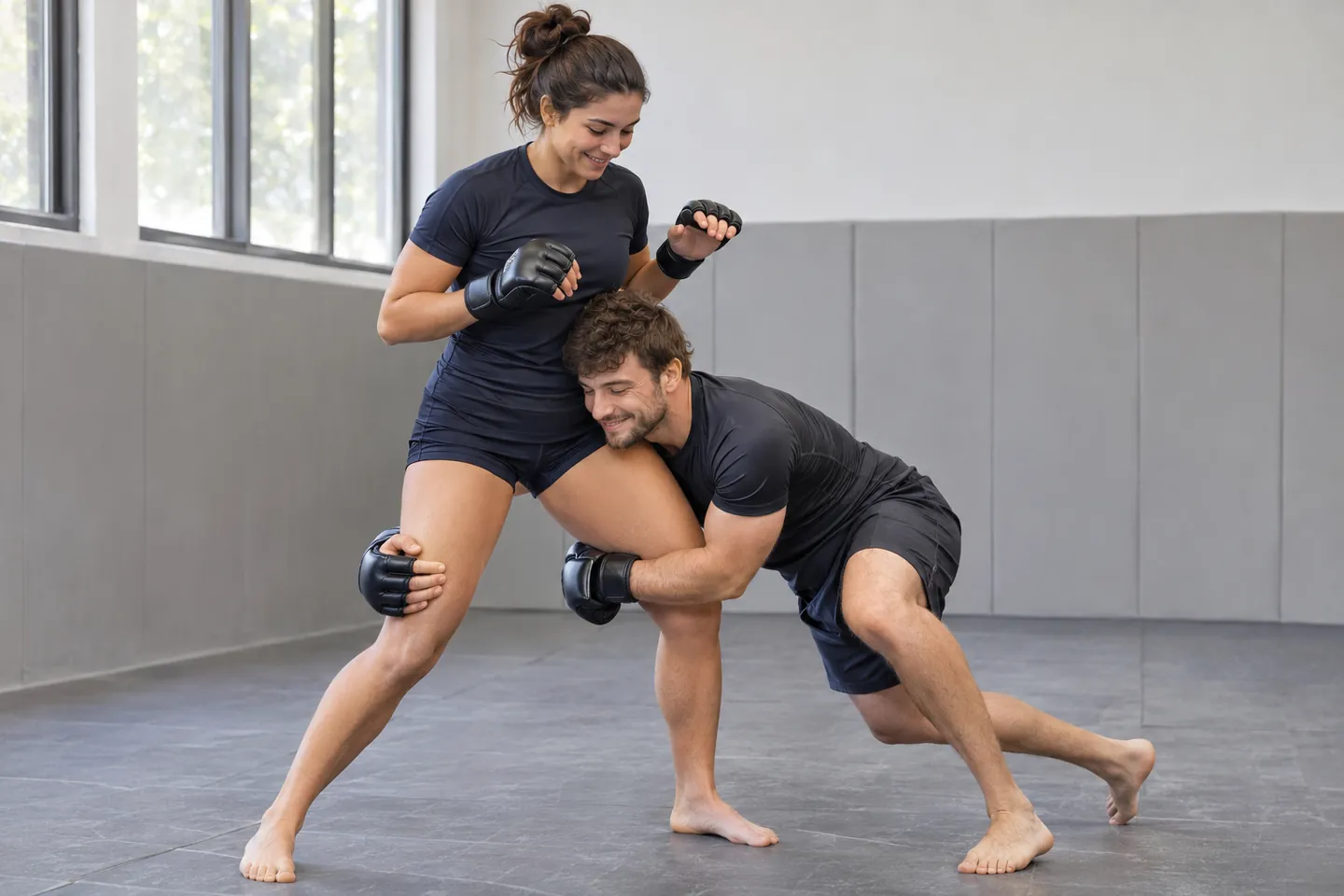
What MMA training looks like in Mississauga when your goal is fitness and skill rather than fighting, including sparring choices, pacing and picking a class.
Mixed martial arts has an image problem. For many people, the words conjure a cage, bright lights and two athletes trying to finish each other in front of a crowd. That picture is real for a small number of professionals, but it says very little about what most people do in an MMA class on a weeknight.
The majority of adults who train MMA in Mississauga are not planning to fight. They are accountants, nurses, warehouse supervisors, students and parents who want an engaging way to get fit, learn something practical, and spend an hour thinking about something other than work. They like that MMA combines striking, wrestling and grappling, which keeps sessions varied and gives the brain as much to do as the body.
If you have been curious but assumed MMA was only for would-be competitors, this post is for you. We will look at what recreational MMA training involves, how to manage contact and risk, what kind of fitness it builds, and how to tell whether a class suits someone who simply wants to train well and go home in one piece.
The honest case for MMA as a workout
MMA classes tend to be physically complete. In a single session you might do footwork and striking combinations, practise takedown entries, work on getting up from the ground, and finish with positional grappling. That variety means you use your legs, hips, core, shoulders and grip, often in ways a standard gym routine does not.
There is also a mental component that keeps people coming back. Learning how a jab sets up a level change, or how to recover guard when someone passes, requires attention. Hours pass quickly when you are solving problems. Many recreational students say this is what finally kept them consistent after years of starting and quitting gym memberships.
It is worth being honest about the trade-offs too. MMA involves contact, and some contact carries risk. A good recreational class manages that carefully, but it will never feel like a spin class. If you want zero physical contact, a fitness-focused striking class or a group class might suit you better, at least to start.
What a typical class looks like
Formats vary between gyms and coaches, so treat this as a general picture. Most classes open with a warm-up that may include skipping, joint mobility, shadowboxing or movement drills such as sprawls and shrimping. This prepares your body for the specific demands of the session rather than just raising your heart rate.
The technical portion usually follows. A coach demonstrates a skill or short sequence, then partners practise it at a controlled pace. In MMA, that might be a striking combination that ends in a clinch, a takedown defence, or a way to stand up safely against the cage or wall. You repeat it many times, gradually adding a little resistance as everyone becomes more comfortable.
Classes often end with some form of live or semi-live work, conditioning rounds, or a cool-down. In a recreational setting, the live portion is usually optional or tightly structured. A good coach will tell you clearly what intensity is expected and will not pressure beginners into full sparring.
Sparring is a choice, not a requirement
The single biggest worry people have about MMA is getting hit in the head. It is a reasonable concern. The good news is that recreational students can train for years with very little hard head contact, and many choose to do exactly that.
There are many ways to practise without heavy sparring. Partner drills with pads and controlled contact let you work timing and distance. Positional grappling, where you start in a specific position and work to improve it, gives you live resistance without striking. Light technical sparring, where both partners agree to low power and focus on movement and defence, can be introduced gradually when you and your coach feel you are ready.
Speak up about your preferences. Tell your coach if you do not want to spar, or if you want to stay at light contact only. In a well-run gym, that request is respected without fuss. Your training partners are also usually happy to know where you stand; most of them have jobs to go to in the morning too.
Fitness benefits you can expect
With consistent attendance, most people notice improvements in general conditioning within a couple of months. Rounds that once left you breathless become more manageable. Your grip, hips and shoulders feel stronger in practical ways. You get better at moving your body through awkward positions, such as getting up from the floor or carrying your weight through a scramble.
MMA can also improve coordination and balance, because so much of it involves shifting your weight while doing something else with your hands. Wrestling-style drills develop leg strength and the ability to stay low and stable. Grappling builds a kind of whole-body endurance that is hard to replicate with machines.
Results depend on many factors, including how often you train, how you sleep and eat, and what your starting point is. We cannot promise specific changes in weight or body composition, and you should be wary of anyone who does. What most students report is that they feel more capable, more energetic and more confident in their bodies over time.
Pacing yourself as a beginner
One common mistake is trying to train every day in the first few weeks. The enthusiasm is understandable, but MMA places demands on your skin, joints and connective tissue that take time to adapt. Two or three classes a week is a sensible starting point for most adults.
Within each class, manage your effort. You do not need to win the warm-up. If you are gasping halfway through, ease off for a round and pick it back up. Coaches would much rather see you complete the session with good technique than burn out early and get sloppy, which is when injuries tend to happen.
Give yourself recovery days. Easy walking, light mobility work or a yoga class can help you feel less stiff between sessions. If you work shifts or have long commutes, factor that into how many classes you schedule. A week with two quality sessions beats a week with four rushed ones.
Choosing training partners wisely
In MMA, your partner shapes your experience. A good partner matches your intensity, communicates, and taps or stops when asked. A poor partner turns every drill into a fight. As a beginner, you are entitled to be selective.
Watch how people train before pairing up for live work. Look for those who are controlled, relaxed and helpful. If someone repeatedly goes harder than agreed, it is perfectly fine to step away or ask the coach for a different partner. You are not being rude by protecting your health.
Be that good partner yourself. Tap early in grappling, keep strikes light when that is the agreement, and check in if you think you caught someone harder than intended. The culture of a room is built by everyone in it, including newcomers.
Protecting your body over the long run
Recreational MMA is meant to be sustainable. That means respecting a few basics. Wear the protective gear your coach recommends, which commonly includes a mouthguard, gloves appropriate to the drill, and shin guards for kicking work. Keep your nails trimmed and your gear clean to protect your skin and your partners.
Strength training outside of class can support joint stability and make you more resilient. A strength and conditioning program that focuses on hips, back, neck and shoulders is especially helpful for grappling-heavy styles. You do not need to lift heavy to benefit; consistent, well-coached work is what counts.
If something hurts beyond normal muscle soreness, do not train through it. Speak with a qualified professional. Konga Fitness has physiotherapy and massage services on site, which some members find convenient for checking in on niggles before they become bigger problems.
How MMA fits with other disciplines
Some people come to MMA after training one discipline, such as boxing or jiu-jitsu, and want to round out their skills. Others start with MMA and later specialise. Both paths are fine. In a gym that offers multiple programs, you can often attend a mix of classes to build your skills from different angles.
If you find you enjoy the striking side most, adding a boxing or Muay Thai class can deepen your hands and kicks. If grappling appeals to you, Brazilian jiu-jitsu classes offer more time on the ground and more detail on positions and submissions. MMA then becomes the place where you learn how those skills connect.
There is no obligation to master everything. Many recreational MMA students simply enjoy the variety and the workout. Over time, you may discover which part of the sport you love most and lean into it.
Questions to ask before you join
When you visit a gym, ask how they handle beginners in MMA. Is there a fundamentals class or a structured introduction? How is sparring introduced, and is it optional? What protective gear do they recommend? These answers tell you a lot about whether the environment suits a fitness-focused student.
Watch a class if you can. Notice whether the coach is attentive, whether partners seem to look after each other, and whether the atmosphere feels focused rather than chaotic. A room full of people laughing between rounds is usually a good sign.
Also consider logistics. If you live in Erin Mills or Malton and work downtown, think about which class times you can realistically reach after work. The adult schedule is a good place to compare options before you commit.
Making it a habit
The difference between people who benefit from MMA and those who do not is rarely talent. It is consistency. Showing up twice a week for a year teaches you far more, and gets you far fitter, than showing up five times a week for a month and then disappearing.
Set a realistic schedule, tell someone about it, and protect those sessions like appointments. Expect some weeks to go sideways because of work, family or winter weather on the roads. When that happens, return the following week without guilt. Your skills will still be there.
Track small wins: the first time you complete a round without stopping, the first time you escape a position you used to get stuck in, the first time a combination flows naturally. Those milestones are more motivating than any number on a scale.
Try a recreational MMA class
If you have been curious about MMA in Mississauga but did not want to train like a professional fighter, a recreational class may be exactly what you are looking for. You get the variety, the challenge and the community without being pushed toward competition.
Take a look at our MMA classes to learn more about how sessions are structured, then book a free trial to see the room for yourself. Tell the coach your goals are fitness and skill, and they can help you start at a pace that suits you.
Filed under
Keep exploring
More training insights await.