
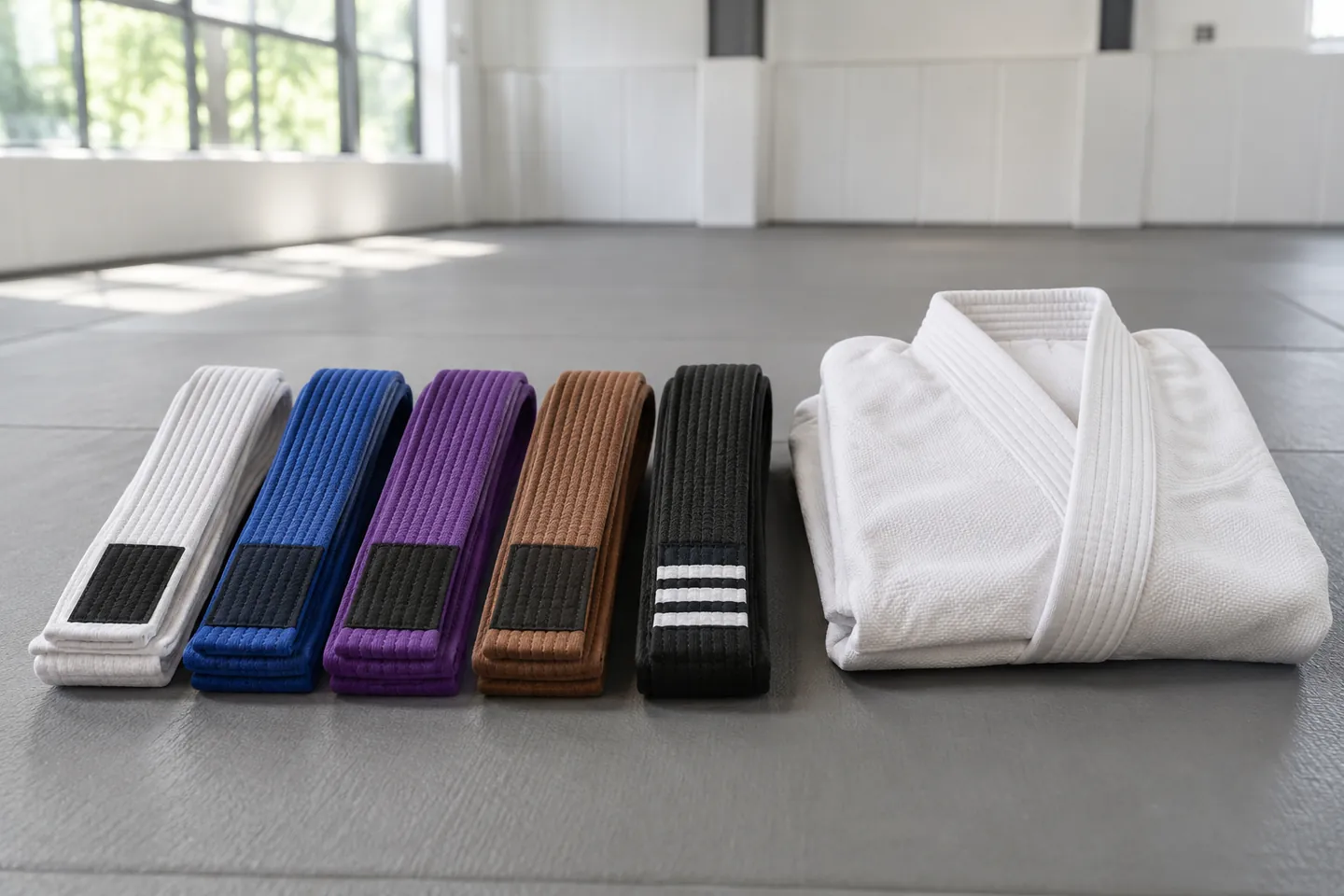
A clear look at the BJJ belt system for Mississauga students: adult and youth belts, stripes, how promotions usually work and why patience matters on the mats.
Walk into a Brazilian jiu-jitsu class and one of the first things you notice is the belts. White belts outnumber everyone else, a few blues and purples move around the room with obvious ease, and perhaps a brown or black belt is leading the warm-up. Newcomers quickly start wondering what each colour means, how long it takes to move up and whether they should care.
Those questions are reasonable. The belt system is part of the culture of BJJ, and understanding it helps you make sense of the room. It also helps to understand what the belts do not mean. For students in Mississauga starting out on the mats, a little background can take away some of the mystery and replace it with realistic expectations.
Below is an overview of how the system generally works, with the caveat that academies differ in their details. Your own instructor is the authority on how promotions happen at your gym, and it is always worth asking them directly.
A ranking system with a reputation
BJJ is known for having relatively few belts and for taking a long time to progress through them. Compared with some other martial arts, where students may move through many coloured belts in their first few years, jiu-jitsu tends to move slowly. That slowness is part of its reputation, and many practitioners see it as a strength.
The reasoning is that each belt is meant to represent a meaningful level of understanding and ability in live grappling. Because students test their skills against resisting partners nearly every class, it is difficult to hold a rank you have not genuinely earned. A blue belt who cannot handle the pressure of a skilled white belt will feel that mismatch quickly.
This creates a culture where belts carry weight but are not the main point. Most experienced practitioners will tell you the real progress happens day to day on the mats, and the belt simply acknowledges it every so often.
The adult belts
For adults, the commonly used sequence is white, blue, purple, brown and black. Many organisations, including the International Brazilian Jiu-Jitsu Federation, set minimum ages for some of these ranks, which is why teenagers moving into the adult system typically start at or around blue belt rather than jumping higher.
White belt is where everyone begins. It is a period of learning the basic positions, surviving, understanding how to escape bad spots and building the habits that keep training safe. Blue belt usually signals that a student has a working understanding of fundamental positions and can apply basic techniques against resistance. Purple belt is often described as the stage where students start to develop their own style and connect techniques into systems.
Brown belt is generally seen as a refinement stage, where gaps are closed and technical detail sharpens. Black belt represents a deep, well-rounded understanding of the art, though most black belts will say it marks the start of a new phase of learning rather than an ending. Beyond black belt, there are degrees and eventually coral and red belts, which are reserved for practitioners with decades of involvement in the art.
Stripes along the way
Because the gaps between belts can be long, many academies use stripes to mark progress within a rank. Stripes are usually small pieces of tape or embroidered bars on the black section near the end of the belt. A common pattern is up to four stripes before promotion to the next colour, though gyms vary in how strictly they follow this.
Stripes can be motivating, especially in the early months. They give you something tangible to show that your instructor has noticed your development. They also give instructors a way to acknowledge consistency and improvement without making a major promotion.
That said, stripes are not a checklist. Some academies award them regularly, others more sparingly. Some students receive a belt promotion without having collected all four stripes. Treat stripes as encouragement rather than a countdown, and try not to compare your stripe count with others who may have very different training histories.
Youth belts
Children and teenagers usually follow a separate belt system before entering the adult ranks. Many academies use a sequence that includes grey, yellow, orange and green belts, sometimes with variations that add white or black bars to each colour. These ranks give younger students more frequent milestones, which suits how children learn and stay motivated.
When young students reach the age where they move into the adult system, their instructor will decide which adult belt reflects their experience. A teenager with years of youth training might move directly to blue belt, while someone who started more recently might begin at white.
If your child trains, it can help to understand that youth promotions often reflect effort, behaviour and attendance as well as technical skill. That is appropriate for their age. Our kids martial arts programs are a good place to ask about how progress is recognised for younger students.
How promotions usually happen
Different academies use different approaches to promotion. Some hold formal grading days where several students are promoted at once. Others promote informally, perhaps at the end of a regular class. Some instructors use structured curricula with technical requirements; others rely mainly on observation over time.
In most cases, instructors look at a combination of factors. These may include technical knowledge, performance in live rolling, consistency of attendance, attitude, how a student treats training partners and how well they understand the principles behind techniques. Competition results can be part of the picture for some students but are rarely required.
If you want to know how your academy approaches promotions, ask. It is a perfectly normal question, and instructors generally appreciate students who want to understand the process. Just be careful to ask about the process rather than lobbying for your own promotion.
Why the timeline varies so much
People often want to know how long each belt takes, and the honest answer is that it depends. Training frequency, prior grappling experience, athletic background, age, consistency, time away for injury or life events and the standards of a particular academy all influence the timeline.
Someone who trains several times a week for years will usually progress faster than someone who trains once a week with long breaks. A former wrestler may move through early stages differently from someone who has never done a combat sport. Two students with similar attendance may still progress at different speeds because they learn differently.
For many Mississauga students juggling work, school, family and commuting, consistency is the factor most within their control. Showing up regularly, even if it is just twice a week, tends to produce steadier progress than intense bursts followed by long gaps.
What a belt does not tell you
A belt colour gives you a rough sense of someone’s experience, but it does not tell you everything. A blue belt who trains five days a week may be close to purple, while another blue belt may have just been promoted. Size, athleticism and age also influence how rolls feel, regardless of rank.
Belts also do not measure character. Some of the most helpful training partners in any room are white and blue belts who are generous with their time and careful with newer members. Respect in BJJ is earned through how you train and treat people, not just through the colour around your waist.
It is also worth remembering that belts from different academies or lineages are not always perfectly equivalent. Standards vary. This is another reason not to place too much weight on rank alone.
The emotional side of ranking
Belt promotions can bring mixed feelings. Some students feel proud and excited. Others feel they do not deserve the new rank, a sensation sometimes jokingly described in BJJ circles as “belt anxiety.” Newly promoted students may feel that everyone expects more from them now and that losing rolls has become more embarrassing.
These feelings are common and usually pass. Your instructor promoted you because they believe you are ready, and the people in the room have generally seen your progress over months or years. Keep training the way you have been, keep asking questions and let the belt settle in.
On the other side, waiting for a promotion can be frustrating, especially if peers seem to move faster. Try to shift your focus to specific skills you want to improve. Progress in those areas will feel satisfying regardless of the colour of your belt, and it is ultimately what leads to promotion anyway.
Etiquette around belts
A few traditions surround belts in most academies. Belts are often tied a particular way, and many instructors show newer students how to do it. Some academies have customs around promotion days, such as a line of students giving light slaps on the back to the newly promoted person. Ask your instructor about local traditions so they do not catch you off guard.
It is also considered polite not to ask other students when they will be promoted or to comment on whether someone deserves their belt. These conversations can create tension in a training room. If you are curious about someone’s journey, ask them about their training rather than their rank.
Keeping the right focus
The belt system gives structure to a long and challenging learning process. It marks milestones, provides encouragement and connects students to a broader tradition. Still, most long-term practitioners agree that the real reward is the daily experience of learning, problem-solving and training with good people.
If you are curious about starting jiu-jitsu, our Brazilian jiu-jitsu classes in Mississauga welcome complete beginners and guide them through the fundamentals at a sensible pace. You can check the adult schedule for class times, and when you are ready, book a free trial to get your white belt journey started.
Filed under
Keep exploring
More training insights await.