
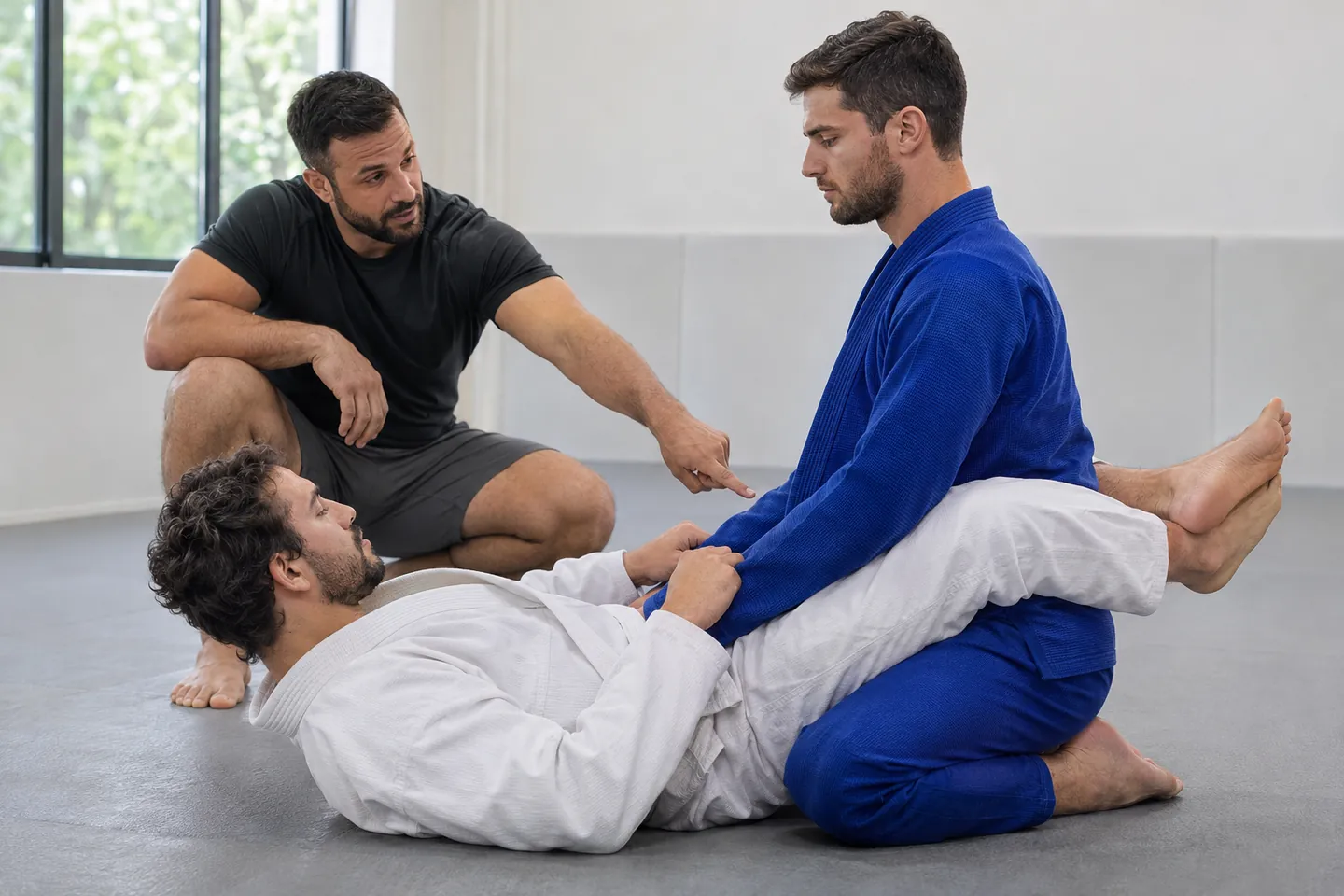
New to Brazilian jiu-jitsu in Mississauga? Learn what the guard is, why fighting from your back makes sense, and how beginners can build a guard step by step.
Ask a room full of people what they would do if they ended up on their back in a struggle, and most would say the same thing: get up as fast as possible. Brazilian jiu-jitsu starts from a stranger idea. It teaches that being on your back is not automatically losing, provided your legs are between you and the other person and you know how to use them.
That idea has a name: the guard. It is one of the first concepts beginners meet in jiu-jitsu classes in Mississauga, and it can take years to understand in depth. For a newcomer, though, the useful question is simpler. What is the guard trying to do, and how do you start building one that works?
This post is aimed at people who have taken a class or two, or who are curious before signing up. It covers the purpose of the guard, the main versions you will hear about, the mistakes nearly everyone makes early on, and how to think about progress without getting overwhelmed by the sheer number of positions.
The basic idea in one sentence
The guard is any position where you are on the bottom, usually on your back or hip, and you use your legs to control, frame against, or connect to an opponent who is on top or standing.
That description is deliberately broad, because there are many guards. What they share is the role of the legs. In most of daily life our legs carry us around and our arms do the fine work. In guard, the legs become something closer to a second pair of arms: they push, pull, hook, and wrap. That is why the position feels so foreign at first.
The guard also has a job. It is not just a place to lie down and wait. From guard, you are generally trying to prevent the top person from passing your legs and settling into a dominant position, while looking for chances to sweep them over or apply a submission. Defence and offence happen from the same place.
Why fighting from your back can make sense
Jiu-jitsu grew around the idea that a smaller or less athletic person could manage a larger one with leverage and positioning. The guard is central to that. When your legs are engaged and your hips can move, the person on top has to deal with your strongest limbs before they can control your upper body.
It is worth being honest that the guard is a sport and training concept with limits. In a self-defence context, with multiple people or hard ground, lying on your back has obvious drawbacks, and many instructors teach getting back to your feet as a priority there. In the training room, though, the guard is where a huge share of the learning happens, and understanding it opens up the rest of the art.
For beginners, the more immediate benefit is calm. Once you understand that you have tools from the bottom, being on your back stops feeling like a crisis. That calm alone makes rolling safer and more productive.
Closed guard: where most people start
Closed guard is the version most beginners learn first. You lie on your back with your legs wrapped around your partner’s waist and your ankles crossed behind them. Your partner is usually kneeling between your legs.
From here, the bottom person can break their partner’s posture by pulling them forward with the legs and arms, control their grips and sleeves, and set up a range of basic sweeps and submissions. The top person is trying to stay upright, keep their elbows tight, and eventually open the legs so they can begin passing.
Closed guard teaches several habits that carry into everything else. You learn to use your hips, to angle off to one side rather than lying flat, and to think about posture as something you can take away from your opponent. Many coaches return to closed guard throughout a student’s training, because the details keep revealing themselves.
Open guards and why there are so many
Once the ankles uncross, the guard is considered open. This is where the vocabulary explodes. You will hear about butterfly guard, spider guard, De La Riva, half guard, and many more. Each one describes a different arrangement of feet, knees, and grips, suited to a different situation or opponent posture.
It is easy to feel that you need to learn all of them. You do not, at least not early on. Most open guards share the same underlying goals: keep your knees and feet connected to your partner, keep your hips mobile, and stop them from getting chest to chest with you. If you understand those goals, the specific versions become variations on a theme rather than separate subjects to memorise.
Your coach will usually introduce open guards in an order that builds sensibly from closed guard. Following that order is more useful than jumping to whatever position you saw a competitor use online.
Half guard as a halfway house
Half guard deserves its own mention because beginners end up there constantly, often by accident. In half guard, your legs trap only one of your partner’s legs. It sits between full guard and having your guard passed entirely.
Early on, many people treat half guard as a place where things went wrong. It can be, if you lie flat and let the top person flatten you further. But half guard can also be a solid position with its own sweeps, especially when you get onto your side and win the underhook or create space with a knee shield.
A common beginner lesson here is to avoid lying flat on your back. Whatever version of half guard you are in, being on your side with your knee or arm creating a frame usually gives you more options than staring at the ceiling.
Frames, hips, and the shrimp
If there is a movement that makes guard work possible, it is the hip escape, often called the shrimp. You push off one foot, move your hips away, and create space between yourself and your partner. It shows up in warm-ups at almost every jiu-jitsu gym because it is that important.
Frames go hand in hand with hip movement. A frame is a structure, made with your forearm, hand, knee, or shin, that holds distance without relying on muscle alone. Instead of pushing someone away with straight arms and getting tired, you create a rigid shape that they would have to move around, then use the space it buys to reposition your hips or legs.
Beginners often wonder why their guard keeps getting passed even though they are working hard. Quite often, the answer is that they are using strength without frames, or they are frozen in place rather than moving their hips. Drilling the shrimp until it feels automatic is unglamorous, but it pays off.
Common beginner mistakes in guard
A few patterns show up in nearly every new student, and recognising them can save you some frustration.
- Lying flat. Being square on your back makes it easy for the top person to pin your hips. Turning onto your side or hip changes the picture.
- Holding on for dear life. Squeezing closed guard as hard as possible exhausts you without creating anything. Ask your coach when to hold tight and when to open up.
- Disconnecting the legs. In open guard, letting your feet drift away from your partner gives them space to walk around you.
- Pushing with straight arms. It feels natural but usually ends with tired arms and a passed guard. Frames are more efficient.
These are not character flaws. They are the default responses of someone who has not yet built new habits, and they fade with patient practice.
Guard retention versus guard attacks
As you train, you will notice two broad sides to guard work. Guard retention is about keeping your guard when someone is trying to pass. Guard attacks are the sweeps and submissions you look for when your guard is stable.
New students are often drawn toward attacks because submissions are exciting. In practice, many coaches encourage beginners to spend a lot of time on retention first. If you cannot keep someone in your guard, your attacks rarely get a chance to happen. Retention also teaches you the hip movement and frames that make attacks possible later.
During positional sparring, where one person starts in guard and the other tries to pass, it can help to set yourself a simple goal like keeping your knees between you and your partner for the whole round. That kind of focus produces clearer learning than trying everything at once.
Training the guard safely
The guard puts unusual demands on the neck, knees, and lower back. When you are pulling with your legs or someone is stacking you, those areas can be strained if you resist awkwardly or hold a position too long out of stubbornness.
Tap early when a submission is locked in, and also tap or speak up if a position is putting uncomfortable pressure on your neck or spine. Good training partners will respect that. Warm up properly, and if you have existing issues with your back or knees, mention them to your coach before you start. Gyms in Mississauga with on-site physiotherapy or other qualified practitioners can be a useful resource if you have ongoing concerns, but a coach cannot diagnose an injury, and neither can a blog post.
It also helps to roll with a range of partners. Rolling only with much heavier or much more experienced people can leave you defending constantly. Rolling with people closer to your level gives you a chance to try guard work under fairer conditions.
How the guard develops over time
Most jiu-jitsu students go through a phase where their guard gets passed all the time. That is part of the process, not a sign you are failing. Over months, you begin to notice why a pass worked, and that awareness is the first step toward stopping it.
Gi and no-gi training also shape your guard differently. With the gi, sleeves, collars, and pants offer grips that support certain guards. Without the gi, guards tend to rely more on underhooks, overhooks, and leg connections. Some people train both, which is a useful way to see the same principles from different angles.
Keep notes if that suits you. Recording one thing that worked and one thing that did not after each class creates a reference for future sessions. Over a season, patterns emerge that show where your guard is improving and where your coach’s attention would help most.
Starting your own guard game
You do not need to be flexible, young, or athletic to begin learning the guard. You do need patience, a willingness to be uncomfortable for a while, and good instruction from people who will explain the why as well as the how.
If you are thinking about trying jiu-jitsu in Mississauga, our Brazilian jiu-jitsu classes introduce guard fundamentals in a structured, beginner-friendly way, and the adult schedule shows when classes run. You are welcome to book a free trial and spend your first session learning what it feels like to have your legs working for you instead of just holding you up.
Filed under
Keep exploring
More training insights await.