
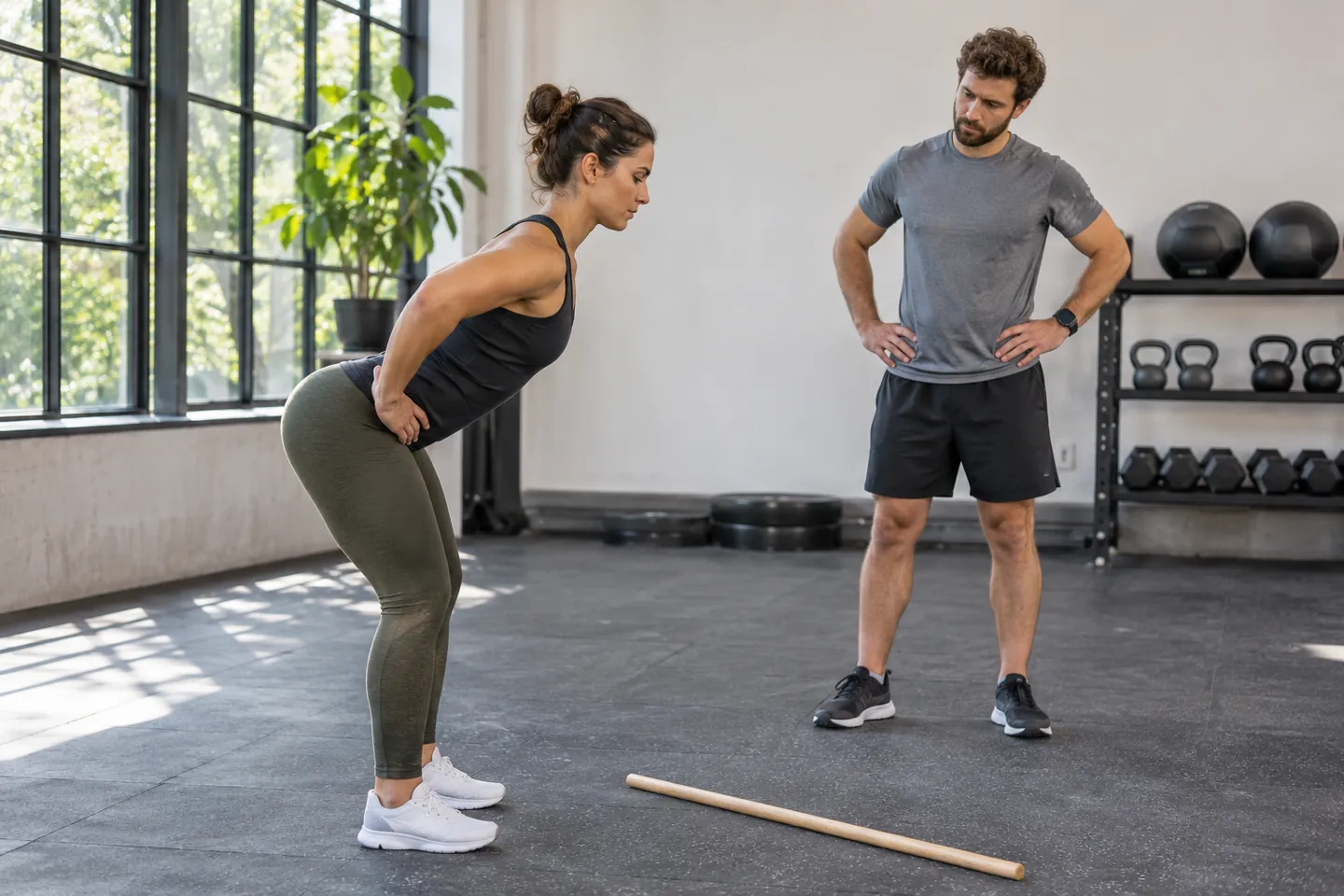
Make hip-hinge coaching in Mississauga easier to follow with practical questions about demonstrations, setup, equipment choices, and useful practice notes.
The phrase hip hinge can be confusing when you first hear it in a gym. It names a movement idea, yet the exercises associated with it may use different equipment and look different from one another. Understanding the hip hinge in Mississauga is easier when you treat it as a coaching conversation: what is the intended movement, which version are you learning, and how will you recognize the setup next time?
This article is about learning effectively with a coach. It is not a complete technique lesson or a prescription for a particular exercise. The useful starting point is a version selected for your experience and goals, demonstrated clearly, and practised with feedback. You do not need to arrive knowing every term that might appear in a strength program.
Begin by clarifying the word
A hip hinge is a movement organized mainly around bending and straightening at the hips. In a common standing version, the hips travel backward as the torso inclines forward, with some knee bend. A squat also involves the hips, but includes more knee bending as the body lowers. The National Academy of Sports Medicine illustrates this distinction in its Romanian deadlift instructions and goblet squat description.
The distinction is about the pattern, not a requirement to keep every joint perfectly still or copy one universal body angle. A coach can demonstrate both movements side by side and explain which pattern your assigned exercise emphasizes. That comparison gives the word hinge a concrete meaning before you begin discussing weights, repetitions, or variations.
Ask your coach what they mean by a hinge in the context of your session. A plain explanation and a demonstration can make the term less abstract. If the description uses other unfamiliar words, pause and ask for those to be explained too.
It may help to watch the movement from the side, where the sequence can be easier to follow than from directly in front. Let the coach choose a suitable demonstration position and point out the feature they want you to notice. You are learning an intended action, not trying to memorize a silhouette.
Repeat the explanation back in your own words. This gives the coach a chance to identify misunderstandings before you begin. A short exchange can be more useful than nodding along while privately remaining unsure what the instruction means.
Separate the movement pattern from the equipment
You may encounter a hinge-related exercise with a kettlebell, dumbbells, a bar, a cable, or no added resistance. Ask why the chosen tool is being used for your lesson. The answer can help you understand the task without assuming that one piece of equipment is the mandatory starting point.
Recognizing a movement pattern does not mean every variation has identical instructions. The placement of the equipment, the starting position, and the way the exercise begins or ends may differ. Treat those differences as part of the lesson rather than details you are expected to infer.
If you have seen another version online, mention it as a question. Ask how it differs from the one in your program. This is more productive than trying to combine instructions from several unrelated demonstrations into a single attempt.
Tell the coach what feels unfamiliar
Some people find the idea easy to describe but difficult to reproduce. Others can follow a demonstration yet forget the sequence when they stand up to try it. Explain which part is confusing instead of assuming that the movement should feel obvious immediately.
You might be uncertain where to place your hands, how to begin, or when to stop the repetition. Each is a specific teaching question. The coach can respond with a demonstration, an adjusted setup, or a simpler version when appropriate.
Share relevant limitations and any existing professional guidance before beginning. Describe what you know without trying to diagnose the reason for every difficulty. The coach’s task is to work within an informed understanding of your situation, and your honest account is part of that information.
Learn the starting arrangement carefully
Ask the coach to show the full setup, including where the equipment belongs before you touch it. If a weight starts on a raised surface or in another particular position, understand how that arrangement is established and checked.
Practise the setup as its own task. You should know where to stand, what you are preparing to do, and how the movement will finish. This separates the logistical questions from the movement itself and prevents you from trying to solve both simultaneously.
Keep the space around the exercise clear. Know where your bag and water bottle should go and how much room the task requires. These practical details help make the lesson repeatable when you return to the same station on another day.
Ask for a cue you can actually use
A cue is useful only if it changes your understanding or action. If a phrase sounds memorable but leaves you guessing, ask the coach to reword it. You may learn better from a demonstration, a target, or a short description of the sequence.
Focus on the cue selected for the current attempt. Trying to remember several corrections at once can make it difficult to tell which one helped. After the repetition, describe what you noticed so the coach can decide what to emphasize next.
Avoid collecting cues from every person nearby. Different instructions may address different situations, and a correction intended for someone else may not apply to you. Keep the conversation anchored to the version you are learning and the feedback your coach is giving you.
Understand the boundaries of the assigned version
Ask how far the movement is intended to go and what marks the end of a repetition. Do not assume that reaching a particular object or matching another person’s range is the goal. The coach should explain the task in terms you can recognize while performing it.
If the exercise uses a reference point, clarify its purpose. You may be asked to approach it, touch it, or use it only as a visual guide. Those are different instructions, and guessing can make an otherwise straightforward lesson confusing.
Communicate promptly if something feels wrong or painful. Stop rather than trying to complete a count at the expense of reporting your experience. The coach needs both observation and your feedback to understand how the assigned version is working for you.
Make changes one understandable step at a time
Once the basic version becomes familiar, you may be curious about adding resistance or trying another variation. Ask what would make that change appropriate within your program. The answer should connect to your learning and goals, not to pressure to use more impressive equipment.
When something changes, identify exactly what is different. Is the setup new? Is the implement held differently? Does the exercise start from another position? A clear comparison prevents you from assuming that only the equipment number has changed when the instructions have also shifted.
It is reasonable to request another demonstration after a change. Familiarity with one version does not remove the need to learn a new one. Treat the transition as another lesson rather than as a test you are expected to pass without help.
Use a short record to preserve the lesson
Write down the exercise name used by your coach and enough detail to distinguish it from related movements. Include the equipment, the setup you were shown, and the cue that made the most sense. If a particular adjustment mattered, note it in language you will understand later.
Record questions too. You might remember the movement but remain unsure how to choose the equipment or how to finish the set. Bringing those questions to the next appointment gives the coach a clear place to begin.
A log does not need to become a diary of every repetition. Its purpose is to help you repeat the lesson and report what happened. A few accurate details are more useful than a long description that leaves out the one setup step you keep forgetting.
Confirm what you should practise independently
Not every demonstration during a session is automatically homework. Ask which version, if any, belongs in your independent plan. Confirm the amount of work and what to do if the usual equipment is unavailable.
If you cannot explain the assigned exercise back to the coach, ask for another review before attempting to reconstruct it later. This is especially important when several similar movements were discussed in one appointment. A clear written plan can prevent them from blending together in memory.
Keep any agreed alternatives alongside the original exercise in your notes. Do not substitute a different movement simply because its name sounds related. If a change has not been explained, ask rather than treating similarity as enough information to proceed.
Judge the lesson by what became clearer
You can also identify one practical detail to prepare before returning. Perhaps you need your notes accessible, a clearer description of a question, or confirmation of the next appointment. Keeping that next step small gives the lesson a useful continuation without turning the rest of your week into an exercise research project. Let the coaching process supply the detail in a sequence you can understand.
After the session, consider whether you better understand the term, the setup, and the instruction. You may have learned only one small part well, and that can still be a useful beginning. Skill learning often involves returning to details until they become familiar.
Notice which kind of explanation helped you most. Sharing that preference can improve future coaching across other exercises too. Perhaps seeing the movement from another angle clarified it, or saying the sequence aloud helped you remember the order.
For guided instruction, explore Konga’s personal training service and contact the team about current options. Bring your questions and your actual experience. Understanding a hinge begins with a clear conversation, an appropriate version to practise, and enough feedback that the next attempt makes more sense than the last.
Filed under
Keep exploring
More training insights await.