
A practical look at upper back training for posture in Mississauga: rows, band work, carries, desk habits and when to see a physio or chiropractor for advice.
Picture the end of a long Thursday. You have spent most of the day at a laptop, then forty minutes in traffic on the 403, then another half hour on your phone on the couch. When you finally stand up, your shoulders feel rounded and heavy, and there is a dull ache somewhere between your shoulder blades. You straighten up, it feels better for a moment, and then you slowly sink back into the same shape.
That experience is common for adults in Mississauga who work at desks, drive a lot, or spend long shifts leaning over a workstation. Posture gets blamed for a lot of things, and the advice to “sit up straight” rarely sticks. A more useful approach is to make the muscles of your upper back stronger and more resilient, so that holding a range of positions comfortably becomes easier, and to move more often throughout the day.
This post explains how upper back strength relates to posture, which exercises are useful for beginners, how to fit them into your week, and what to keep in mind if you have pain. It is general education, not a diagnosis. If you have ongoing discomfort, numbness or a recent injury, please see a qualified health professional before starting a new program.
A more realistic view of posture
There is no single perfect posture you should hold all day. Bodies are built to move, and almost any position becomes uncomfortable if you hold it long enough. Slouching for a few minutes is not dangerous. Staying in the same slouched position for hours, day after day, without much variety, is what tends to leave people feeling stiff and sore.
Strength helps because it gives you options. When the muscles that pull your shoulders back and support your upper spine are stronger, you can sit or stand more upright without feeling like you are fighting yourself. You also tend to tolerate long periods of sitting better, and you recover faster when you do get stiff.
So rather than aiming for rigid “good posture,” aim for a capable upper back and frequent changes in position. That combination is more achievable and, for most people, more comfortable over time.
The muscles involved
Your upper back is a busy area. The muscles between and around your shoulder blades, often grouped under names like the rhomboids and the middle and lower trapezius, help draw the shoulder blades together and down. The large muscles along the sides of your back help pull your arms toward your body. Smaller muscles around the shoulder joint help keep it stable.
Along your spine, the extensor muscles help you lift your chest and resist rounding forward. Your neck muscles also play a role in how your head sits over your shoulders, which matters when you spend hours looking down at screens.
You do not need to memorise anatomy to train well. What matters is choosing exercises that ask these areas to pull, hold and stabilise, and performing them with control. A coach can point out which muscles you should feel during each movement, which helps you connect the exercise to the outcome.
Rows: the foundation
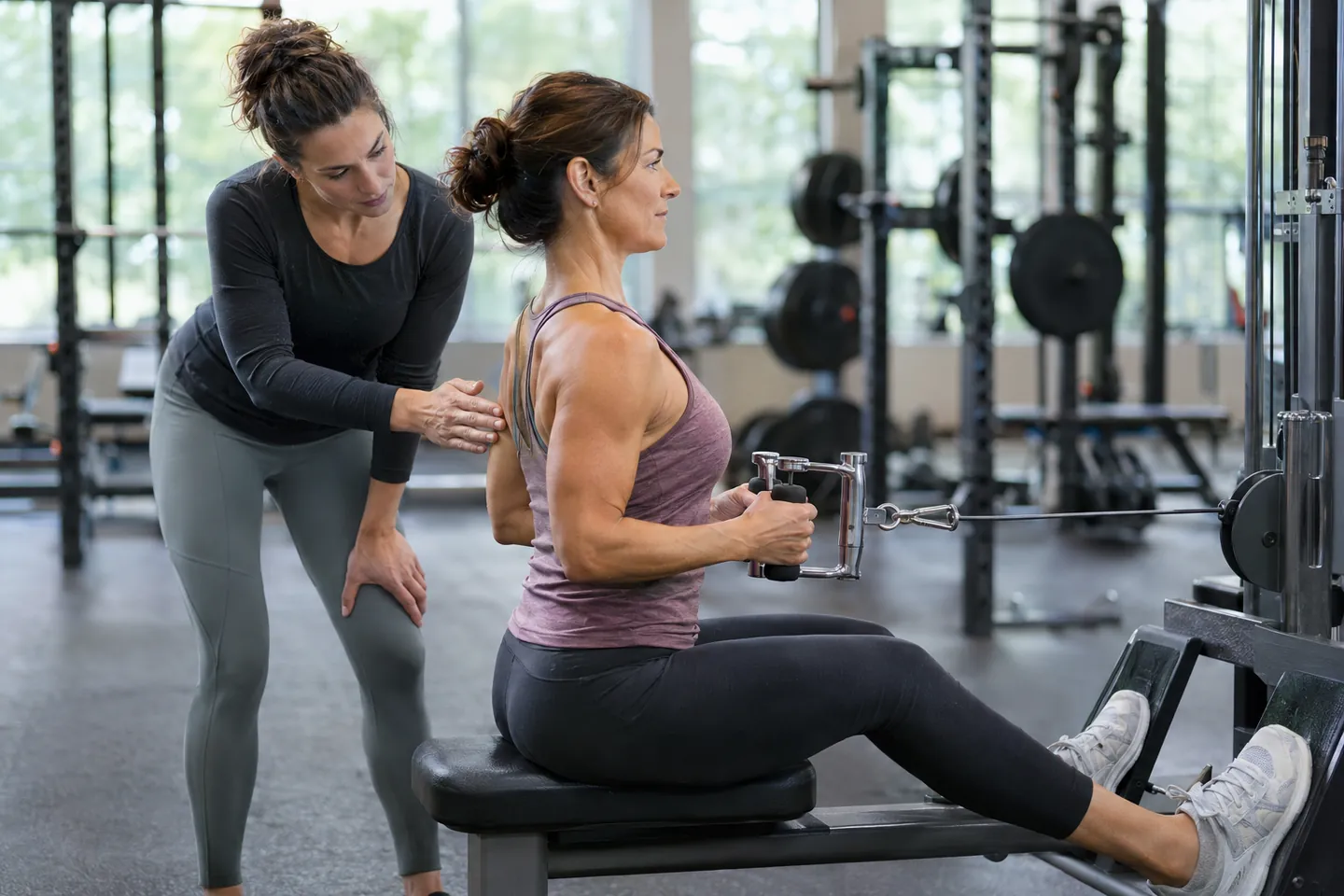
If you only add one type of movement, make it a row. Rowing exercises involve pulling a weight or band toward your body while your shoulder blades move back. They train many of the upper back muscles at once and are easy to adjust for any level.
Good options for beginners include seated cable rows, chest-supported dumbbell rows, single-arm dumbbell rows with a hand on a bench, and resistance band rows anchored at chest height. The chest-supported variations are helpful if your lower back gets tired easily, because the bench takes the strain off your spine.
Focus on quality. Start each repetition by letting your arms reach forward fully, then pull your elbows back while keeping your neck relaxed and your ribs down. Pause briefly when your shoulder blades are drawn together, and lower slowly. Many people rush rows and shrug their shoulders up toward their ears; slowing down usually fixes both problems.
Band work you can do anywhere
Resistance bands are inexpensive and practical for people who want to do a few minutes of upper back work at home or in an office. Band pull-aparts, where you hold a light band at shoulder height and pull it apart by moving your arms outward, are a classic. Face pulls with a band anchored at head height are another good choice.
These movements work well as a short break during a long day. Two or three sets of fifteen to twenty slow repetitions take only a few minutes and can make your shoulders feel noticeably looser afterward. Keep the band light enough that you can control every repetition without arching your back or jutting your chin forward.
Bands are not a full replacement for heavier training, but they fill the gaps between gym sessions. Someone working from home in Churchill Meadows, for example, could keep a band by the desk and use it at the end of each video call.
Holds and carries
Strength is not only about moving weight; it is also about holding positions. Exercises that ask you to resist rounding forward under load can be very effective for posture.
Farmer’s carries, where you walk while holding a heavy dumbbell or kettlebell in each hand, train your upper back, grip and core to keep you upright. Suitcase carries, with weight in one hand only, add a sideways challenge. Start with moderate weights and short distances, and focus on walking tall with your shoulders relaxed and down.
Isometric holds, such as pausing at the top of a row or holding a band pull-apart for a few seconds, can also build endurance in the muscles you need for long periods of sitting. These do not need to be exhausting. A few well-controlled holds are more useful than many sloppy ones.
Opening up the front of the body
Strengthening the back is half of the picture. People who spend a lot of time sitting often feel tight across the chest and front of the shoulders. Gentle mobility work for these areas can make it easier for the back muscles to do their job.
Simple options include doorway chest stretches, lying on a foam roller placed lengthwise along your spine, and thoracic rotations in a side-lying position. Move slowly and stay within a comfortable range. You should feel a stretch, not pain.
A yoga class can be a pleasant way to add this kind of mobility to your week. Many poses involve opening the chest and lengthening the spine, and the slower pace gives you time to notice where you are tight.
Putting together a simple routine
For beginners, two strength sessions a week that include upper back work is a solid starting point. Each session might include one row variation, one band or cable movement such as face pulls, and one carry or hold. Three sets of eight to fifteen repetitions for the rows, and two or three sets for the others, is reasonable for most people.
You can add these to a full-body program rather than giving them their own day. For instance, pair a row with a squat variation, a push-up or press, and a carry. That gives you a balanced session in under an hour.
Progress gradually. When an exercise feels comfortable for all your sets with good form, add a small amount of weight or a few repetitions. If you are unsure how to progress, a personal trainer can help you set sensible targets and correct technique early.
Habits outside the gym
Training a few hours a week will not offset everything you do in the other hundred and sixty-plus hours. Small changes at work and at home add up. Set up your screen so the top is around eye level. Keep your keyboard close enough that you do not need to reach. Use a chair that supports your back, and adjust it so your feet rest comfortably.
More important than any single setup is variety. Stand up every thirty to sixty minutes, even briefly. Walk to refill your water, take a phone call standing, or do a few shoulder rolls and band pull-aparts. If you commute by car, take a moment at red lights to relax your grip and drop your shoulders.
Phones are a big factor too. Try holding yours a little higher rather than looking down at your lap for long periods. It feels awkward at first, but your neck will thank you.
Combat sports and upper back strength
If you train boxing, Muay Thai or jiu-jitsu, upper back strength matters for more than posture. Boxers spend a lot of time with their hands up and shoulders slightly rounded, which can leave the back of the shoulders fatigued. Grapplers pull on collars, sleeves and limbs constantly, and a strong back helps them do so without straining.
Adding rows and carries to your week can improve your endurance in these positions and help balance the pushing and punching motions that dominate striking sports. Many combat athletes also find that face pulls and band work help their shoulders feel healthier over time.
A strength and conditioning program designed around your sport can make sure you are covering these bases without interfering with your classes.
When pain is part of the picture
Some discomfort in the upper back and neck is common, especially after long days. Strength and movement often help. However, if pain is sharp, persistent, getting worse, or accompanied by numbness, tingling or weakness in your arms, stop and see a qualified professional.
Physiotherapists and chiropractors can assess what is going on and recommend a plan suited to you. Konga Fitness offers physiotherapy and chiropractic services, and these practitioners can work alongside your training rather than replacing it. They may suggest specific exercises, adjustments to your routine, or other approaches depending on their assessment.
Do not try to diagnose yourself from articles or videos. General guidance like this post is meant to help healthy adults train sensibly, not to treat injuries.
Start with one session this week
Better posture rarely comes from a dramatic overhaul. It comes from a stronger back, a bit more mobility, and a habit of moving regularly throughout your day. You can begin with one gym session and a resistance band at your desk.
If you would like help building a program that fits your schedule and goals in Mississauga, book a free trial at Konga Fitness or contact us to ask about personal training and strength classes. A coach can show you the key exercises, check your technique, and help you progress safely.
Filed under
Keep exploring
More training insights await.