
A grounded guide to women's self-defence training in Mississauga: awareness, boundaries, simple strikes, escapes, and how to find a class that feels supportive.
Many women who look into self-defence classes have a specific moment in mind. Maybe it was a walk to the car in a dark parking lot after an evening shift. Maybe it was a stranger who stood too close on a bus, or a situation that felt off and left them wondering what they would have done if it had escalated. Others have no single moment at all; they simply want to feel more prepared and more confident in their own bodies.
All of those reasons are valid. Women’s self-defence classes in Mississauga can offer practical skills, a supportive space to practise them, and a chance to build physical confidence that carries into everyday life. They cannot make anyone invincible, and a responsible class will be honest about that. What they can do is give you options, and options matter.
This post walks through what a good women’s self-defence program generally covers, how to tell whether a class is a good fit, and how training in a martial art over the longer term can build on the basics. We have kept it practical and calm, because fear-based marketing does not help anyone learn.
What self-defence actually includes
When people hear “self-defence,” they often picture fighting off an attacker. Physical techniques are part of it, but they are usually the last layer. Most programs begin with awareness, boundary-setting and avoidance, because the safest confrontation is one that never turns physical.
Awareness means noticing your surroundings without becoming anxious. It is the habit of looking up from your phone when you walk to your car, noticing exits in an unfamiliar building, or trusting the feeling that something is not right. Boundary-setting involves using your voice and body language to communicate clearly, such as stepping back, raising your hands in a calm “stop” position, and saying firmly that someone needs to give you space.
Physical skills come after that foundation. They typically include simple strikes, ways to escape common grabs, and methods for creating distance so you can leave. The goal is almost always to get away safely, not to win a fight.
Using your voice
One of the most underrated self-defence skills is a strong, clear voice. Many women are socialised to be polite and to avoid making a scene, which can make it hard to speak up when someone crosses a line. Good classes practise this deliberately.
You might rehearse saying “Back off” or “Stop” loudly and firmly, with your hands up in front of you. It can feel awkward at first, especially in a room of strangers. That awkwardness is exactly why practice helps. When you have said the words aloud many times, they are more likely to come out when you need them.
A loud voice also draws attention, which can discourage someone who was counting on a quiet situation. Combined with confident posture and eye contact, it sends a message that you are not an easy target.
Simple strikes that suit real situations
Self-defence striking tends to focus on a handful of techniques that are easy to learn and work under stress. Palm-heel strikes, where you hit with the base of your open hand, are common because they are less likely to injure your own hand than a closed fist. Elbows and knees are effective at close range. Kicks are usually kept low and simple.
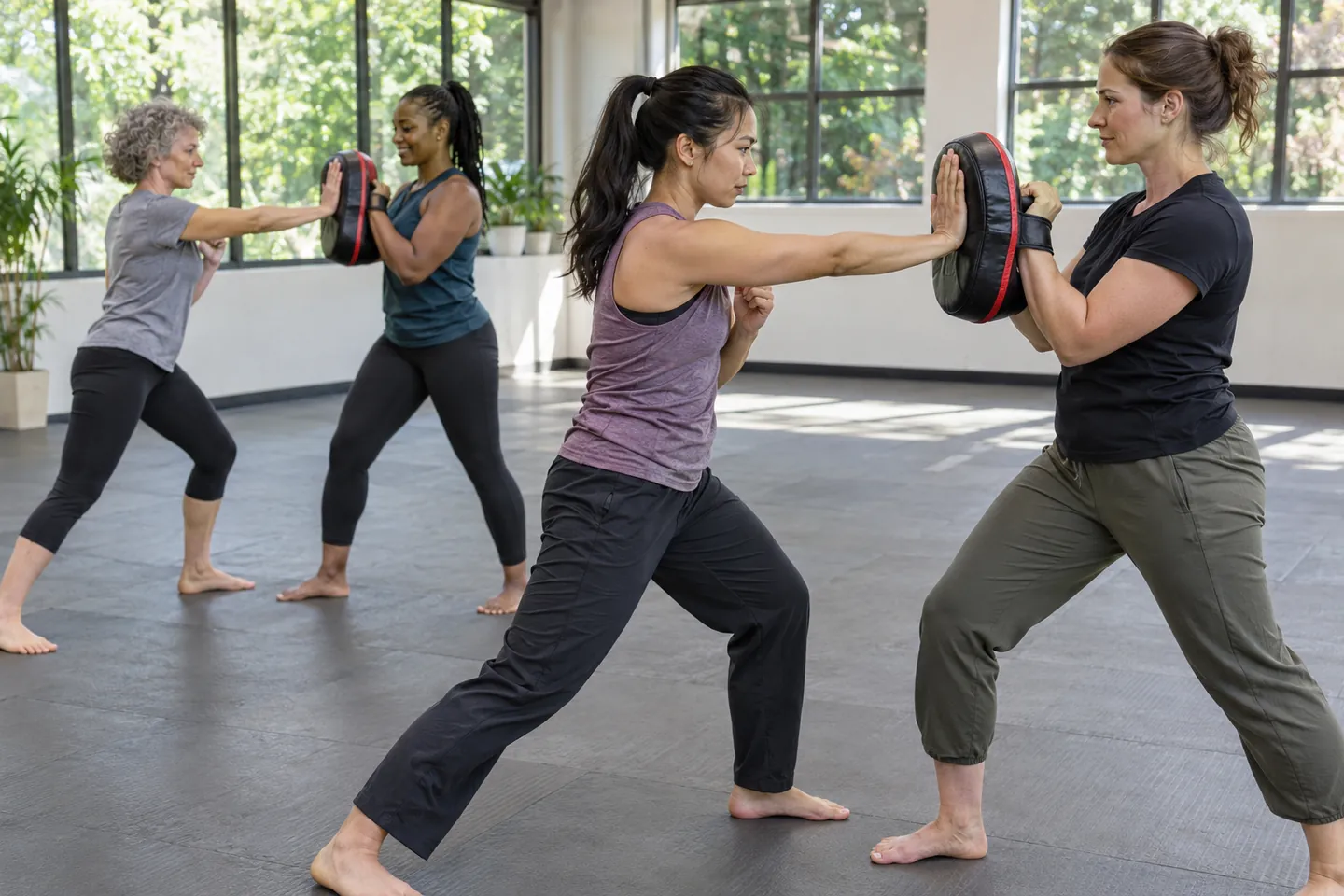
The aim is not to master complex combinations. It is to practise a few reliable movements until they feel natural, often against pads held by a partner. Repetition builds the confidence that you can move decisively if needed.
Classes should also explain when striking is appropriate. Physical force is generally a last resort, used to create an opening to escape. Your instructor may discuss the importance of proportionate responses and of getting to safety and help as quickly as possible. For specific questions about the law, speak with a legal professional rather than relying on general class discussion.
Escapes from grabs and holds
Many real-world confrontations start with a grab: a wrist, a sleeve, a bag strap, a shoulder. Learning how to break these grips is a central part of most women’s programs. The techniques often rely on leverage and angles rather than strength, which makes them accessible to people of any size.
For example, a wrist grab can often be broken by rotating your arm toward the gap between the other person’s thumb and fingers, which is the weakest part of their grip. Escapes from a bear hug might involve lowering your centre of gravity and creating space with your hips and elbows.
These skills improve dramatically with partner practice. Reading about them or watching a video gives you an idea, but feeling a real grip and learning to respond is what builds genuine competence. Good instructors introduce resistance gradually, so you can learn without feeling overwhelmed.
Getting up and getting away
Some programs include basic ground skills, because falls happen and people can end up on the floor during a struggle. Learning how to protect your head, create space with your legs and get back to your feet safely is valuable. This is one area where training in Brazilian jiu-jitsu can add a great deal of depth over time.
The core idea is simple: if you end up on the ground, your priority is usually to get up and leave. Techniques like the technical stand-up, where you rise while keeping a hand and foot posted for balance and the other hand up for protection, are practical and easy to drill.
Escape always includes where you go next. Instructors may encourage you to think about moving toward lit, populated areas, contacting emergency services, and getting help from people nearby.
What a supportive class feels like
The environment matters as much as the curriculum. A good women’s class should feel welcoming to complete beginners, including women who have never done any martial arts or fitness training. The pace should allow everyone to learn, and you should never feel pushed into something you are not ready for.
Instructors should explain techniques clearly, check that partners are comfortable, and allow you to opt out of any drill. Some women attend self-defence classes after difficult experiences, and a thoughtful coach will keep that in mind without making assumptions or asking intrusive questions. You are in control of what you share and how you participate.
Many women appreciate women-only sessions, which can feel more comfortable for learning close-range skills. Konga Fitness offers women’s classes designed with this in mind. Others prefer mixed classes once they feel more confident, because they want to practise with partners of different sizes.
One workshop versus ongoing training
Short workshops are a great introduction. In a few hours you can learn awareness strategies, practise your voice, and try several basic techniques. Many women leave feeling more confident and more aware.
However, physical skills fade without practice. A technique you tried once is unlikely to be reliable months later, especially under stress. That is why many people choose to follow a workshop with ongoing training in a martial art. Regular classes build fitness, reinforce technique, and help you stay calm under pressure because you have experienced controlled pressure many times.
Disciplines like kickboxing, Muay Thai and Brazilian jiu-jitsu all offer useful skills for self-defence. Striking arts teach you to move and hit effectively; grappling arts teach you to handle close contact and ground situations. You do not need to pick the “best” style. Choose the one you enjoy enough to keep attending.
Confidence beyond the class
Many women find that the benefits of self-defence training go far beyond physical techniques. Practising saying no clearly, standing your ground in a drill, and discovering what your body can do often changes how you carry yourself in daily life.
That confidence can show up in small ways: holding eye contact in a difficult meeting, walking more assertively through a parking garage near Square One, or speaking up when something feels wrong. It is not about becoming aggressive. It is about trusting yourself.
Fitness improvements help too. Stronger legs, better balance and improved endurance make you more capable in many situations, from carrying groceries up icy steps in January to keeping up with your kids at the park.
Choosing a class in Mississauga
When comparing options, ask a few questions. What does the curriculum cover beyond physical techniques? How are beginners introduced to partner work? Are there women-only options? What do instructors do to keep the environment safe and respectful?
Visit if you can, or book a trial class. Notice how the instructor speaks to students, whether people seem relaxed and engaged, and whether the space feels clean and well organised. Trust your instincts; if a place feels wrong, it probably is not the right fit.
Consider practical factors too. Choose a location and schedule you can manage regularly, whether you live in Meadowvale, Malton, Erin Mills or somewhere else in the city. Consistency matters more than finding the perfect class.
Practising safely
Even in self-defence classes, safety comes first. Wear comfortable clothing, remove jewellery, and let your instructor know about any injuries or health concerns. Communicate with your partners and use agreed signals to stop a drill if you need to.
Start with controlled speed and build up gradually. There is no need to go hard in your first sessions. The point is to learn correct movements, which then become faster and more reliable with time.
If you feel emotional during a class, that is normal and nothing to be embarrassed about. Step aside, take a breath, and rejoin when you are ready. A good instructor will make that easy.
Take the first step
Women’s self-defence classes in Mississauga can be a practical, empowering way to build skills and confidence. Whether you are interested in a single introduction or want to train long term, the most important step is the first one.
Explore our women’s classes to see how sessions are structured, then book a free trial to experience the environment for yourself. If you have questions before you come in, you are welcome to contact us and talk through what you are looking for.
Filed under
Keep exploring
More training insights await.