
Learn simple yoga breathing practices that help Mississauga athletes settle before class, pace hard rounds, and wind down after training, explained gently.
Breathing is the one thing you do in every class, every lift and every round, and it is also the thing most people never practise on purpose. You learn stances, combinations and techniques with care, but breath is left to look after itself. Usually it does. Sometimes, though, it rushes ahead of you: you hold it during a heavy rep, gasp through the second round of pads, or lie awake after an evening session with your heart still racing.
Yoga has a long tradition of attending to the breath, and a few of its simpler practices translate well to people who also box, lift, roll or run. You do not need to become a dedicated yogi to benefit. Ten quiet minutes a few times a week, plus a couple of tools you can use mid-session, can make training in Mississauga feel more settled and more controlled.
This piece walks through why breath awareness matters for athletes, the handful of practices worth learning first, and how to place them before, during and after your workouts. It stays general and gentle. If you have a respiratory or heart condition, check with your doctor before changing how you breathe during exercise.
Noticing before changing
The first breathing practice is not really a technique at all. It is simply paying attention. Sit or lie down somewhere comfortable, close your eyes if that feels fine, and watch your breathing for a minute without trying to adjust it. Where do you feel the movement? Chest, belly, sides, back? Is the inhale longer than the exhale, or the other way round?
Many people discover that they breathe higher in the chest than they expected, or that they pause briefly after each exhale. None of this is wrong. It is information. Training any skill starts with an honest look at where you are, and breathing is no exception. A yoga teacher may call this awareness; a coach might call it a baseline.
Try this a few times across different days. Notice whether your breathing looks different after a long drive home on the 403, after a calm Sunday morning, or after a hard class. That variety is the point. Breath responds to what is happening in your life, which is precisely why it can also be used to influence how you feel.
Three-part breathing
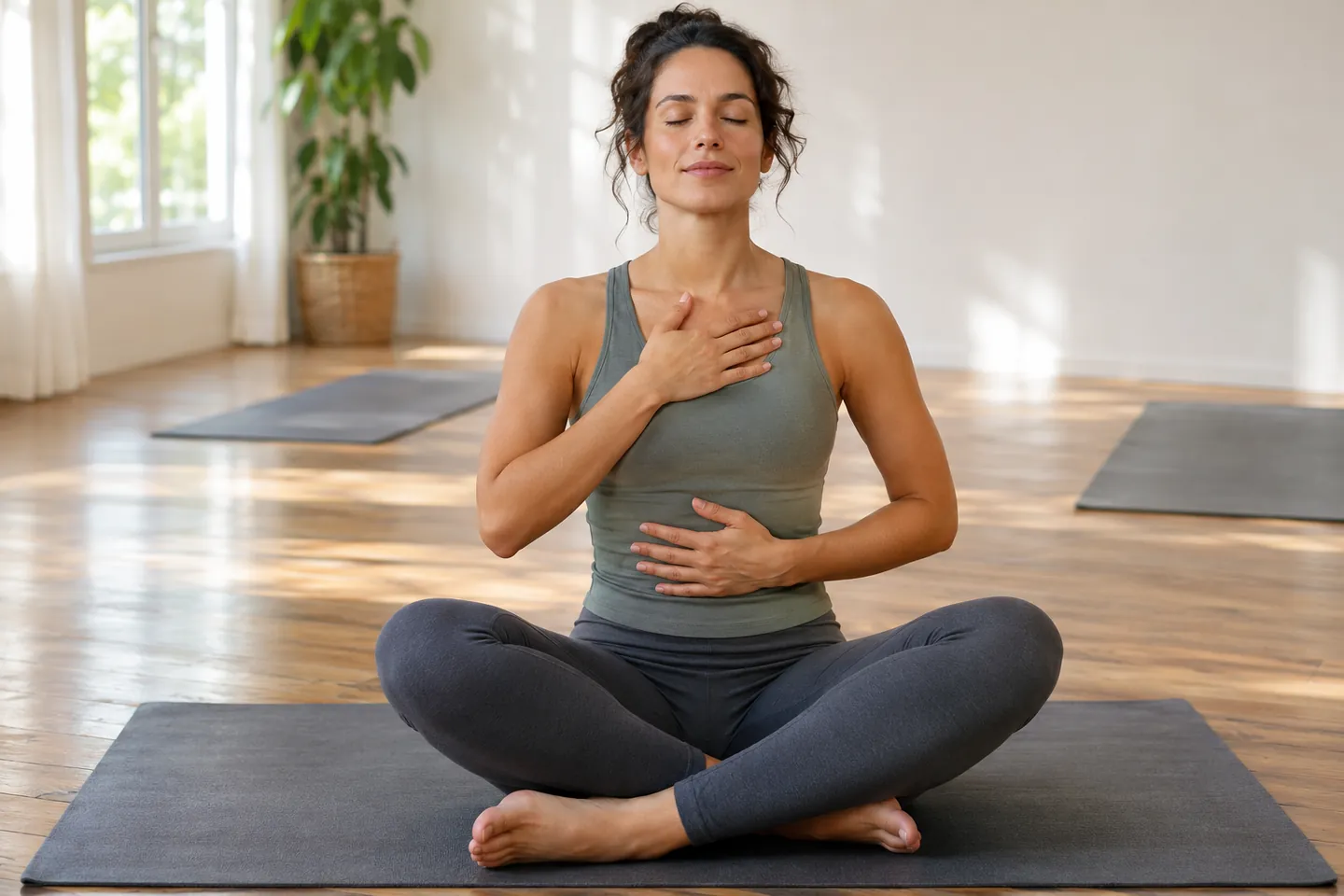
One of the most common foundational practices in yoga is sometimes called three-part breath. You breathe in slowly, letting the belly soften and expand first, then the lower ribs widen, then the upper chest rises a little. On the exhale, you let the breath leave in roughly the reverse order. It is less about a rigid sequence and more about letting the whole torso take part.
Placing one hand on the belly and one on the chest can help you feel the movement. At first it may seem mechanical or awkward. With repetition, it tends to feel smoother, and many people find it a calming way to start or end a practice. Keep the effort low. If you feel light-headed, return to normal breathing and rest.
For athletes, three-part breathing is useful because it builds familiarity with the ribcage moving in all directions. Fighters and lifters often brace hard through the midsection, which is appropriate during effort, but it can turn into a habit of staying tight all the time. Learning to let the ribs move freely when you are not under load helps you switch between bracing and relaxing more deliberately.
Lengthening the exhale
A gentle, extended exhale is one of the most practical tools for winding down. A simple version is to breathe in through the nose for a comfortable count and then out through the nose or softly pursed lips for a slightly longer count. If you inhale for four, perhaps exhale for six. The exact numbers matter less than the sense of unhurried release.
Many people find this helps them shift out of the alert, wound-up state that hard training creates. It is commonly used at the end of yoga classes, and it can be equally useful after a sparring session or a late-evening strength workout in Mississauga, when you still need to drive home and get some sleep.
Avoid straining to make the exhale extremely long. If you run out of air and gasp on the next inhale, the count is too ambitious. Shorten it until the rhythm feels sustainable for several minutes. A relaxed breathing pattern that you can actually keep is more valuable than an impressive number.
Nasal breathing at easy effort
Yoga practice generally emphasises breathing through the nose. During easy activity, such as warm-ups, light mobility work, or a gentle walk along the Credit River trails, breathing through the nose can encourage a slower, steadier rhythm. It also acts as a natural speed limit: if you cannot keep your mouth closed, you are probably working harder than “easy”.
Some athletes like to use this as a simple guide during warm-ups or recovery sessions. If you can breathe through your nose comfortably, you are in a gentle zone. Once you start to need your mouth, the intensity has risen. That feedback is useful when you are trying to keep a recovery day genuinely easy rather than sliding into another hard workout.
During intense rounds or heavy sets, nobody expects you to keep your mouth closed. Breathing through the mouth is normal when effort is high, and there is no need to force nasal breathing when your body is asking for more air. The aim is flexibility, not rules.
Box breathing for focus
Box breathing involves four equal parts: inhale, hold, exhale, hold. Each part might last four counts to begin with. It is widely used outside yoga, but it fits comfortably into a breath practice and gives the mind something concrete to follow. The structured counting can help when thoughts are scattered.
Some people use a short round of box breathing before a class to arrive mentally. You might have come straight from work in Meadowvale or Erin Mills, phone still buzzing, head still in meetings. Two minutes of measured breathing on the mat before warm-ups can help you let go of the commute and focus on what you are about to practise.
Keep the holds gentle. If the pauses cause any discomfort, shorten them or skip them entirely and simply breathe in and out evenly. People with certain medical conditions are often advised to avoid breath holding, so if you are unsure, ask your doctor first. There is nothing to prove here.
Using breath during striking and lifting
Breathing patterns during training are usually taught by coaches in each discipline, and you should follow their guidance. In boxing, kickboxing and Muay Thai, many coaches teach a short, sharp exhale with each strike. In strength work, coaches may teach a brace or a controlled breath around a lift. Those cues are specific to the sport and the movement.
What yoga practice adds is awareness. If you have spent time noticing your breath when calm, you are more likely to notice when you are holding it in the middle of a pad round or a set of squats. That small moment of recognition gives you the chance to reset rather than gradually suffocating your own effort.
Between rounds, a slow exhale is often the most helpful thing you can do. Instead of pacing around with fast, shallow breathing, let one or two long exhales lead the recovery. Many people find their heart rate seems to settle a little more comfortably when they give the exhale a bit of time, though everyone’s response is different.
Breath after hard sessions
The minutes after training are an excellent time for breathing practice. Your body is warm, your mind may be buzzing, and you have usually just pushed through some discomfort. Rather than jumping straight into your car or onto your phone, take a few minutes on a mat or bench to breathe quietly.
Lie on your back with your knees bent or legs resting up on a wall. Let your breathing find its natural pace, then gradually lengthen the exhale. Notice the floor supporting your back. Some people like to scan through the body, softening the jaw, shoulders and hands one at a time. It is a simple routine, and it tends to make the transition from training to the rest of your evening feel more gradual.
At Konga Fitness, our yoga classes often end with this kind of quiet time. For people who mainly attend boxing, jiu-jitsu or strength sessions, borrowing that closing habit can be a useful bridge into recovery, especially after evening classes in the darker months.
Building a short routine
A routine does not need to be long to be useful. Here is one possible ten-minute outline that many people find manageable:
- Two minutes of simply noticing the breath without changing it.
- Three minutes of three-part breathing, with hands on chest and belly.
- Three minutes of gentle extended exhales.
- Two minutes of resting, breathing naturally, before getting up slowly.
You might do this in the morning before work, at lunch in a quiet corner, or in the evening after training. Consistency tends to matter more than duration. Ten minutes three times a week may serve you better than an hour once a month, simply because the practice becomes familiar.
If you notice that your mind wanders constantly, that is normal. Just bring attention back to the breath each time. The returning is part of the practice, not a sign that you are doing it badly.
When breathing practices are not enough
Breath work is a supportive tool, not a treatment. If you regularly feel breathless during light activity, experience chest discomfort, or notice dizziness that does not settle quickly, these are reasons to speak with a doctor rather than trying a new breathing technique. The same goes for persistent anxiety or sleep problems. A qualified professional can help you understand what is happening.
Some people also find that certain techniques do not suit them. Long holds may feel uncomfortable, or counting may make them more anxious rather than less. That is fine. You can choose a softer approach, such as simply breathing slowly with a hand on your belly, or skip the practice that does not fit. Good yoga teachers will offer options.
The most useful attitude is curiosity. Try a technique a few times, notice how you feel before and after, and keep what helps. Over a few weeks, you will likely build a small set of breathing habits that genuinely support your training.
Bringing breath into your week at Konga Fitness
Breathing well will not replace good coaching, sensible programming or adequate sleep, but it can make each of those things a little easier to access. It is a skill you carry into every session and every stressful moment outside the gym, and it costs nothing but some attention.
If you would like to explore breath practice with guidance, our yoga classes are a calm place to start, and they pair well with the more intense training many members do through the week. Have a look at the adult schedule to find a time that suits you, or book a free trial to try a class at our Mississauga location.
Filed under
Keep exploring
More training insights await.