
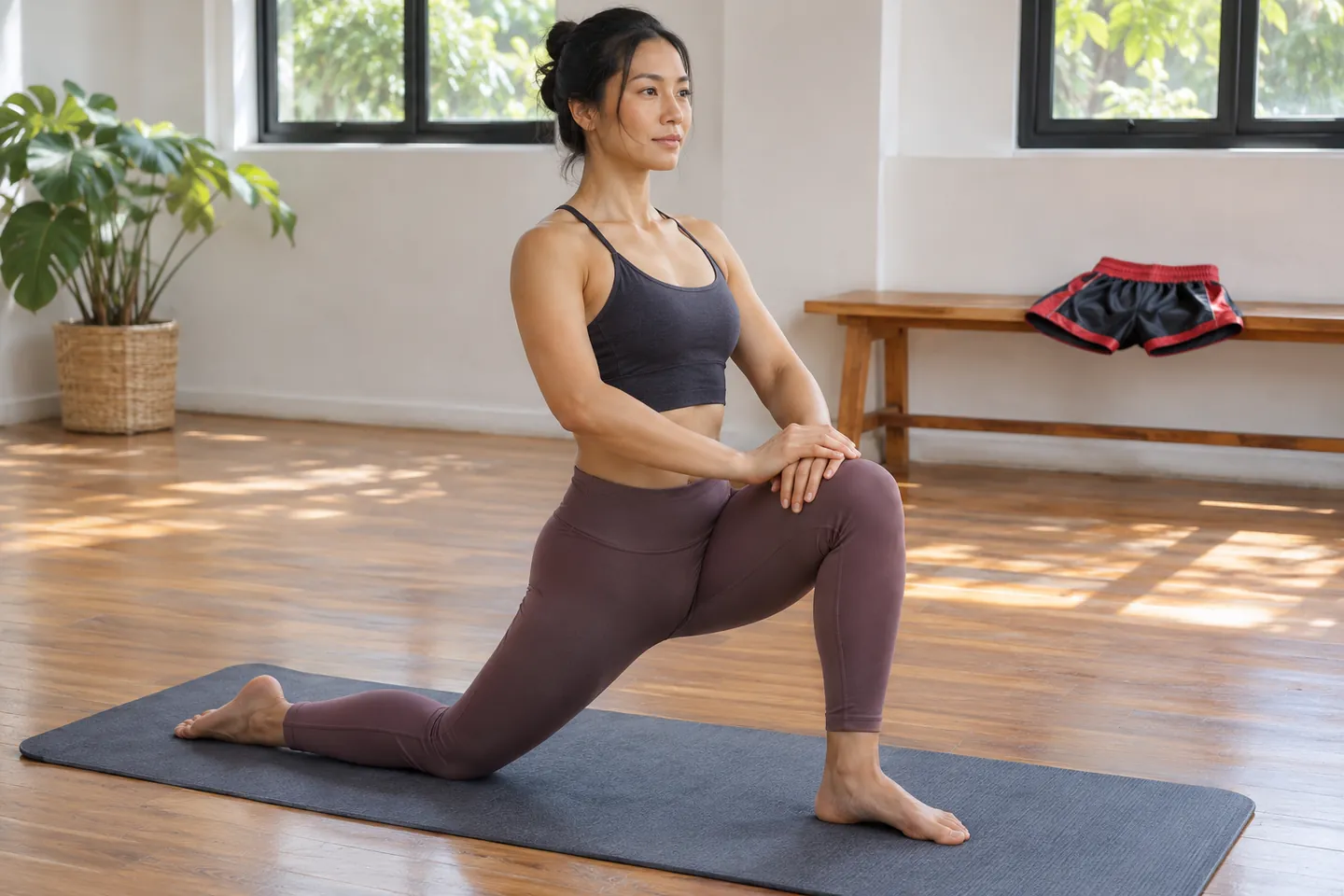
Want easier, smoother kicks? See how regular yoga in Mississauga builds hip mobility, balance and control for kickboxing and Muay Thai, at a sensible pace.
Ask a room of beginner kickboxers what they would most like to improve, and a surprising number will mention the same thing: they want to kick higher. They watch a coach throw a smooth roundhouse to head height and then try it themselves, only to find their hips feel like a rusty gate and their standing leg wobbles before the kick even leaves the floor.
High kicks are not essential for good kickboxing or Muay Thai. Plenty of effective fighters rarely kick above the ribs. Still, the qualities that make higher kicks possible, such as hip mobility, balance, and the ability to control your leg through a full range of motion, help every kick you throw. They also tend to make training feel more comfortable. That is where yoga comes in, and why a growing number of strikers in Mississauga add a yoga class or two to their weekly routine.
This post looks at what yoga can and cannot do for your kicks, which areas tend to matter most, and how to fit it alongside your striking without overdoing it.
Flexibility is only part of a good kick
When people talk about kicking flexibility, they often picture a full split. Passive range of motion, meaning how far a joint can move when gravity or a partner pushes it, does matter. But a kick is an active movement. You need to lift the leg yourself, rotate through the standing foot and hip, and control the limb as it extends and returns.
That is why some people who can sit comfortably in a deep stretch still struggle to kick high, and why some people with modest flexibility kick very well. The second group has learned to use the range they have with strength and control. Good yoga practice works on both sides of that equation: it gently increases range over time, and it asks you to hold and move through positions using your own muscles.
Keeping that in mind will stop you treating yoga as a stretching contest. The aim is usable range, the kind you can access while balanced on one foot with your hands up.
The hips are the main event
Most of the limitation people feel when kicking comes from the hips. The muscles at the front of the hip can be tight from long hours of sitting at a desk or in traffic on the 403. The inner thigh muscles limit how far the leg opens out to the side. The glutes and deep hip rotators influence how freely the hip turns over during a roundhouse.
Yoga addresses these areas in a variety of ways. Lunging postures open the front of the hip. Wide-legged standing poses and seated postures work the inner thighs. Pigeon-style shapes and figure-four variations target the outer hip and rotators. Over weeks of regular practice, many people notice that these positions become more comfortable, and that their kicks feel less blocked.
Progress tends to be gradual. Hips that have been sitting in a chair for years will not open up in a fortnight. Patience matters, and so does consistency: a modest practice done twice a week will usually do more than one heroic session a month.
Hamstrings and the front kick
The front kick, or teep in Muay Thai, asks the hamstrings of the kicking leg to lengthen as the leg rises. If they are tight, the knee tends to bend early, the hips lean back, and the kick loses both reach and balance.
Forward folds, both standing and seated, are a familiar part of many yoga classes and can help here. So can poses where one leg is straight and the other bent, which let you focus on one side at a time. The important thing is to fold from the hips with a long spine rather than rounding hard through the lower back to reach your toes. A good instructor will cue this and offer props such as blocks or straps if your hands do not reach the floor yet.
Hamstrings often respond well to gentle, regular attention and poorly to forcing. If you find yourself bouncing or straining in a forward fold, ease off. You will usually get further by breathing calmly in a moderate stretch than by yanking yourself into a deep one.
Balance on the standing leg
Every kick is thrown from one foot. If your standing leg is unstable, you will instinctively keep the kick low and short to avoid toppling over. Improving balance therefore has a direct effect on how confident and controlled your kicks feel.
Yoga includes a lot of single-leg work: tree pose, warrior three, standing figure-four, and various balancing flows. These positions train the small muscles of the foot and ankle, as well as the hips and core, to keep you steady. They also teach you to stay calm when you wobble, which is a useful skill on the mats.
Notice where your weight sits on your standing foot when you balance. Many coaches teach kicks with some pivoting on the ball of the foot. You can bring the same attention into yoga by spreading your toes, feeling the floor, and staying light rather than rigid.
Strength through range
A common observation from people who start yoga for flexibility is how much strength it demands. Holding a lunge with the back knee lifted, or lowering slowly from a standing balance, takes real muscular effort. That effort is useful for kicking.
When you can hold your leg at a certain height using your own strength, that range becomes available to you in a kick. When you only reach it passively, with your hand pulling your foot or your body sinking into a stretch, it often stays out of reach in training. Yoga postures that ask you to actively lift, hold, and control your limbs help bridge that gap.
You might also find it helpful to pair yoga with some targeted strength and conditioning work. Exercises such as split squats, hip hinges, and controlled leg raises complement yoga nicely and can be programmed by a coach to suit your level.
Breathing and relaxation in the kick
Tension is one of the hidden enemies of a fluid kick. When beginners try to kick hard, they often clench their shoulders, hold their breath and lock up the hips, which makes the leg slower and the movement stiffer. Yoga spends a lot of time on calm breathing in effortful positions, which is surprisingly relevant to striking.
Learning to exhale steadily while holding a challenging pose is good practice for staying relaxed while you throw a kick. Many strikers breathe out sharply as they strike, and the general habit of not holding your breath under effort carries across.
Relaxation also helps you feel what is going on in your body. When you are less tense, you notice which hip is tighter, where your weight is shifting, and which part of the movement feels awkward. That awareness makes coaching cues easier to apply in your next kickboxing class.
A sensible weekly balance
If you already train striking two or three times a week, one or two yoga sessions is a reasonable place to start. You do not need to practise every day to see benefits. What matters most is that the practice is regular and that you leave enough recovery for your other training.
Some people like to attend yoga on a lighter day between harder striking sessions. Others prefer it at the end of the week as a way to unwind. Check the adult schedule to see what fits around your existing classes and your commute. In the middle of a Mississauga winter, a warm studio and a slower class can also be a welcome change of pace.
Try not to stretch hard right before a session where you will be kicking at full intensity. Many coaches prefer an active warm-up before striking and keep longer, deeper stretching for another time. If you are unsure how to arrange things, ask your coach.
Listen to the difference between a stretch and a strain
Stretching should feel like mild to moderate tension in the muscle, not pain in a joint. Sharp sensations, pinching at the front of the hip, pain behind the knee, or anything that lingers after class are signs to back off. Yoga is not a competition, and pushing into a position your body is not ready for is a common way to get hurt.
Good yoga instructors will offer modifications and remind you to work within your own range. Use blocks, straps and bolsters without embarrassment. They are tools that let you get the benefit of a pose without forcing it.
If you have an existing injury, a history of hip or back problems, or ongoing pain, speak to a qualified professional before starting a new flexibility routine. A physiotherapy assessment can help identify which positions are appropriate for you and which to approach carefully.
Notice the small changes
Improvements in kicking flexibility tend to sneak up on you. One week you notice that the low lunge is easier. A few weeks later your roundhouse feels smoother on the bag. Later still a coach comments that your teep has more reach. None of these changes is dramatic on its own, but together they add up.
It can help to note a couple of reference points when you start: how far you fold forward, how comfortable a particular hip stretch feels, how long you can balance on one foot. Check in on them every month or so. It is much easier to stay motivated when you can see that something is moving in the right direction.
Remember that kicking skill is still built in kicking classes. Yoga supports it, but technique, timing and distance come from practising strikes with coaching. Treat the two as partners rather than substitutes.
Bringing yoga into your striking routine
If your kicks feel limited, adding regular yoga is one of the most practical, low-impact steps you can take. Focus on the hips, hamstrings and balance, build strength through range, breathe calmly, and give the process time. The result is usually not just higher kicks, but kicks that feel easier, more controlled, and less effortful to throw.
At Konga Fitness in Mississauga, you can combine yoga with kickboxing or Muay Thai under one roof. If you would like to try that mix for yourself, book a free trial and ask our team which classes would suit your goals.
Filed under
Keep exploring
More training insights await.