
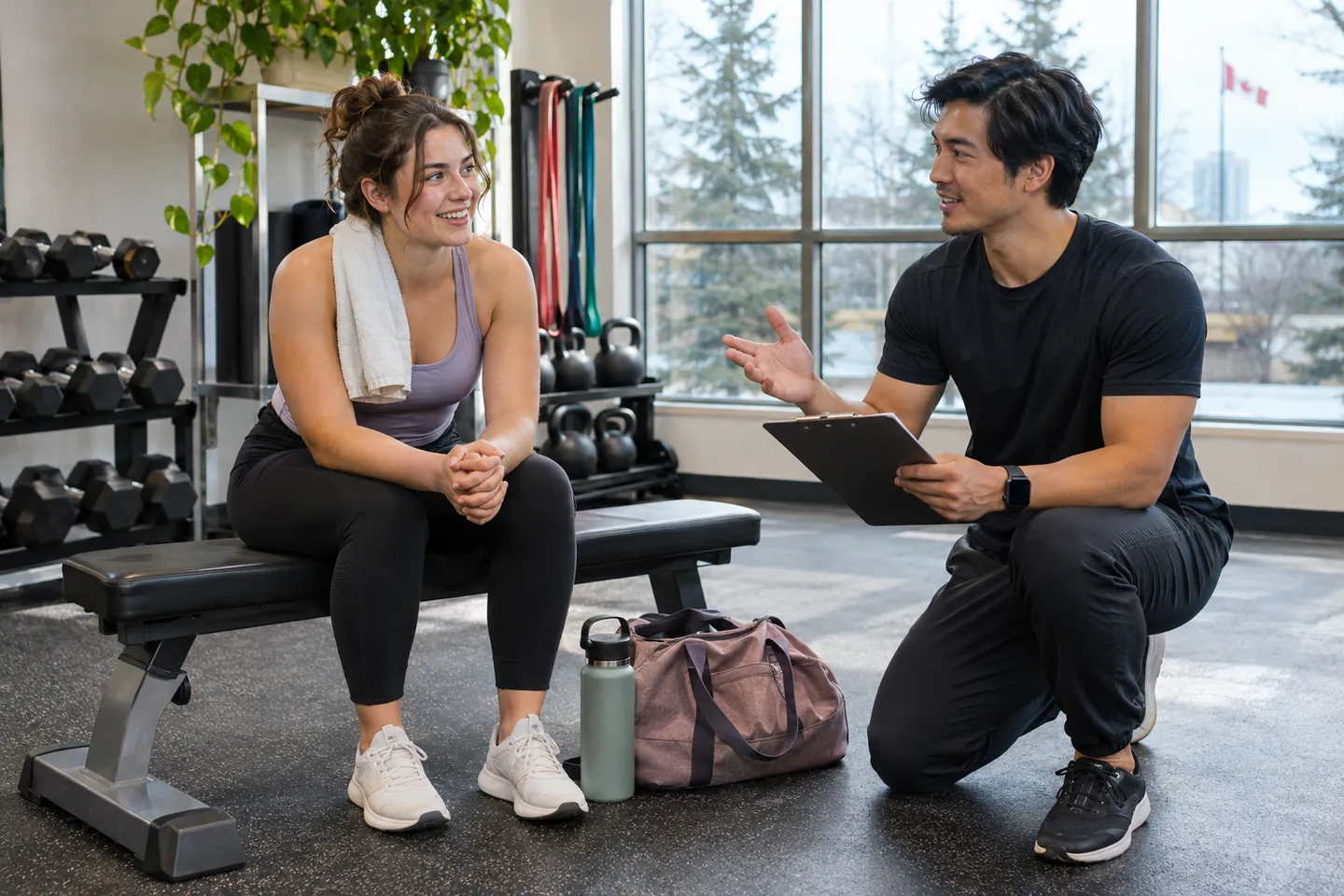
Prepare for your first personal training session in Mississauga with useful questions, a simple packing plan, and a clear approach to learning exercises.
Your first personal training session in Mississauga does not require you to arrive already knowing how to train. The appointment exists partly to establish that starting point. You may be learning the layout of a gym, discovering how a coach explains movements, and working out which questions you have never had a chance to ask. Preparation can make that experience more comfortable without turning it into an examination.
The most useful preparation is practical. Know where you are going, understand what the appointment is intended to cover, and bring an honest account of your experience. A first session can include conversation, demonstrations, and opportunities for the coach to observe how you move. The exact format varies, so confirm it with the facility instead of assuming every introduction follows the same checklist.
Confirm the details that affect your arrival
Before the appointment, check the date, time, address, and instructions for finding the entrance. Ask whether you should arrive earlier for any forms or orientation. If there are questions about changing facilities, footwear, or what to bring, ask them now. Resolving small uncertainties in advance frees you to pay attention once you arrive.
Consider your route at the relevant time of day. Travelling across Mississauga after work can involve different timing from making the same journey on a quiet weekend. Build your plan around the day you actually booked. Include the time needed to park or walk from transit and find the reception area.
If something changes and you expect to be late, contact the gym using its stated process. Avoid assuming that an appointment can simply be shifted forward by the amount of the delay. Clear communication makes it easier for the staff to explain what is possible and for you to understand how the session will proceed.
Bring a short account of your experience
You do not need a detailed athletic history. A few accurate notes are more useful than trying to sound experienced. Mention activities you currently do, exercises you have tried before, and what has made previous routines easy or difficult to maintain. Include long breaks from training if they are relevant.
Try to distinguish familiarity from confidence. You may recognize the name of an exercise but have never set it up yourself. You may have completed a workout video many times without knowing whether the pace suited you. Saying this helps the coach choose an appropriate explanation rather than guessing from the vocabulary you use.
Share relevant limitations and any guidance you have already received from a qualified professional. A trainer needs accurate information to understand the boundaries of the appointment. You do not need to diagnose yourself or offer a theory about every sensation. Describe what you know and allow questions to clarify the rest.
Choose clothing for the actual activities
Wear clothing that lets you move comfortably and does not require constant adjustment. A first visit is not a reason to buy an entirely new wardrobe. Familiar items can make it easier to notice the exercise itself instead of worrying about a waistband, a loose sleeve, or a shoe you have never worn.
Follow the facility’s footwear instructions. If indoor shoes are requested, pack them separately so that wet or dirty outdoor footwear does not become an arrival problem. During colder months, think about where your coat and other outer layers will go, and allow enough time to change without rushing.
Keep accessories simple. Bring the essentials the facility recommends, such as a water bottle and towel where appropriate, and leave unnecessary valuables at home if you can. A small, organized bag is usually easier to manage than a collection of items packed because you are uncertain what a gym visit might involve.
Give your goal a plain-language version
A goal does not need to sound technical to be useful. “I want to understand strength training” tells the coach something important. So does “I want a routine that fits around two late shifts” or “I would like to feel less lost in a gym.” These statements create a practical starting point.
If you have a larger outcome in mind, explain why it matters to you. The meaning behind the goal can help shape the first steps. Wanting to feel more capable during a recreational activity may lead to a different discussion from wanting structure after years of inconsistent exercise.
It is acceptable to have several interests without knowing their order. Ask the coach to help you identify what can be addressed first. Trying to pursue every possible improvement immediately can make the first session feel scattered. A narrower starting focus gives both of you something clear to discuss afterward.
Treat demonstrations as an invitation to ask questions
Watching an exercise once may not be enough to understand it. Ask to see it again if needed, or request that the coach describe the setup before the movement. You can also ask which part deserves your attention on the first attempt. One useful cue may be easier to apply than a list of details.
When you try the movement, describe what feels confusing. There is a difference between not understanding where your feet go and not understanding how quickly to move. Specific feedback gives the coach a better chance to make the next explanation helpful.
Avoid comparing your first attempts with another person’s practiced repetitions nearby. You cannot see their learning history from across the room. Your task is to establish a version of the exercise that you understand and can discuss with your coach, not to look as though you have been attending for years.
Say what the effort feels like to you
The coach can observe your movement, but you still need to communicate your experience. Describe whether the task feels manageable, confusing, or more demanding than you expected. If something feels wrong or painful, stop and say so rather than treating silence as proof of determination.
You might not yet have precise words for effort. That is fine. Ordinary descriptions such as “I could do a few more like that” or “I was losing track of the instructions near the end” provide information. Ask how your trainer prefers you to report difficulty so you can use a shared language over time.
Do not assume that a first session must leave you exhausted to count. Learning the equipment, practising a movement, and identifying a realistic starting level are meaningful work. A dramatic finish can be memorable, but it is not the only possible measure of a useful introduction.
Understand the purpose of notes and observations
A trainer may record what you tried, how the setup was adjusted, or which instructions helped. Ask what is being noted and how those details will inform future appointments. Understanding the purpose of the record can make the session feel more collaborative and less mysterious.
You can keep your own brief notes too. Record an exercise name, a cue that made sense, or a question you want to revisit. Do not try to write a complete transcript while the coach is teaching. A few lines immediately after the appointment are often enough to preserve useful information.
If you receive a program, check that you understand it before leaving. Exercise names, repetition ranges, and equipment labels may be unfamiliar at first. Ask the coach to clarify anything you would otherwise have to guess when training independently. Guesswork is not a useful substitute for a short explanation.
Leave with a clear next step
Toward the end of the session, ask what the coach considers the main takeaway. It might be a movement to practise under supervision, a scheduling decision, or a simple plan for the next appointment. A clear next step turns a collection of new experiences into an understandable process.
If independent activity is discussed, make sure you know exactly what is expected. Ask which parts you can complete on your own and which should wait for further coaching. You should not feel obligated to reconstruct an entire session from memory simply because you are enthusiastic about starting.
Confirm any practical arrangements before you go. That may include the next booking, how to ask a follow-up question, and where to find the information you were given. The fewer loose ends you leave, the easier it becomes to follow through without needing another round of administrative decisions.
Review the experience without grading yourself
Later that day, consider three questions: what did you understand better, what remains unclear, and what would make the next visit easier? These questions focus on learning. They are more useful than deciding whether you were impressive enough or whether someone else would have found the session easy.
You may discover that the exercise itself was manageable but the arrival felt rushed. You may have liked the coach’s explanations yet forgotten the name of a movement. These are ordinary observations that can improve the next visit. Bring them back into the conversation rather than treating them as personal shortcomings.
Give yourself room to become familiar with the process. New environments involve many small decisions, from where to put your bag to when to ask for another demonstration. As those decisions become familiar, you can devote more attention to the training itself.
Konga’s personal training information can help you understand the service before booking. For current appointment details and preparation instructions, contact the team. Arriving with practical questions and an honest description of your starting point is already good preparation. The rest of the first session is something you and your coach can work through together.
Filed under
Keep exploring
More training insights await.